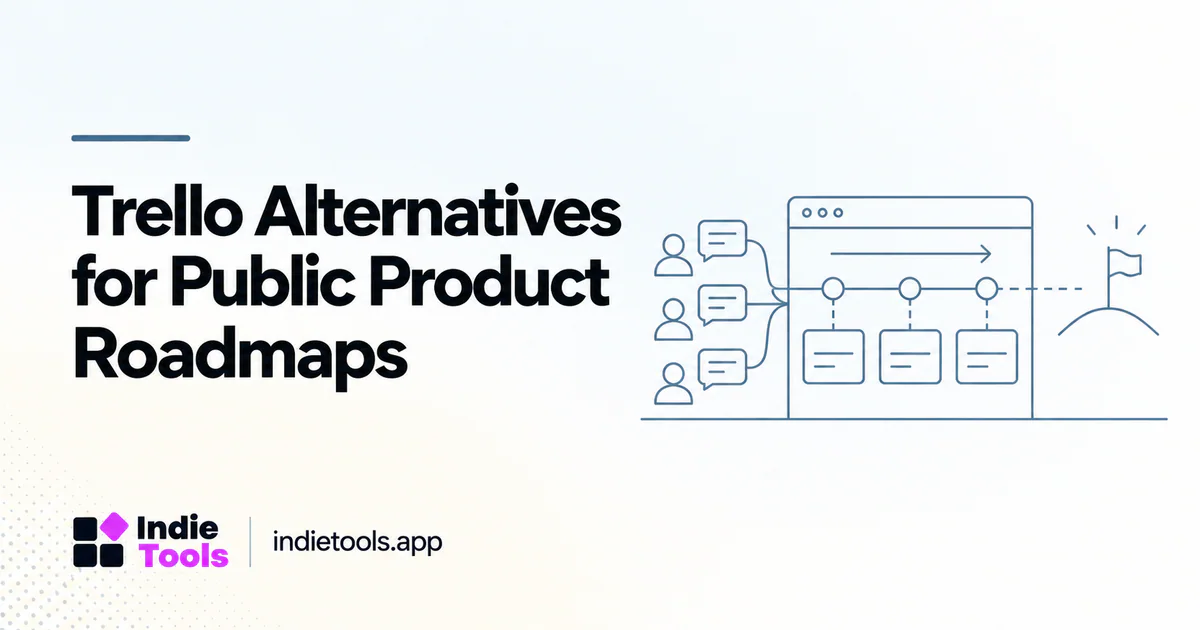
A public product roadmap needs to communicate direction without exposing internal work or promising more certainty than the team has. Choose a Trello alternative when a dedicated feedback and roadmap workflow solves a real problem—not simply because another product offers a more attractive board.
The key distinction is between an internal execution system and an external communication surface. They may share information, but customers and engineers do not necessarily need the same fields, statuses or level of detail.
Decide what the roadmap is for
A public roadmap can explain priorities, collect interest or show progress on commonly requested improvements. These purposes require different interactions. A read-only direction page may be enough for one team, while another needs customer submissions and a review process.
Write the promise of each status. “Exploring” should not imply a committed delivery date. “In progress” should explain the level of certainty your team intends to communicate. Clear definitions prevent the visual board from becoming an accidental contract with every reader.
Compare dedicated feedback workflows
Fider presents a place for customers to submit feature requests and vote on product direction. [1] FeedbackCat's IndieTools listing describes a workflow spanning feedback, roadmap and changelog functions. [2] These are relevant examples to investigate, not a tested ranking of roadmap products.
For each candidate, verify whether the public surface is separated from internal notes and whether moderators can merge related requests. Do not assume that voting, status updates and release announcements are connected simply because all three appear in the marketing copy.
Test the life of one request
Use a fictional request with enough ambiguity to require clarification. Add a related request from another customer, merge or connect them and record the decision. Then move the idea through the intended public statuses.
Inspect what subscribers see at each step. They should understand what changed and what remains uncertain. A notification that simply announces a status label may create confusion when the label has no published meaning.
Protect internal and customer information
A request can contain an account problem, private workflow or identifying screenshot. Establish a review process before publishing submissions. A public roadmap should not automatically expose everything a customer sends through a feedback form.
Keep implementation tasks and internal discussions separate when necessary. An engineering ticket may include security details, customer data or speculative designs that are not appropriate for a public audience. The roadmap should communicate the outcome relevant to users, not mirror the entire internal system.
Treat votes as one signal
Votes can indicate visible interest, but they do not represent every customer or the effort required to deliver a feature. A low-vote issue may still block an important workflow, while a popular idea may conflict with the product's intended scope.
Document how votes influence decisions alongside support evidence, strategic fit and maintenance cost. This makes it easier to explain why a request is deferred without implying that customers were ignored or that the board's arithmetic makes the decision automatically.
Plan the migration and archives
Before moving from an existing board, export the records and identify which information should remain public. Preserve useful links where possible and give readers a clear route to the new location. Do not publish internal attachments accidentally during a bulk import.
Decide how completed and declined requests will be presented. An archive can preserve context without crowding the active roadmap. A declined idea should have a concise explanation when that explanation helps users understand the product's direction.
Questions before choosing a roadmap tool
Does a public roadmap need dates? Only when the team is prepared to communicate and maintain that commitment. A date-free direction page can be more honest for uncertain work.
Should the highest-voted feature always be next? No. Explain the other criteria rather than pretending the vote count is the whole prioritization process.
What is the best alternative? The one that can complete your request-to-decision workflow while keeping public expectations and private work appropriately separated. Use IndieTools to discover candidates, then test that boundary.
Explore related IndieTools resources: founder updates and releases.
Continue your research
- Customer Feedback Tools: Requests to Releases
- Turn Release Notes into Useful Directory Updates
- Productivity Tools for Asynchronous Founder Teams
Sources and verification
Sources consulted for this article on October 1, 2026. Product capabilities are documented claims unless an actual test is explicitly described.