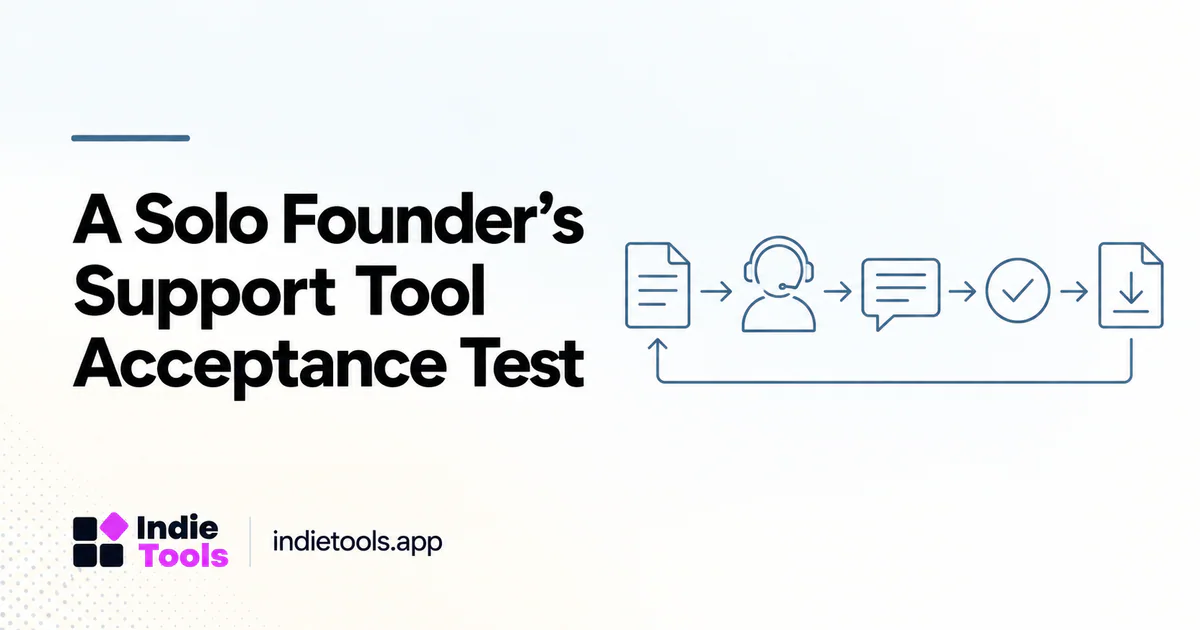
Evaluate a support tool by running one clearly fictional customer case from intake to reopening and export. This acceptance test helps a solo founder check privacy, escalation and record portability before moving real customer conversations.
Use the customer support tools comparison to build a vendor shortlist. This guide has a different job: define the evidence to collect while testing one candidate. It does not report hands-on results or certify any vendor.
A solo founder needs a support system that makes the next customer action clear without adding a second job administering the helpdesk. Start with the channels customers actually use, the information needed to answer them and a reliable way to avoid losing a conversation.
A lightweight setup is not necessarily the product with the fewest features. It is the smallest workflow that can handle your real support obligations, including handoffs when a contractor or future teammate joins.
Identify the support bottleneck
Review recent conversations. Are requests being missed, repeated or answered without context? Are customers contacting several addresses about the same issue? Does a founder forget to follow up after an engineering fix?
Each problem suggests different requirements. A shared inbox can help organize conversations. A knowledge base can reduce repeated explanations. A chatbot might assist with known questions but will not automatically fix a missing escalation process. Choose the bottleneck before choosing the product category.
Shortlist by conversation workflow
Chatwoot describes a shared inbox with assignments, private notes and conversation context. [1] Those capabilities are relevant when several people may work on the same request, even if the team begins with one founder.
Other candidates may focus on email-first support or an embedded chat experience. Discover options through IndieTools, then verify the exact channels and edition required. [2] This guide does not claim that a specific product was hands-on tested or that a broad “omnichannel” label proves support for your preferred channel.
Test a realistic support case
Use sample data only: a fictional customer cannot find an invoice, a test agent needs clarification, and the founder becomes unavailable before the issue is resolved. Run both an agent view and a customer view so internal visibility is checked from each side. Adapt the issue to your own product without adding real customer information.
Create a fictional customer request that needs clarification, an internal note and a later follow-up. Check whether the customer can see the correct reply without seeing the private discussion. Then reopen the case and inspect whether the history is still understandable.
Include an attachment and a change of assignee when those are part of your workflow. The test should reveal how the system handles ordinary complexity, not only how quickly it can send the first greeting.
Record the evidence at each handoff
This is an acceptance-test worksheet, not a completed product evaluation. For each stage, save the observation you actually obtain and note any limitation. Define acceptable response behavior for your own support model before running the case.
| Stage | Observation to collect | If the check fails |
|---|---|---|
| Intake | The test request appears once, with the correct customer and channel. | Resolve identity or duplication problems before importing conversations. |
| Private note | The agent can see an internal note and sample attachment; the customer view cannot. | Stop real-data use until the visibility boundary is verified. |
| Handoff | A second test agent can find the history, current owner and outstanding action. | Clarify assignment and follow-up responsibility before rollout. |
| Public reply | The customer receives only the intended reply through the chosen channel. | Correct recipient, channel or disclosure problems before use. |
| Resolution and reopening | Reopening retains the prior messages and shows the current status clearly. | Document missing history or ambiguous status and retest. |
| Human escalation | An unsupported automated question reaches a person without an invented account action or promise. | Disable the unsafe automated path until escalation works. |
| Export | The exported sample preserves the conversation, identities, timestamps and attachment references you need. | Identify what is missing and verify a workable exit path before committing. |
A quick first reply cannot compensate for a failed privacy or ownership check. Re-run the affected stage after changing configuration, and keep the evidence with the candidate's edition and settings. Do not mark a behavior as verified because a marketing page lists a related feature.
Keep automation narrow at first
Automate routing, acknowledgments or suggested replies only when the behavior is predictable and reviewable. Do not let an automated answer invent account-specific explanations or promise a refund, deadline or feature without an authorized basis.
Give customers a clear route to a person when the automated path does not help. A fast but irrelevant response can increase frustration while making the dashboard's response-time metric look better. Measure whether the problem is resolved, not just whether a message was sent.
Build a small reusable knowledge base
Start with the questions that recur and can be answered accurately without private account details. Link the article to the relevant part of the product and give it an owner. When behavior changes, update the answer rather than allowing support agents to work around stale documentation indefinitely.
A good article can also help a new teammate understand the product. Keep internal procedures separate from customer-facing instructions so a useful knowledge base does not accidentally become a repository of sensitive operational information.
Review cost and portability
Check what happens when a second person needs access or the conversation volume grows. Include email, messaging and AI-related dependencies where relevant. A simple headline price may not describe the configuration you intend to use.
Export a sample conversation with its timestamps, attachments and status. Confirm that you can preserve important customer history before committing the whole support operation. Also test backup and recovery responsibilities when evaluating a self-hosted deployment.
Questions for a solo founder
Is a shared mailbox enough? It can be, when volume is low and follow-up is reliable. Move to a helpdesk when the workflow problem is clear.
Should live chat be enabled immediately? Only when the response expectations and staffing model are manageable. A channel that appears immediate can create expectations your team did not intend.
What should decide the first purchase? A realistic support case becomes easier to resolve and harder to lose, without requiring more administration than the founder can sustain.
Explore related IndieTools resources: reported technology collections.
Continue your research
- Customer Feedback Tools: Requests to Releases
- International SaaS Support: Coverage and Handoffs
- Find Software Alternatives by Workflow
Sources and verification
Sources consulted for this article on October 1, 2026. Product capabilities are documented claims unless an actual test is explicitly described.