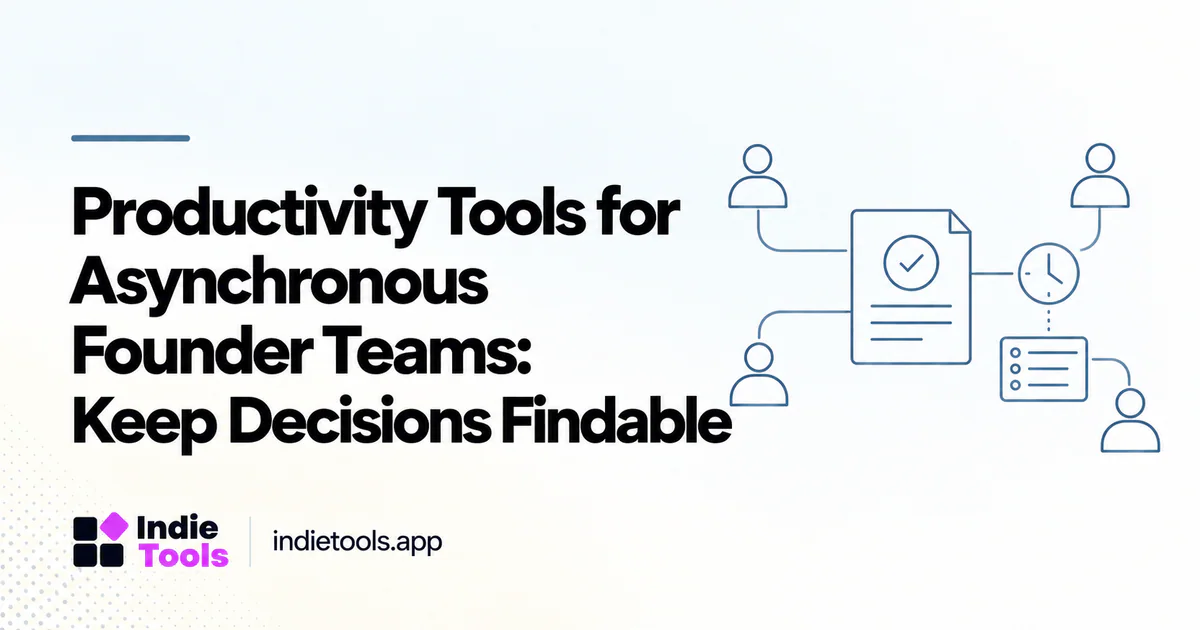
For an asynchronous founder team, the most useful productivity tool is the one that preserves a decision with its context, owner and next action. A large collection of chat, task and document apps can still leave the team asking the same questions every morning.
Start with the work that crosses time zones or working hours. A tool should reduce the need for someone to be present at exactly the right moment, while making it clear when a problem genuinely requires a live conversation.
Map the information that gets lost
Identify three recent situations where someone had to ask for an update. Was the decision buried in chat? Was a task marked complete without a release note? Did a document describe an idea that had already been rejected?
These examples define your requirements better than a generic search for the “best productivity stack.” A two-person SaaS team may need a decision log and a shared work queue, while a larger distributed team may also need approval history and separate customer workspaces.
Assign each type of information a home
Use a durable location for decisions, a task system for work in progress and a conversation channel for discussion. The same product may handle several roles, but the boundaries should remain clear.
A decision record can be short: question, options considered, chosen direction, owner and conditions that would cause a review. Link the associated task instead of copying its changing status into multiple documents. This makes the record useful after the original discussion has scrolled out of view.
Compare collaboration permissions explicitly
Notion's documentation distinguishes sharing and permission controls for collaboration. [1] Similar words in another product do not guarantee the same boundary. Test what a guest, teammate and workspace administrator can actually see and change.
For a team that collaborates with contractors, create a sample project containing both internal notes and a client-safe brief. Verify the intended separation before moving real information. A convenient share button is not evidence that the default access model fits your work.
Trial one complete handoff
Choose a routine task that passes between two people. For example, a founder records a proposed pricing-page change, a designer prepares an alternative and an engineer implements the approved version. Complete the handoff without relying on an unrecorded call.
The trial should reveal who makes the decision, where feedback belongs and what counts as complete. Record every point where someone has to ask which document is current. Those are workflow defects to fix before adding more automation.
Make notifications selective
Not every update needs to interrupt everyone. Distinguish requests for a decision from information that can be read later. Give urgent operational incidents a clear channel separate from ordinary project updates.
Avoid using unread notification counts as a productivity metric. A healthier test is whether the responsible person can identify the next action without searching across several tools. Configure subscriptions around ownership and relevance rather than broadcasting every edit to the whole team.
Protect the exit path
Export a completed project, its decisions and its attached files. Check whether the relationships survive well enough for another person to understand the history. A flat collection of text files may be acceptable for a small project, but only when the team knows what context will be lost.
An illustrative monthly review can ask which tools created duplicate work and which prevented repeated questions. Remove a tool when it no longer has a distinct role. The objective is not a fashionable stack; it is a reliable operating system for the team's actual work.
Questions when building an async stack
Does asynchronous work mean avoiding meetings? No. Use a live discussion when ambiguity or urgency warrants it, then preserve the outcome in the durable record.
Should every decision have a long document? No. The record should be proportional to the decision and its likely consequences.
Where should a founder discover alternatives? IndieTools' productivity category is a starting point for finding different approaches. Evaluate candidates with your own handoff test rather than choosing by category popularity alone. [2]
Explore related IndieTools resources: reported technology collections.
Continue your research
- Notion Alternatives for Client Portals
- Customer Feedback Tools: Requests to Releases
- Turn Release Notes into Useful Directory Updates
Sources and verification
Sources consulted for this article on October 1, 2026. Product capabilities are documented claims unless an actual test is explicitly described.

 Pushable AI
 99helpers