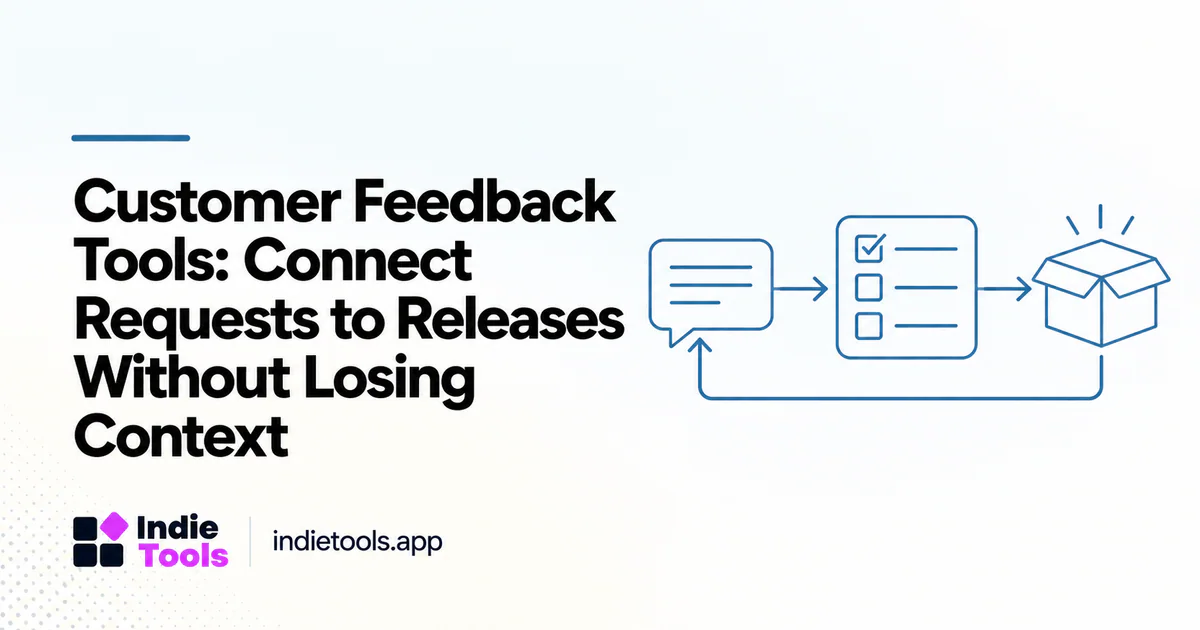
A useful customer feedback system connects a request to the underlying problem, the product decision and the eventual release. Collecting votes is only one step. The workflow should help a small SaaS team understand what people need and communicate what actually changed.
Choose tools by testing that complete loop. A public board may look active while the team still copies requests into private notes and forgets to follow up with the people who raised them.
Capture the problem before the proposed feature
A customer asking for a button is often describing a workflow problem in the language of a solution. Preserve the original request, but add context: what they were trying to accomplish, where they got blocked and how they work around it today.
Do not force the customer to write a perfect product brief. The tool should allow your team to enrich the record after a conversation while keeping the original evidence visible. This makes it easier to recognize when several differently worded requests describe the same need.
Evaluate intake and triage separately
FeedbackCat's IndieTools listing describes feedback collection alongside triage, roadmap and changelog workflows. [1] That is a relevant candidate for investigating an end-to-end approach, not proof of the quality of every feature or an independent test of the product.
For any candidate, submit a few controlled examples through each intended channel. Check whether the team can identify the customer, protect private information and merge related requests without losing their original context. A frictionless public form is not enough if the triage view becomes unmanageable.
Define statuses that do not overpromise
Use status labels with clear meanings. “Under review” should not mean committed. “Planned” should explain the degree of certainty your team intends to communicate. Avoid presenting a speculative idea as a dated promise simply because the board template provides a timeline field.
Publish a short explanation of how decisions are made. Votes can inform prioritization, but the team may also consider severity, customer fit, maintenance cost and the broader product direction. A transparent process is more useful than pretending the highest vote count automatically determines the roadmap.
Link the decision to implementation
When a request becomes work, connect the feedback record to the engineering task or release record. Keep customer-facing explanations separate from internal implementation details that are not appropriate to publish.
An illustrative workflow might begin with three requests about confusing imports. The team identifies a shared validation problem, implements a preview screen and links the release back to the original requests. The explanation should describe the problem solved, not claim that every requested variation was delivered.
Test customer follow-up
Complete a test release and inspect the notification path. Does the right person receive a useful explanation? Does the message link to a page they can access? Can they control future notifications? Verify these behaviors rather than assuming “close the loop” means the same thing in every product.
A follow-up should make it easy to try the improvement and report remaining problems. Avoid a generic “shipped” notification that provides no context. The customer may have forgotten the original request or may need to know whether the change applies to their plan.
Measure the process rather than board activity
Review how long requests remain untriaged, how often duplicate problems are recognized and whether released improvements reach the affected users. These process measures are more actionable than the total number of votes collected.
Also inspect what the system excludes. Some customers do not use public boards, and urgent support problems may arrive through different channels. Do not treat the visible board as a representative survey of the entire customer base. It is one source of evidence among several.
Questions before selecting a feedback tool
Should every request appear on a public roadmap? No. Some contain private details, duplicate existing work or need clarification before public discussion.
Does a changelog complete the feedback loop? Only when the people affected can understand and discover the relevant change. Publishing a release note alone does not guarantee that connection.
How should a founder compare tools? Use a realistic request from intake through triage, decision, release and follow-up. IndieTools' product categories can help you find candidates, but the complete workflow should determine fit. [2]
Continue your research
- AI Tools for Customer Interview Synthesis
- Trello Alternatives for Public Product Roadmaps
- Turn Release Notes into Useful Directory Updates
Sources and verification
Sources consulted for this article on October 1, 2026. Product capabilities are documented claims unless an actual test is explicitly described.

 Pushable AI
 99helpers