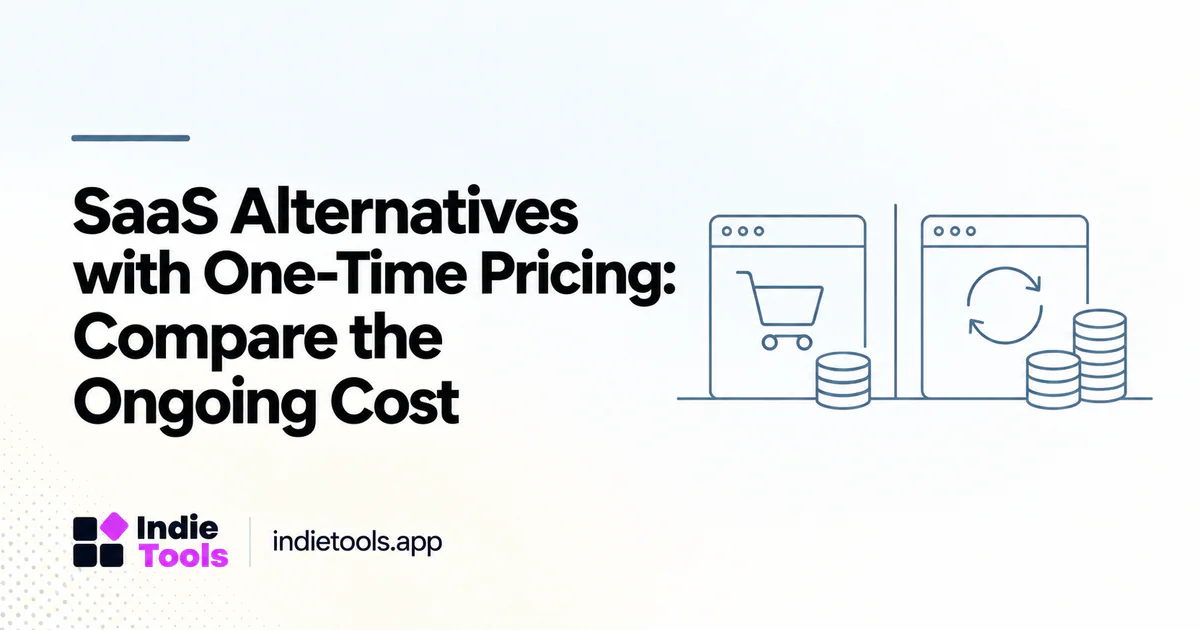
A one-time software price is attractive when the included service matches a durable need. It is not proof that the product will have no future costs. Evaluate the purchased entitlement, ongoing dependencies and exit path before comparing it with a subscription.
This is a product evaluation framework, not financial advice or a prediction about any vendor's survival. The aim is to make the tradeoffs visible so a founder does not mistake an appealing checkout price for a complete operating budget.
Define what the payment actually buys
Read the current offer and distinguish a perpetual software license from hosted service access, credits or a time-limited promotion. “Lifetime” needs a defined scope: the product, account, plan or another condition specified by the seller.
Record included users, projects, storage, support and updates. A tool may be suitable even with limits, but the comparison should show them. Do not describe a product as unlimited when the offer contains fair-use conditions or resource caps relevant to your workload.
Include variable dependencies
AI processing, email delivery, storage and payment transactions may create separate costs. A product that lets you bring your own API key can still be a good fit, but usage of that external service is not covered merely because the application was purchased once.
For a hosted tool, ask what happens when usage grows. Are additional credits available? Does the account move to another plan? Is the workflow paused? The answer matters more than a theoretical savings calculation based on today's smallest usage level.
Use an explicit illustrative comparison
Suppose a fictional tool costs $120 once and requires an external service costing $8 per month at the expected workload. Its first-year cash cost would be $216 before tax or other expenses. A fictional $15 monthly alternative would cost $180 over the same period.
These figures are examples, not current vendor prices or a recommendation. They show why the one-time payment alone is not the total. Repeat the calculation using the actual offers, realistic usage and a review date before making a purchasing decision.
Test the feature boundary
Use the exact plan being sold, not a demonstration of a higher tier. Complete the core workflow and inspect exports, integrations and collaboration limits. A discounted plan can be perfectly adequate, but only when its capabilities match the use case.
Check what future updates mean in the offer. Do not assume that every newly introduced feature will belong to the original entitlement. Keep a copy of the purchased terms and the provider's description so your team has an accurate record of the decision.
Evaluate continuity without speculation
Review public documentation, release activity, support routes and the ability to export data. These observations can inform operational planning, but they do not justify a confident prediction that a vendor will succeed or fail.
Build an exit path proportional to the tool's importance. A disposable image utility creates a different dependency from the system holding customer support history. Test whether critical records can be retrieved in a usable form before the application becomes difficult to replace.
Avoid buying overlapping tools
A discounted alternative can create more work when it duplicates an existing system. Include migration, training and the effort of maintaining two sources of truth. The lowest purchase price does not help when the team must reconcile the same information every week.
IndieTools can support discovery, but pricing should be checked at the provider immediately before purchase. [1] Directory labels are a starting point and should not be treated as a contractual record of a changing offer.
Questions about one-time pricing
Is a one-time deal always cheaper? No. The answer depends on included usage, external costs and the period being compared.
Does “lifetime” guarantee permanent service availability? Do not assume that. Read the defined entitlement and plan for continuity independently.
When is the model a good fit? When the current capability solves a clear need, the terms are understandable and the ongoing dependency is acceptable even without optimistic assumptions about future features.
Explore related IndieTools resources: reported technology collections.
Continue your research
- Payment Provider Stacks: What Founders Disclose
- Pricing Currencies in SaaS Comparisons
- Open-Source vs Free SaaS Alternatives
Sources and verification
Sources consulted for this article on October 1, 2026. Product capabilities are documented claims unless an actual test is explicitly described.