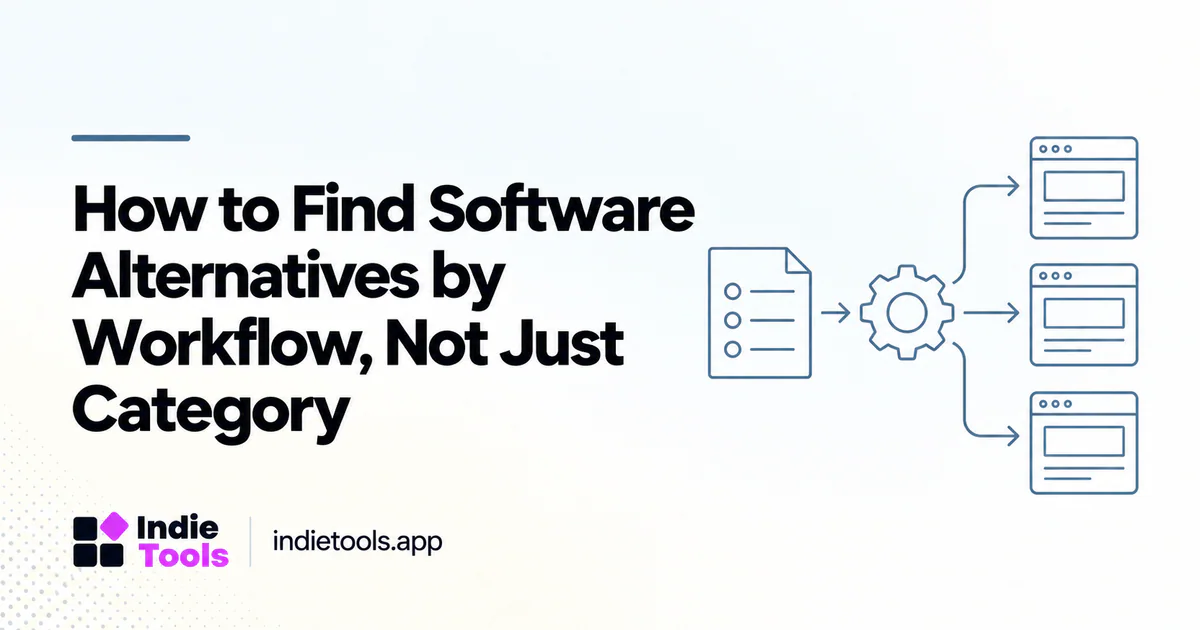
Find a useful software alternative by describing the work that must continue after the switch. A shared category is only a discovery aid. Two products can both be labeled “project management” while solving different problems for different users.
For a founder, the goal is not to assemble the longest comparison table. It is to identify the smallest set of candidates that can perform the essential workflow, accept the data you need to move and remain manageable after the trial ends.
Write the reason for switching
Be specific about the current problem. “Too expensive” might mean a seat model that penalizes occasional collaborators. “Too complicated” might mean that customers cannot find a shared file. “Missing automation” might mean one repetitive handoff rather than a need for an entirely new platform.
Keep this reason visible throughout the evaluation. Otherwise, an impressive demo can replace the original problem with a list of features nobody asked for. A candidate should solve the reason for switching without creating a more serious operational gap.
Separate requirements from preferences
Define a few non-negotiable tasks and the evidence needed to confirm them. For a client portal, that could include inviting a client, restricting access to their own project and exporting the final deliverables. A preferred interface theme belongs in a different column.
Use three states: verified, not supported and not yet verified. Do not convert silence in a product listing into a definitive “no.” Equally, do not assume a broad phrase such as “team collaboration” proves that a specific permission boundary exists.
Discover candidates across adjacent categories
IndieTools organizes products into categories that can help you find options beyond familiar brands. [1] Start with the primary job, then inspect an adjacent category when the workflow crosses boundaries. A customer feedback problem might involve support, product management and communication tools.
Keep the shortlist small enough to test properly. Record the official URL and the reason each candidate is relevant. The purpose of discovery is to produce a defensible trial set, not to manufacture a ranking from incomplete directory fields.
Run the same scenario in every product
Prepare sample data and a repeatable task. For an onboarding tool, import a few fictional users, configure one journey and inspect the failure path. For an analytics tool, create a controlled event and verify where it appears.
Use the same acceptance criteria for the current product and the alternatives. This exposes whether the replacement truly improves the workflow or merely feels unfamiliar in an appealing way. Record setup effort and workarounds, not only the final screenshot.
Test migration before negotiating the full rollout
Export a representative subset from the current system and import it into the candidate. Check relationships, timestamps, attachments and permissions. A successful import count can hide important losses, such as comments detached from the record they explain.
Create a rollback plan before moving live work. Identify which changes can safely run in parallel and which would create conflicting records. A replacement decision is incomplete until the team understands how to leave both the old and new system without losing critical context.
Compare the operating model
Review who will administer the tool, what support is available and how the cost changes with realistic usage. Include integrations, external services and staff time. A lower subscription can be outweighed by a recurring manual task that the current product already handles.
An illustrative decision note might conclude that a candidate fits a small internal team but not a client-facing workflow because a required access boundary remains unverified. That is a useful result. Not every evaluation needs to end with a purchase.
Questions about alternative searches
Should the first result be the first trial? Search visibility does not establish workflow fit. Use the same requirements for every candidate.
Is a feature-by-feature comparison enough? Only when the features map to the work you need to perform and their behavior has been verified.
When should the team stop looking? When one candidate meets the essential requirements with an acceptable migration and operating cost, or when the evidence shows that keeping the current product is the better practical choice for now.
Explore related IndieTools resources: reported technology collections.
Continue your research
- Open-Source vs Free SaaS Alternatives
- Answer-First Software Comparisons with Evidence
- Local SaaS Alternatives vs Global Platforms
Sources and verification
Sources consulted for this article on October 1, 2026. Product capabilities are documented claims unless an actual test is explicitly described.