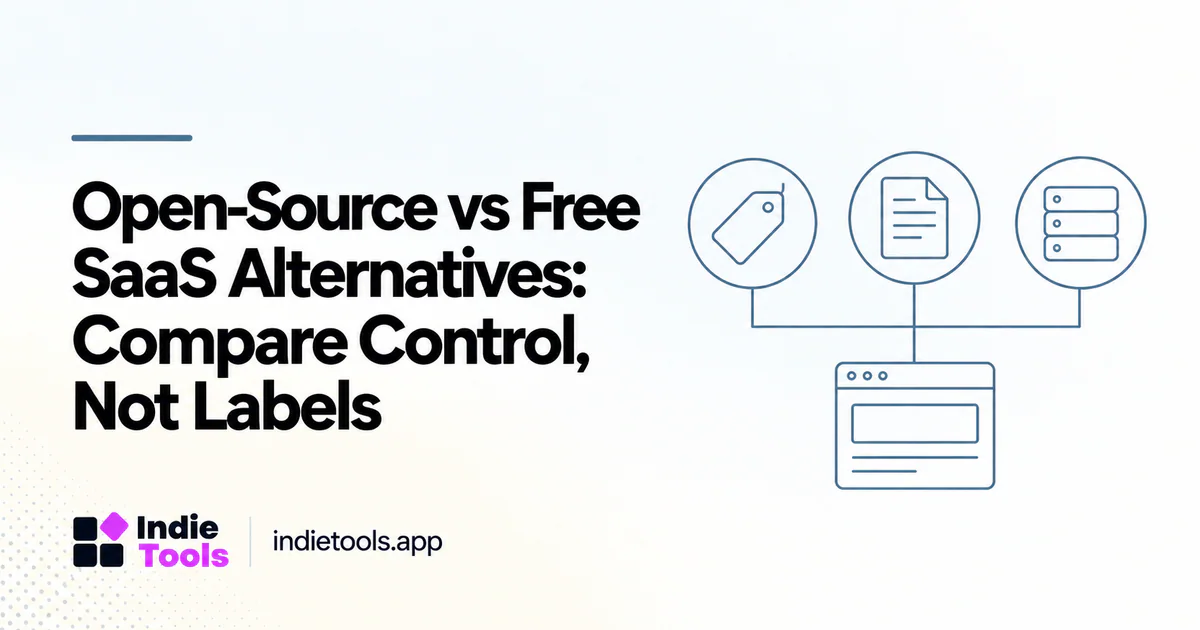
“Free,” “open source” and “self-hosted” describe different things. A free plan concerns price and limits. Open source concerns the software's licensing terms. Self-hosting concerns where and by whom the application is operated. Evaluate those dimensions separately before choosing an alternative.
The Open Source Initiative explains that access to source code alone does not make a license open source. [1] A public repository is therefore a starting point for verification, not a complete answer about your rights or operating responsibilities.
Ask what control you actually need
A founder may want predictable costs, an export path, the ability to modify the software or control over infrastructure. These are related but not interchangeable goals. A hosted service can offer useful exports, while a self-hosted application can still be difficult to migrate away from.
Write the desired outcome in practical terms. “We need to export customer records and attachments in a usable format” is testable. “We want ownership” is too broad unless the team explains which decisions and data it needs to control.
Separate editions and deployment modes
Plausible distinguishes its managed service from its self-hosted Community Edition, including differences in features and operational responsibility. [2] Do not assume a product's hosted and community editions are identical simply because they share a name or codebase.
For every candidate, record the exact edition, version and deployment model being evaluated. Check the current license and the features required by your workflow. Licensing questions that materially affect a commercial deployment deserve qualified review rather than a conclusion based on a directory badge.
Calculate the work behind self-hosting
Someone must maintain updates, backups, monitoring and recovery procedures. Include these tasks in the comparison even when the server already exists. Spare infrastructure capacity does not mean administration time is free.
Run a small operational trial. Install the product in an isolated environment, create a backup and restore it somewhere else. Then review an upgrade procedure. A successful first installation proves much less than a working recovery process when the application becomes important to the business.
Inspect the limits of the free plan
For a hosted free tier, look beyond the headline price. Check usage limits, retention, collaboration, exports and what happens when the limit is reached. Avoid building a production workflow around an assumption that a promotional allowance will remain unchanged.
Use your expected workload rather than the smallest possible example. A tool that is free for one administrator may have a different cost when contractors, customers or several brands need access. Record the conditions instead of labeling the entire product simply “free.”
Test portability in both directions
Export a realistic record with its attachments, comments and relationships. Open it outside the application. Then consider whether the same information could be imported into another system without an expensive manual reconstruction.
Source availability does not automatically solve this problem. You may still need engineering time to understand the data model and write a migration. Conversely, a hosted product with a documented export can be practical when your team does not need to modify the application itself.
Choose the model the team can sustain
An illustrative comparison might favor a managed service for a two-person team that needs dependable support and has no capacity for infrastructure maintenance. Another team with an established operations function may value a self-hosted edition more highly. Neither conclusion follows from the label alone.
Use IndieTools to discover products, then confirm licensing and deployment details at the provider's current source. [3] Keep the decision record explicit about what was verified and what remains an assumption.
Common questions
Does open source mean zero total cost? No. Hosting, maintenance, support and migration can still require money or staff time.
Does self-hosting automatically make a deployment secure? No. The deployment needs its own configuration, maintenance and review.
What should decide between the options? The control you need, the edition's actual capabilities and the operating work your team can reliably perform—not the appeal of a label on a comparison page.
Explore related IndieTools resources: reported technology collections.
Continue your research
- Privacy-First Analytics Alternatives: Migration
- WordPress Alternatives for Product Directories
- One-Time Pricing SaaS Alternatives: Total Cost
Sources and verification
Sources consulted for this article on October 1, 2026. Product capabilities are documented claims unless an actual test is explicitly described.