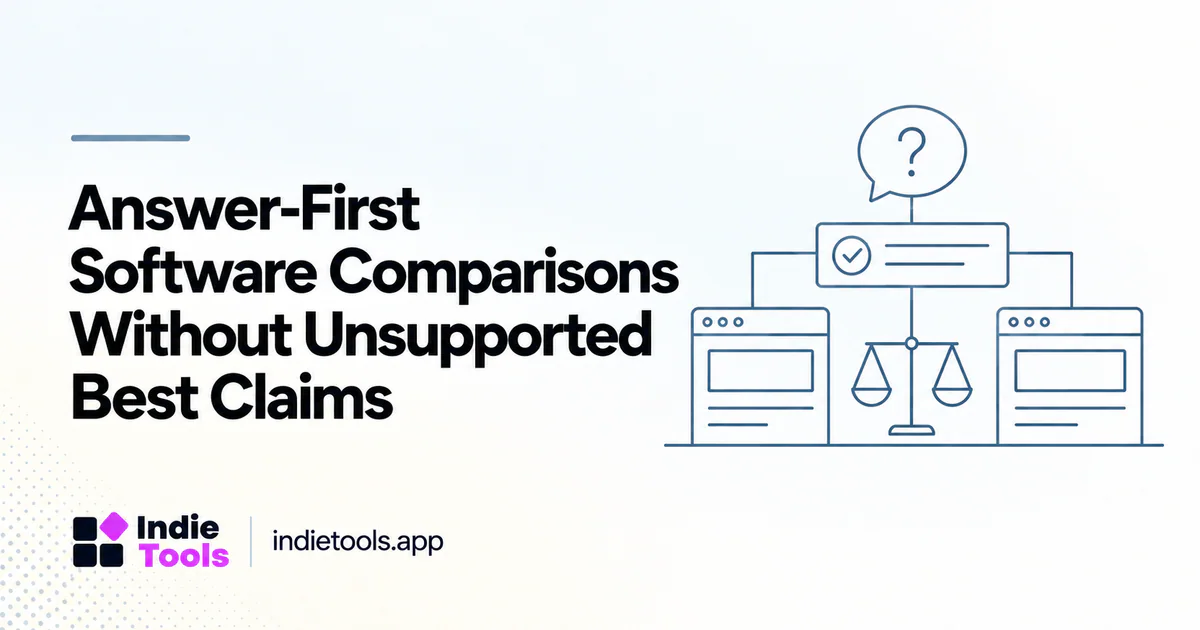
An answer-first software comparison should state which requirements determine the decision before presenting a long feature list. It does not need to declare one product universally best. A conditional recommendation is often more useful because teams differ in workflow, budget and operational constraints.
For IndieTools content, the opportunity is to help readers turn product discovery into a testable shortlist. That means explaining the evidence behind a comparison and identifying where a hands-on trial or current documentation check is still necessary.
Open with the decision conditions
Replace an absolute verdict with a statement of fit. An illustrative opening might say: “A hosted tool suits teams that want managed operations; a self-hosted option deserves evaluation when infrastructure control is a requirement.” This frames the choice without pretending that deployment model settles every other question.
Name the user and task. A comparison for a solo founder sending release updates should not silently become advice for a regulated enterprise coordinating multiple departments. The criteria and evidence will differ.
Separate essential requirements from preferences
Define the features that can eliminate a candidate: a required export format, a supported network, a permission boundary or an integration. Then list preferences such as interface style or convenience.
A tool that fails an essential requirement should not win because it accumulates points for unrelated extras. When using a scorecard, explain the weights and acknowledge that they reflect the stated scenario rather than an objective universal ranking.
Attach evidence to material claims
Check current official documentation and pricing conditions. A product listing can help identify candidates, but it should not be treated as independent proof of every feature. IndieTools' categories are a discovery starting point, not a substitute for vendor verification. [1]
Record the date checked and distinguish documented capability from observed test results. Do not write “we found the interface intuitive” without an actual evaluation. A desk-researched comparison can still be valuable when its limits are explicit.
Use a concrete evaluation task
Give the reader a repeatable scenario. For a feedback tool, that might involve submitting a request, identifying a duplicate, linking it to a release and notifying the original requester. For an analytics tool, it might involve confirming attribution on a known visit and checking a defined conversion event.
The task should expose the decision criteria, not merely demonstrate a polished homepage. Include a failure condition so the reader knows when a candidate does not meet the requirement.
Keep commercial placement separate
Disclose a paid relationship or sponsored position rather than presenting it as an organic evaluation result. Google asks publishers to qualify paid links appropriately; its guidance identifies rel="sponsored" for advertising or paid placements. [2]
Commercial context does not require abandoning useful comparisons. It requires clear boundaries: who paid, what the placement includes and whether payment affects order. Do not invent independent testing or label a sponsored product a universal winner to justify its position.
Finish with a short decision tree
Summarize the conditions that narrow the shortlist. A reader might first select the deployment model, then verify an essential integration and finally test the core workflow. This makes the article actionable without compressing every trade-off into a single score.
Answer-first writing is a readability choice, not a special certification for AI systems. Google explicitly rejects the idea that publishers must use a special writing format for generative search. [3] Use the structure because it helps the reader make a decision.
Frequently asked questions
Can a comparison use the word best?
Only with a clearly defined context and support. “Best for this tested scenario” is narrower than an unsupported claim that one product is best for everyone.
Must every comparison contain a winner?
No. A useful result may be two suitable options with different trade-offs or a clear explanation that no candidate meets an essential requirement.
Should DR or PageSpeed decide which software to buy?
Not alone. Those measurements describe particular website attributes, not the full quality, suitability or reliability of the software workflow being evaluated.
Explore related IndieTools resources: IndieTools MCP catalog documentation and IndieTools product guides.
Continue your research
- Dynamic Software Comparison Pages: A Fair Template
- Find Software Alternatives by Workflow
- Featured Placement vs Organic Discovery
Sources and verification
Sources consulted for this article on October 1, 2026. Product capabilities are documented claims unless an actual test is explicitly described.