Quick answer: IndieTools helps early SaaS founders create more opportunities for discovery through a permanent product listing, categories, related products, founder profiles, social posts, release notes, followers, direct messaging, editorial content, and optional Featured visibility. It does not guarantee users. The product still needs clear positioning, working onboarding, and a reason for the right visitor to act.
The first users rarely come from one announcement. They come from several small paths: a direct conversation, a category page, an article, a founder update, a recommendation, or a product comparison. IndieTools can strengthen the discovery layer around those paths.
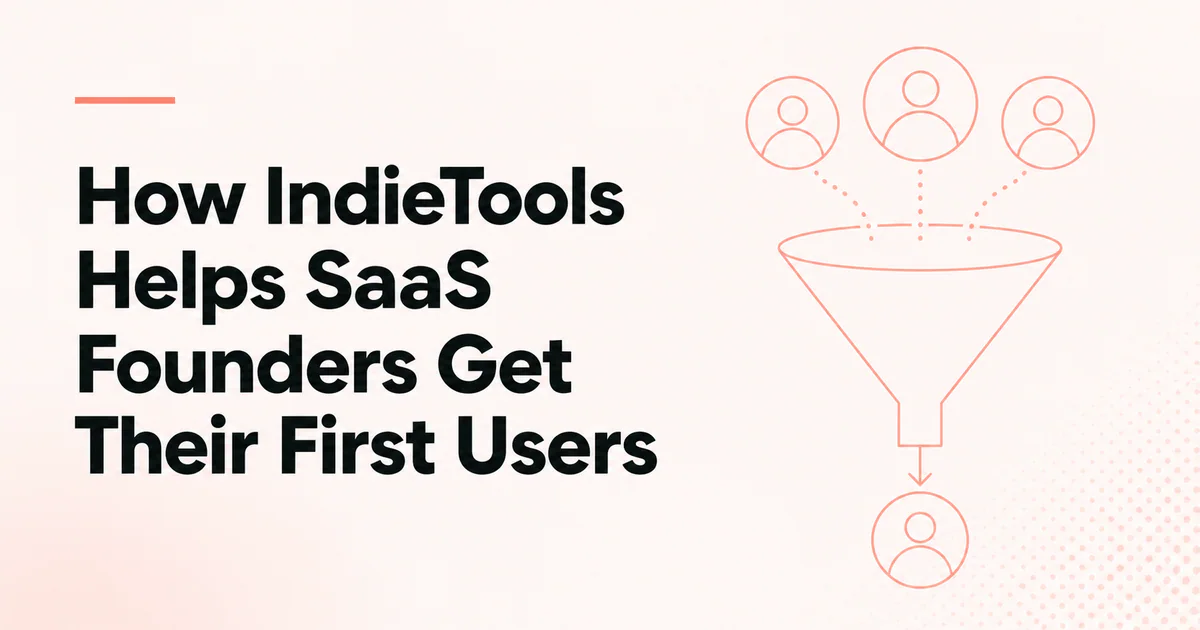
The IndieTools discovery funnel
| Stage | IndieTools surface | Founder responsibility |
|---|---|---|
| Discovery | Directory, categories, tags, related products | Choose accurate positioning |
| Interest | Product page, features, pricing, visuals | Explain the outcome clearly |
| Trust | Founder profile, posts, releases | Be factual and visible |
| Action | Official product link | Make signup and onboarding work |
| Return | Followers, social feed, newsletter | Share useful progress |
| Conversation | Comments and direct messages | Respond without spamming |
| Optional reach | Labelled Featured placement | Measure qualified results |
IndieTools can create an opportunity. It cannot make an unclear product convert or retain visitors.
1. Create a permanent product home
An approved listing gives the product a durable page inside the IndieTools directory. Unlike a temporary social announcement, that page can remain discoverable through categories, search, related products, founder activity, and blog references.
Prepare:
- a specific product name and tagline;
- a complete description;
- target audience and use case;
- features and practical benefits;
- pricing and availability;
- relevant category, tags, and technologies;
- founder attribution;
- current destination links;
- screenshots or other evidence.
Start with how to submit a product to IndieTools and how to optimize the listing.
2. Reach category-aware visitors
Someone browsing an IndieTools category already has a broad problem area in mind. Correct classification can place a product near relevant alternatives and adjacent tools.
Do not select unrelated categories for impressions. A smaller number of qualified visitors is more useful than broad exposure to people who will never activate.
Track category-page visits, product-page engagement, official-site clicks, and activation after referral.
3. Use the founder profile to reduce anonymity
Early products do not have the trust of a familiar brand. A complete founder profile can show:
- who is responsible for the product;
- other products they have shipped;
- recent posts and releases;
- public social identity;
- follower context;
- continuity over time.
This does not prove that every product is good. It gives visitors more context than an anonymous listing.
Read how IndieTools founder profiles work.
4. Share useful progress on the social feed
The IndieTools social feed lets founders publish updates close to the products they describe. Useful posts include:
- a product decision and its tradeoff;
- a customer problem and what changed;
- a measurable improvement;
- a milestone with context;
- a focused request for feedback;
- a lesson from building or distribution.
Avoid repeated promotional links with no explanation. A post should help a reader understand the product or learn from the founder's work.
Use how to share product updates on IndieTools.
5. Publish release notes for meaningful changes
Versioned releases create a public record on the product page. They can demonstrate maintenance and give existing or prospective users a clear explanation of what changed.
A release is especially useful for:
- a major feature;
- a redesign;
- new integrations;
- platform support;
- performance and reliability improvements;
- pricing or packaging changes;
- breaking changes and migrations.
Release notes are not a launch competition. They are durable product history that can also be shared to the social feed.
See IndieTools release notes and product history.
6. Build a relevant follower base
A visitor may discover one product and decide to follow the founder's future work. Followers create continuity between products, posts, and releases.
Do not buy, exchange, or automate follows. A smaller audience that understands the founder's work is more useful than an inflated count.
Read how IndieTools followers support social discovery.
7. Turn discovery into a conversation
Comments and direct messages can help founders:
- clarify an ambiguous question;
- invite a relevant tester;
- exchange product feedback;
- discuss a partnership or integration;
- connect with another builder.
Do not send unsolicited promotional messages to everyone who interacts. Start from the person's stated problem or question and make it easy to decline.
8. Use editorial content as a contextual path
IndieTools blog articles can connect relevant products to a real problem, use case, or comparison. Editorial inclusion should help the reader—not merely create a backlink.
For example, a screenshot API belongs in a developer comparison only when it fits the selection criteria. A founder should keep the product page accurate so an editor and reader can verify the facts.
Explore the IndieTools blog and product categories.
9. Consider Featured only after the listing converts
Featured provides labelled paid visibility for a defined period. Under the current model, it does not buy organic rank and does not automatically change the product's external link treatment.
Featured makes more sense when:
- the product is live and usable;
- the listing is complete;
- the target audience is represented on IndieTools;
- onboarding has been tested;
- analytics can distinguish qualified visits;
- the founder knows what action should follow a click.
It is poor timing when the product page is empty, the destination is broken, or the founder is still unsure who the product serves.
Review IndieTools visibility options and the current pricing page.
10. Convert the visitor on your own product
The official destination must continue the promise made in the directory. Check:
- message match between listing and landing page;
- page speed and mobile usability;
- clear pricing or next step;
- working signup and email delivery;
- a short path to first value;
- privacy, terms, support, and trust details;
- analytics that record activation, not only visits.
If visitors click but do not activate, investigate the destination and audience fit before buying more exposure.
A practical first-user workflow
- Define one narrow target user and problem.
- Publish and verify the product listing.
- Complete the founder profile.
- Speak directly with prospective users.
- Share one useful post about the problem or decision.
- Publish a release when a meaningful change ships.
- Respond to relevant feedback.
- Measure referral visits, activation, and retention.
- Improve the listing and onboarding.
- Add paid visibility only when the path already works.
Pair this with how to get your first ten SaaS customers and how to get your first 100 users.
What IndieTools does not promise
IndieTools does not guarantee:
- a fixed amount of traffic;
- customer acquisition;
- Product Hunt-style ranking outcomes;
- search-engine indexing or positions;
- a Domain Rating increase;
- conversions or retention;
- coverage in an editorial article or newsletter.
Its value is a set of connected discovery surfaces. Results depend on audience fit, product quality, founder participation, and what happens after the click.
Frequently asked questions
Can IndieTools get me my first users automatically?
No. It can make the product and founder easier to discover. Founders still need direct conversations, onboarding, support, and a clear product outcome.
Does IndieTools have a launch ranking?
No. The separate launch feature has been removed. Product activity now uses permanent listings, social posts, and release notes.
What is the social feed URL?
The current public feed is https://www.indietools.app/social.
Should I buy Featured immediately?
Usually not before the listing, landing page, and activation path have been tested. Paid visibility multiplies the current funnel; it does not repair it.
Which metric matters most?
Measure qualified activation and retention after IndieTools referrals. Impressions and clicks explain the path but do not prove product value.
 LaunchLog
 FoundrList
 Niches Hunter
 Email SDK