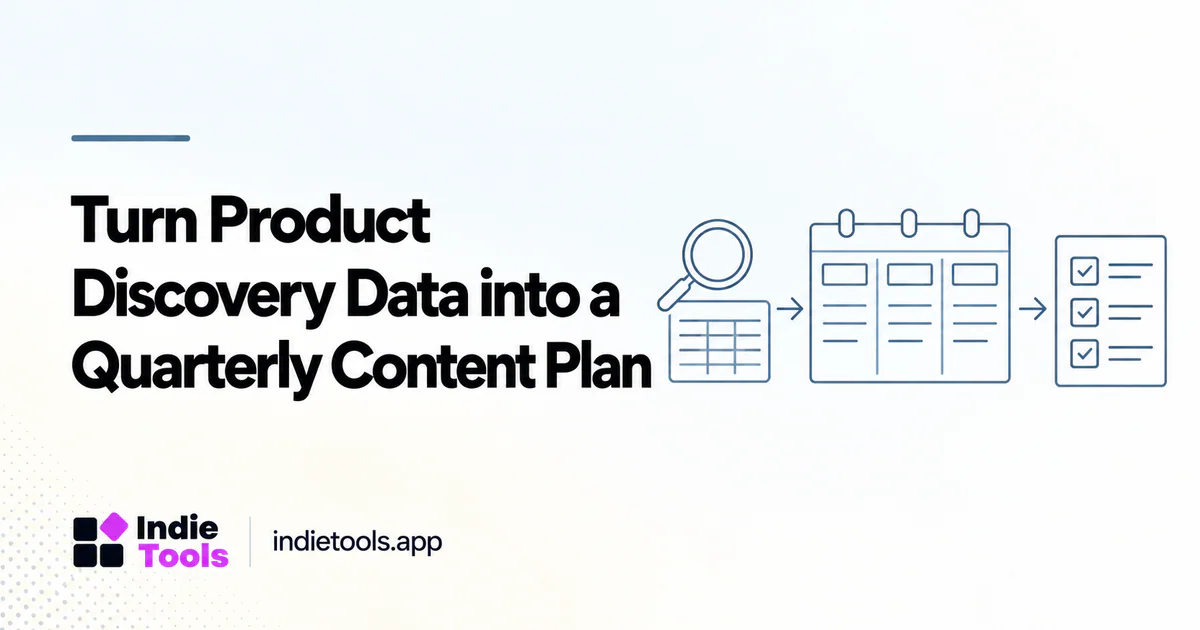
A quarterly content plan should connect observed reader questions with useful product evidence and an appropriate page type. The objective is not to fill a calendar with the largest possible number of keywords. It is to decide which explanations, comparisons and data updates deserve editorial effort next.
For IndieTools, discovery categories, reported technologies and benchmark contexts offer several starting points. They become valuable content inputs only when their scope is understood and the proposed article answers a distinct question.
Inventory the evidence available
Separate public catalog observations from private analytics and search data. A product count shows catalog coverage, not keyword demand. A frequently viewed category may reflect navigation or promotion rather than a large external search opportunity.
Record the source, date and meaning of each input. Useful categories include search queries, internal searches, support questions, product-update requests and benchmark observations. Leave unavailable data blank instead of filling it with plausible-looking volume estimates.
Assign the right page type
Some needs belong on an existing product page, others on a category collection or an editorial guide. A user looking for the current product price should not need a new blog post when the canonical product record can answer the question.
Use articles for explanation, methodology and conditional comparisons. Use data collections when readers need an updated set of eligible products. IndieTools' categories and technology pages provide existing discovery destinations that new guides can support rather than duplicate. [1] [2]
Prioritize by evidence and usefulness
For each proposal, record the reader's task, the available evidence, the closest existing page and the additional value the new content would provide. Add the work required to maintain it after publication.
A proposed scoring rubric can help organize editorial judgment, but do not label its output as measured search potential. Without authenticated keyword data, volume and difficulty remain unknown. A topic can still deserve attention because it resolves a real question with distinctive evidence.
Build a balanced quarterly mix
Combine durable guides, product-specific updates and carefully scoped original analysis. Avoid relying entirely on one format. A benchmark methodology guide can support recurring reports, while an accurate product comparison may need more frequent feature checks.
For a hypothetical quarter, the team could reserve capacity for maintenance before assigning new articles. The exact allocation should follow workload and evidence, not an invented universal ratio. Updating a misleading high-traffic page may be more useful than publishing another overlapping introduction.
Define the success signal before publication
Choose the relevant outcome: a query finding the right page, a reader opening the underlying dataset, a product-profile visit or a qualified submission. Not every informational guide should be judged only by immediate sales.
Keep search impressions, visits, citations and conversion events separate. A rise in one metric does not establish a rise in all others. Review the landing-page experience as well as acquisition so editorial decisions reflect what readers can actually do after arriving.
Review the portfolio, not just individual winners
At the end of the quarter, identify pages to retain, improve, merge or retire. Check whether several articles now answer the same intent and whether data-dependent claims remain current. Preserve useful history where appropriate, but remove contradictions from active decision pages.
Google's people-first guidance encourages evaluating content for usefulness rather than producing it primarily to attract search visits. [3] A strong plan therefore includes the decision not to publish when the evidence is weak, the topic duplicates an existing answer or the maintenance burden exceeds its value.
Frequently asked questions
Does every catalog filter deserve a blog article?
No. A filter combination is not automatically a distinct reader need. Publish only when the content adds an explanation or evidence beyond the existing collection.
Can the plan proceed without keyword-volume data?
Yes, as a qualitative editorial plan. Clearly label unmeasured demand and validate priorities when reliable search data becomes available.
What should be carried into the next quarter?
Carry forward unresolved reader needs, proven useful explanations and necessary maintenance. Do not keep weak topics solely because they were already assigned a place in the previous calendar.
Continue your research
- Category vs Blog vs Product Page SEO
- Internal Links Between Products and Guides
- Publish Original SaaS Benchmarks Responsibly
Sources and verification
Sources consulted for this article on October 1, 2026. Product capabilities are documented claims unless an actual test is explicitly described.