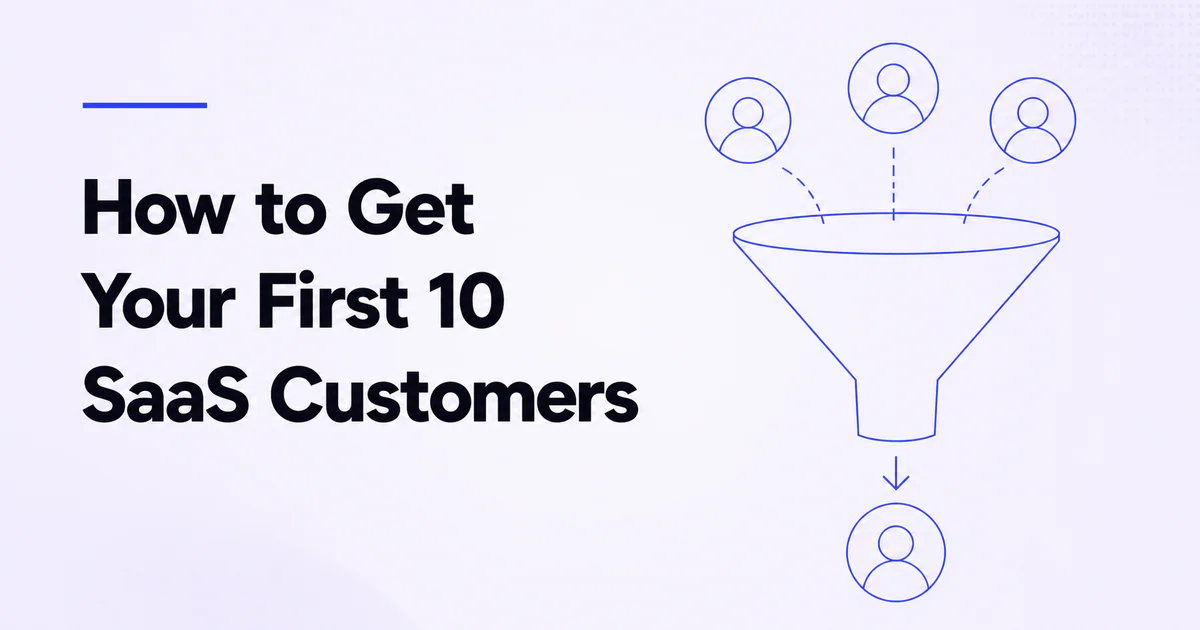
Quick answer: Get your first 10 SaaS customers by choosing a narrowly defined buyer, recruiting them through direct founder outreach, solving one painful workflow with a hands-on pilot, charging early, and asking successful users for specific introductions. At this stage, conversations and onboarding quality matter more than scalable acquisition.
Your first customers are not a miniature version of a mature funnel. They are a learning cohort. The founder must understand why they bought, what nearly stopped them, how they reached value and whether the problem recurs. That information becomes positioning, onboarding and eventually a repeatable channel.
Define “customer” before counting
A customer should make a meaningful economic commitment. Depending on the model, that may be a paid subscription, paid pilot or signed contract with a clear start. A waitlist signup is a lead; a free user is a user. Keep the definitions separate so validation remains honest.
If willingness to pay is still untested, use the SaaS idea validation framework first.
Step 1: Write a narrow customer hypothesis
Use a sentence:
We help [role/company type] when [trigger] to achieve [outcome] without [current costly alternative].
“Marketing teams” is too broad. “Owners of small SEO agencies preparing weekly client reports” gives you a specific role, recurring trigger and observable workflow.
Write down three assumptions:
- who feels the problem most often;
- what they do today instead;
- what outcome would justify paying.
Do not broaden the audience after two rejections. A narrow hypothesis is useful because it can be disproved and improved.
Step 2: Build a list of 30 qualified prospects
You do not need thousands of leads. Build a small list manually from places where the buyer already identifies themselves: professional communities, LinkedIn, industry directories, conference speaker lists, integration ecosystems and referrals.
For every prospect, record:
| Field | Why it matters |
|---|---|
| Role and company | Confirms ICP fit |
| Trigger evidence | Shows why the problem may be urgent now |
| Current workflow | Gives the outreach a concrete starting point |
| Contact route | Prevents random multi-channel chasing |
| Hypothesis | Records why this person might care |
Thirty researched prospects teach more than 3,000 scraped addresses. Avoid buying an unrelated list or sending the same message to everyone.
Step 3: Start with a problem conversation
The first message should show relevance and make a small request. It should not present a long feature list.
Hi Maya — I noticed your agency publishes weekly client reports. I am researching how small SEO teams collect data and turn it into those reports. Would you be open to a 15-minute conversation about the current workflow? I am building around this problem, but I am not asking you to buy on the call.
During the conversation, ask about the last real occurrence:
- What triggered the task?
- Which steps did the team complete?
- Where did time, money or accuracy get lost?
- What has already been tried?
- Who would approve a replacement?
- What would make switching too risky?
Specific past behavior is stronger evidence than a hypothetical answer about future interest.
Step 4: Offer a narrow paid pilot
A pilot should solve one painful workflow with a defined beginning, outcome and review date. Early customers may accept more manual work behind the scenes when the result is valuable and the process is transparent.
Define:
- the workflow included;
- what is explicitly excluded;
- setup responsibilities;
- price and billing date;
- success measure;
- pilot duration;
- support route;
- what happens at the end.
Charging matters because payment tests priority, procurement and trust—not only whether someone likes the idea. A discounted pilot can be reasonable when it buys structured feedback or extra implementation work, but explain the standard price direction so the discount does not become the product's perceived value.
Use the SaaS pricing models guide before improvising a different deal for every customer.
Step 5: Onboard each customer personally
For the first ten customers, founder-led onboarding is research. Watch where users hesitate, which data they lack, what they misunderstand and how long it takes to reach the first useful result.
Track four timestamps:
- account or workspace created;
- setup completed;
- first value reached;
- first repeated use.
Do not confuse a successful sales call with successful adoption. A customer who pays but never reaches value is an onboarding warning, not a complete win. The SaaS user onboarding checklist provides a fuller activation review.
Step 6: Keep a customer evidence log
After every call or support interaction, record the customer's own language for the problem, desired outcome, objections and proof of value. Separate repeated evidence from one-off requests.
| Evidence | Possible use |
|---|---|
| Repeated problem phrase | Landing-page language |
| Common switching objection | FAQ or onboarding step |
| Time saved | Case study, with permission |
| Repeated missing capability | Product prioritization |
| Unexpected use case | New segment hypothesis |
Do not publish customer names, screenshots, revenue or quotes without permission.
Step 7: Ask for a specific introduction
Ask only after the customer has received value. Make the request easy to evaluate:
You mentioned that other agency owners have the same reporting problem. Is there one person you think would be useful for me to speak with? I can send a two-sentence note you can forward, and there is no pressure for them to buy.
An introduction to one relevant peer is more useful than asking a customer to “share us everywhere.” If the customer is willing, also ask for an honest testimonial or short case study focused on the problem and outcome.
Step 8: Use discovery channels as support
Founder outreach should not be the only permanent acquisition asset. Create a clear website, publish an accurate IndieTools product listing, and participate in communities where the target buyer already learns.
Directories and launch platforms can create discovery, but they do not replace direct learning. Use the startup directory distribution guide and small-budget SaaS marketing guide to build a wider channel mix.
A practical 30-day plan
Week 1: customer hypothesis
- Define one segment, trigger and outcome.
- Interview five people without pitching features.
- Update the problem statement with their language.
Week 2: pilot recruitment
- Research 30 qualified prospects.
- Send 10–15 personalized messages.
- Offer a narrowly scoped paid pilot to strong matches.
Week 3: delivery and onboarding
- Onboard pilot customers personally.
- Measure time to first value.
- Fix repeated blockers before adding broad features.
Week 4: proof and referrals
- Review outcomes with every active customer.
- Ask successful users for one relevant introduction.
- Turn approved evidence into a case study or clearer landing page.
Metrics that matter before customer ten
Avoid a large dashboard. Track:
- qualified conversations;
- problem confirmation rate;
- pilot offers;
- paid conversions;
- time to first value;
- weekly active customers;
- retention or renewal intent;
- primary rejection reason;
- introductions received.
Traffic and follower counts are secondary unless they lead to qualified conversations or product use.
Common mistakes
Targeting several segments at once
Different segments create conflicting messaging, features, onboarding and sales cycles. Earn clarity in one segment before expanding.
Building every requested feature
Early customers describe needs through their own workflow. Look for the repeated job underneath the request before changing the roadmap.
Treating free users as paid validation
Free usage may validate utility. It does not prove willingness to pay. Track the two signals separately.
Scaling outreach before the message works
Automation multiplies an unclear hypothesis. First learn which trigger, problem and outcome consistently earn a reply.
Hiding the founder from onboarding
Self-service automation can come later. Direct observation is unusually valuable while the product and positioning are still flexible.
Frequently asked questions
How long should getting the first ten customers take?
There is no universal timeline. Sales cycle, price, risk, integrations and buyer access matter more than an arbitrary deadline. Measure learning and conversion by cohort rather than assuming a viral launch should produce ten buyers immediately.
Should the first customers receive a discount?
Sometimes. Tie any discount to a clear reason such as limited scope, a pilot period or extra feedback. Avoid permanent discounts that make future pricing difficult to explain.
Should I offer the product for free first?
A free test can reduce risk when setup is incomplete, but introduce a paid commitment as soon as the product delivers meaningful value. Otherwise you may optimize for users who never intended to buy.
What if prospects reply but nobody pays?
Review problem urgency, buyer authority, trust, switching cost, promised outcome and price. More features are only one possible answer. Return to interviews and ask what prevented a real commitment.
When should I start paid advertising?
Usually after the product has a clear customer, working activation path and evidence that a qualified visit can convert. Paid traffic is expensive research when those foundations are unknown.
 LaunchLog
 FoundrList
 Niches Hunter
 Email SDK