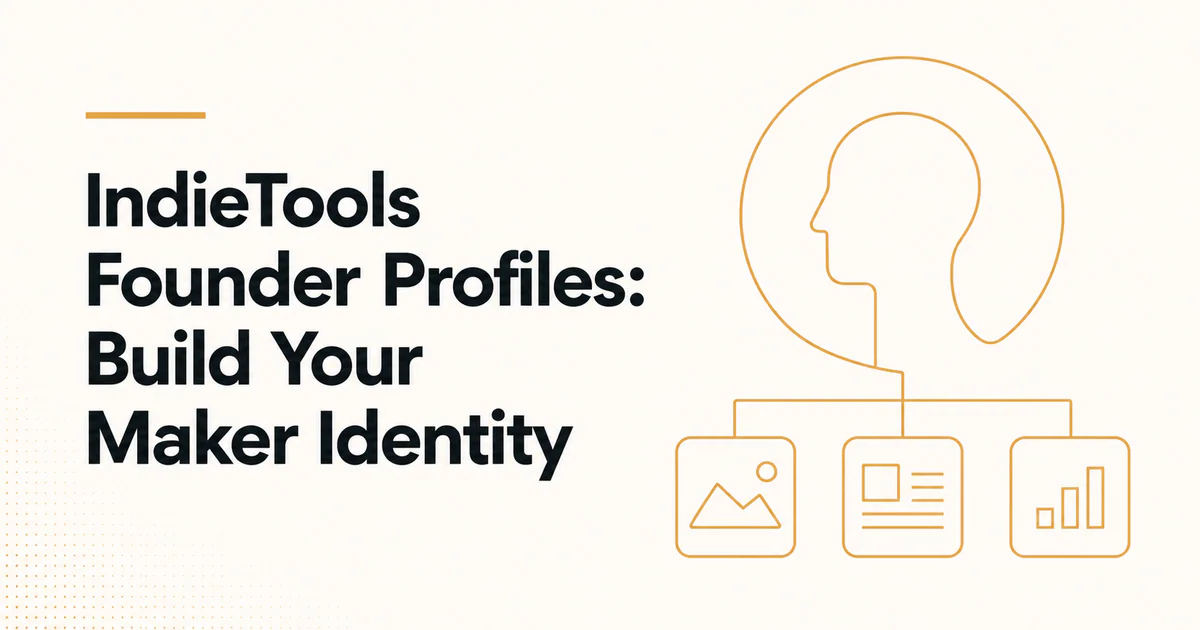
Quick answer: An IndieTools founder profile is a public maker page that connects identity, handle, social links, products, releases, posts and follower context. It helps visitors move from one product to the rest of a founder's work and gives repeat builders a durable portfolio. The profile is most effective when it is factual, complete and updated—not when it is treated as a vanity biography.
Product pages answer “what is this?” Founder profiles answer “who built it, what else have they shipped, and should I follow their work?”
What appears on a founder profile?
The current founder experience is designed to bring together:
- founder name and handle;
- avatar and concise biography;
- public social links;
- follow action and follower context;
- product count and product cards;
- release history;
- public post count and latest posts.
The exact visible information depends on the founder's activity and privacy choices. Empty sections should not be filled with invented achievements.
Why founder identity matters for indie products
Large companies borrow trust from brand familiarity. Indie products often borrow initial trust from visible maker accountability.
A founder profile can show:
- a consistent public identity;
- a history of shipping;
- related products;
- responsiveness through updates;
- continuity after a release;
- a path for visitors to follow future work.
This does not replace product evidence, security documentation or support. It adds human context.
Product page vs founder profile
| Product page | Founder profile |
|---|---|
| Explains one product | Shows the maker's portfolio |
| Focuses on features and use cases | Focuses on identity and activity |
| Links to official product | Connects products, releases and posts |
| Supports product discovery | Supports relationship and trust |
| Updated when product changes | Updated as founder ships and publishes |
Visitors should be able to move naturally between the two. Browse IndieTools products to see creator attribution in product discovery.
How to write a strong founder bio
Use two or three factual elements:
- what you build;
- who you build for;
- relevant expertise or current focus.
Example:
Independent developer building privacy-first analytics and monitoring tools for small SaaS teams.
Avoid generic labels such as “visionary entrepreneur” or a list of every technology you have used. The bio should help a visitor understand the connection between the founder and the products.
Use one consistent public identity
Choose the name, avatar and handle you intend to maintain. Consistency helps visitors recognize the same person across:
- IndieTools listings;
- release pages;
- founder posts;
- product websites;
- X, GitHub, LinkedIn or other public profiles.
Do not create separate founder accounts for each product. A portfolio is more valuable when ownership is connected accurately.
Connect all products you maintain
Claim or associate products only when you are the actual creator or authorized team member. Accurate ownership allows the profile to function as a portfolio.
For every connected product:
- verify the current domain;
- use consistent founder attribution;
- correct legacy ownership after acquisitions;
- remove duplicate listings;
- update discontinued status honestly;
- keep product descriptions distinct.
If the product is not listed, use how to submit a product to IndieTools.
Use release history as evidence of shipping
A release record can show when a founder introduced a product or major update. It is more useful when paired with:
- what changed;
- who the release served;
- what the founder learned;
- the resulting product state.
Do not publish separate releases for minor changes simply to make the profile appear active. Use IndieTools directory vs social feed to choose the right format.
Publish posts that add context
Founder posts can turn a static profile into a useful public record. Strong topics include:
- a product decision and tradeoff;
- a release lesson;
- a specific milestone;
- customer feedback that changed the roadmap;
- a technical or marketing experiment;
- an honest retrospective;
- a request for targeted feedback.
Avoid copying the same promotional sentence every week. A follower should learn something or understand meaningful progress.
Read how to build in public on IndieTools.
Followers are a continuity signal
The follow feature gives visitors a way to stay connected to a maker after discovering one product. It can help future products and releases reach people who already understand the founder's work.
Do not optimize for follower count through giveaways, exchanges or automation. A small audience with real category interest is more useful than inflated reach.
See how followers help indie founders.
A founder profile for first-time builders
You do not need a long portfolio. A first-time founder can create trust through:
- specific biography;
- one complete product listing;
- a working product destination;
- transparent release story;
- useful posts;
- consistent links;
- responsive communication.
The profile grows with the founder. Do not fabricate past products or numbers to make it look established.
A founder profile for repeat founders
Repeat founders can use the profile to:
- show products across categories;
- connect an audience between releases;
- explain acquisitions or discontinued projects;
- demonstrate a pattern of shipping;
- centralize current social links;
- create a public maker portfolio independent of one product brand.
Each product still needs its own positioning. A portfolio should not collapse different products into one generic description.
Founder profile optimization checklist
- Public name and handle are consistent
- Avatar is recognizable at small size
- Bio states what you build and for whom
- Social links are current
- Product ownership is accurate
- Product cards have distinct positioning
- Release history reflects real releases
- Latest posts add useful context
- Discontinued or transferred products are labeled correctly
- No private or sensitive information is exposed
How to measure profile value
Track:
- product-to-profile visits;
- profile-to-product clicks;
- follows from product and release traffic;
- repeat visits;
- post engagement;
- conversion assisted by founder context;
- follower quality across product categories.
The goal is not maximum profile views. It is helping the right people understand and continue following the founder's work.
Privacy and accuracy
Publish only information intended to be public. Do not add private addresses, personal contact details or client information. Link to professional channels you monitor.
When product ownership changes, update the founder association. Public identity is valuable only when it is accurate.
Frequently asked questions
Is a founder profile the same as a company page?
No. It represents the maker or authorized creator identity and connects that identity to products and activity.
Can one founder profile contain multiple products?
Yes. That is a central portfolio benefit, provided ownership is accurate.
Does follower count guarantee release reach?
No. Followers indicate voluntary interest, but feed visibility and reader behavior vary. Founders should not promise that every follower will see or respond to every release.
Should I link every social account?
Only link current, public accounts relevant to your founder identity. Fewer maintained profiles are better than many abandoned ones.
 LaunchLog
 FoundrList
 Niches Hunter
 Email SDK