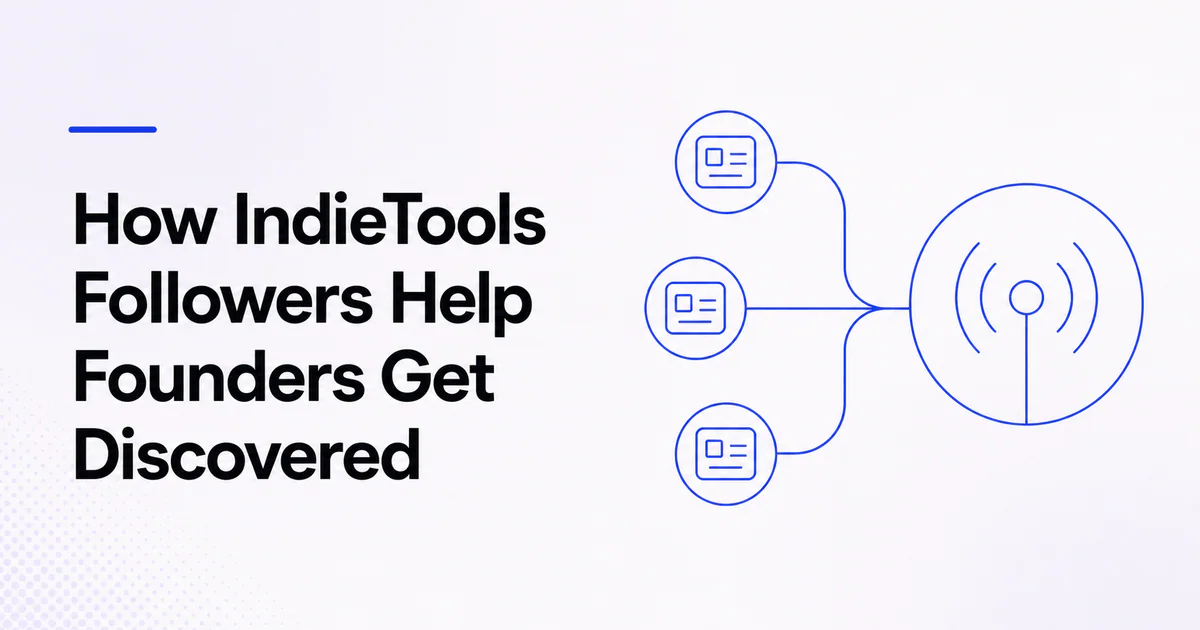
Quick answer: IndieTools followers create continuity between a founder's products, releases and public posts. A visitor can discover one product, open the maker profile and follow future work. For founders, this creates a relevant returning audience; for visitors, it creates a simple way to track builders they trust. Follower count is not a guarantee of reach, rankings or sales and should never be inflated artificially.
Traditional directories focus on product pages. Social networks focus on people and feeds. IndieTools connects the two so the founder relationship remains attached to a useful product context.
The social discovery loop
- A visitor finds a product through the IndieTools directory, category or release.
- The product page identifies its creator.
- The visitor opens the founder profile.
- The profile shows products, releases and posts.
- The visitor follows the founder.
- Future activity creates another discovery opportunity.
This loop is more valuable when every step contains accurate, relevant information.
Follower vs product visitor
| Product visitor | Founder follower |
|---|---|
| Interested in one product now | Interested in future founder activity |
| May arrive from category or search | Has made a relationship choice |
| Evaluates one use case | Can discover multiple products |
| Often one-time | More likely to return |
| Conversion depends on current product | Value can span several releases |
Not every product visitor should become a follower. The follow action is useful precisely because it reflects voluntary continued interest.
Why founder-level following matters
Independent founders often build more than one product. A person may stop using one tool but remain interested in the maker's approach or next release.
Founder-level following supports:
- portfolio discovery;
- repeat releases;
- build-in-public updates;
- category expertise;
- founder reputation;
- audience continuity across pivots.
Read how IndieTools founder profiles work.
How products generate relevant followers
A product listing should make founder identity visible without distracting from the product. Visitors are more likely to explore the founder when:
- the product solves a clear problem;
- the description is credible;
- the founder has a specific bio;
- the portfolio is coherent;
- updates demonstrate useful experience;
- ownership and social links are accurate.
Optimize the product foundation with the IndieTools listing guide.
How posts deepen discovery
Posts explain what a product page cannot:
- why a decision was made;
- what happened during a release;
- what user feedback changed;
- which experiment failed;
- what the founder is building next.
Useful posts help a visitor evaluate whether to follow. Repeated promotional slogans do the opposite.
Use how to build in public on IndieTools for a responsible content format.
How releases activate an existing audience
Followers can provide a starting audience for a genuine release. That does not mean every follower will see or support every release.
Founders should still:
- explain what is new;
- notify only through permitted channels;
- avoid repetitive support requests;
- make the product easy to try;
- remain available for questions;
- follow up with results.
Read how to share a product update on IndieTools.
Social discovery benefits for visitors
Visitors can use founder context to:
- find other products from the same maker;
- follow a specialist in a product category;
- see whether a founder maintains products actively;
- learn from release and build-in-public posts;
- discover new releases without searching from zero.
Founder activity should not be treated as a security audit or product guarantee. Visitors must still review the actual product, permissions, pricing and documentation.
Social discovery benefits for founders
More durable attention
A product click can be temporary. A follow can support future discovery if the founder continues publishing useful work.
Portfolio distribution
Repeat founders can introduce adjacent products to people already familiar with their work.
Better feedback context
Followers who understand the product history can provide more informed feedback than cold traffic.
Release continuity
The founder does not begin every release with a completely new identity.
Public accountability
Visible posts and product history can encourage accurate updates and long-term maintenance.
What follower count does not mean
Follower count does not automatically prove:
- product quality;
- customer count;
- active usage;
- organic directory position;
- revenue;
- authority in every category;
- guaranteed distribution.
Treat it as one public relationship signal, not an absolute score.
Ethical audience growth
Do:
- ship useful products;
- write specific updates;
- respond to relevant founder updates;
- respond thoughtfully;
- keep the profile accurate;
- cross-link public profiles consistently;
- invite existing users to follow without pressure.
Do not:
- buy followers;
- exchange follows at scale;
- automate fake profiles;
- promise rewards for following;
- impersonate makers;
- repeatedly tag unrelated accounts;
- use personal data for unsolicited outreach.
Artificial followers make metrics less useful and reduce trust in the platform.
A founder audience workflow
- Complete one high-quality product listing.
- Create a recognizable founder profile.
- Publish a useful product lesson.
- Follow up when feedback changes the product.
- Publish a meaningful product release.
- Share an honest retrospective.
- Continue posting at a sustainable cadence.
- Review which activity attracts relevant followers.
The workflow starts with product value, not growth tactics.
Metrics to track
| Metric | What it can show |
|---|---|
| Product-to-profile rate | Whether maker context creates interest |
| Profile follow rate | Whether the public identity is relevant |
| Post-to-product clicks | Whether updates drive useful discovery |
| Followers by product/category | Which work attracts the audience |
| Return visits | Whether attention is durable |
| Release-to-product activity | Whether followers explore a product after a release |
| Activation from follower traffic | Whether the audience fits the product |
Review quality alongside volume. Ten relevant users who test a product can be more valuable than hundreds of passive follows.
Social network vs IndieTools follow
General social platforms remain useful for broad conversation and distribution. IndieTools adds product-specific structure:
- profiles are connected to listings;
- releases are connected to products;
- posts are connected to a public maker portfolio;
- followers can discover future products inside the same ecosystem.
Use both when appropriate. Do not copy identical content to every platform without adapting it.
Frequently asked questions
Can visitors follow products or founders?
The current social model centers the public founder relationship. Product and interface behavior can evolve, so use the live profile controls as the source of truth.
Do followers automatically receive every post?
Visibility depends on the current feed and notification design. Founders should not promise guaranteed delivery.
Does a larger follower count guarantee distribution?
No. Follower count does not guarantee that every person will see, open, or act on a post or release.
Should I ask existing users to follow me?
Yes, if the request is relevant, optional and not tied to a misleading reward.
 LaunchLog
 FoundrList
 Niches Hunter
 Email SDK