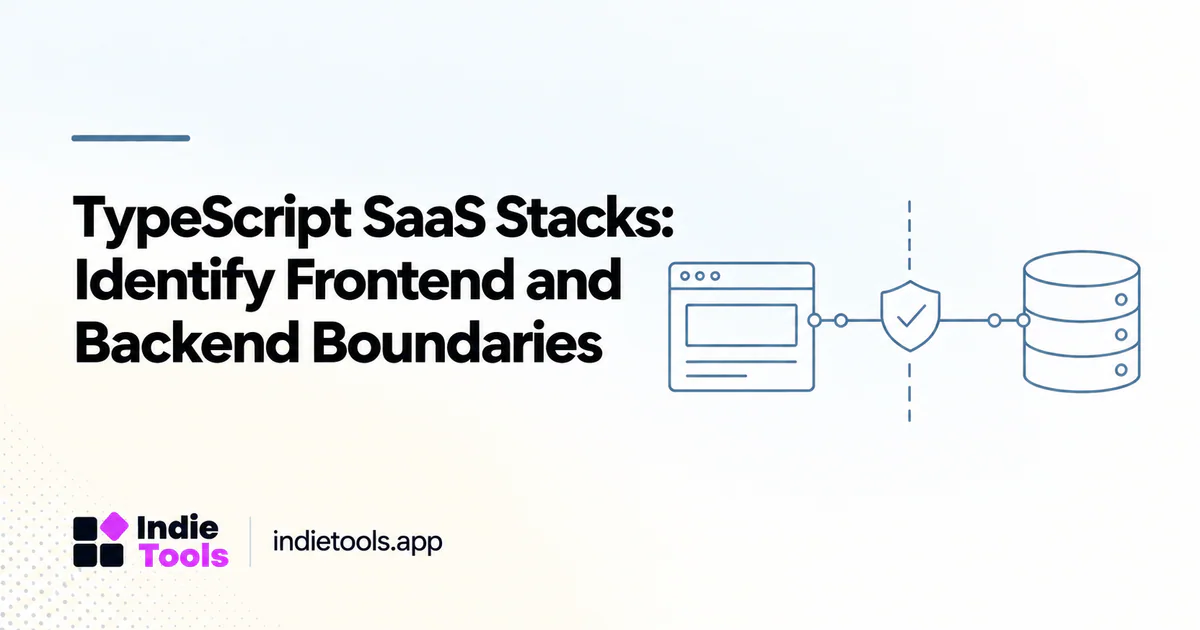
A TypeScript SaaS stack should be described by where types are used and where data crosses a trust boundary. A shared language can improve developer coordination, but a public TypeScript label does not prove that every request, database record or external response is validated.
The TypeScript handbook explains that type annotations are erased when JavaScript is produced. [1] That distinction matters at runtime: a value arriving from a network request still needs the application's appropriate validation and authorization controls.
Map the execution environments
List the browser, application server, workers and external services. Identify which code is TypeScript and which components use another language or platform. Keep the marketing site separate from the authenticated application when their architectures differ.
IndieTools' TypeScript collection provides declared product examples. [2] Use those records for discovery, not as evidence that the products share one deployment model or a particular validation library.
Identify data contracts
Document the shapes of requests and responses at each boundary. Include required fields, optional values, units and error states. A type called Product may mean different things in the database, public API and editorial interface; naming those differences explicitly can prevent accidental exposure or incorrect assumptions.
Decide who owns contract changes. If a worker and API deploy independently, a shared type definition alone does not guarantee that both running versions agree. Plan compatibility and versioning for the operational reality of the system.
Validate untrusted inputs
Use runtime validation appropriate to the application's requirements. Treat user input, webhook payloads and third-party responses as data to check, even when a generated client provides convenient types. Validate permissions separately from shape: a correctly formed request can still be unauthorized.
This guide does not prescribe a specific library or replace a security review. The important architectural question is where checks occur and what happens when validation fails. Keep errors recoverable and avoid leaking sensitive implementation details to the client.
Trace a realistic asynchronous workflow
Consider an illustrative directory measurement job. The API accepts a request, a worker collects an observation and the result updates a product page. The workflow needs stable identifiers, explicit job states and a plan for duplicate or delayed messages.
Types can document those states, but operations still need retries, idempotency and monitoring. A job marked complete in a local type definition is not evidence that the external measurement succeeded. Preserve source timestamps and failure states in the actual data model.
Evaluate shared-code tradeoffs
Sharing contracts can reduce duplication, but excessive coupling can make independent services difficult to release. Decide which packages represent stable interfaces and which contain implementation details that should remain private.
Test a change that adds a field, removes an assumption or introduces a new error case. Verify how older clients behave. That exercise reveals more about the stack's maintainability than simply counting how much of the repository uses TypeScript.
Learn from public examples carefully
A provider's engineering article can reveal useful practices when its date and scope are clear. A directory entry cannot establish code quality, test coverage or runtime safety. Keep “declared technology,” “documented architecture” and “independently tested behavior” as distinct evidence levels.
When presenting a comparison, describe the workflow that makes an example relevant. Avoid treating TypeScript adoption as a universal signal that a product is more reliable than one implemented in another language.
Does TypeScript validate incoming JSON automatically? Static types alone do not replace runtime validation.
Does one language eliminate service boundaries? No. Network, deployment and authorization boundaries still exist.
What should a founder prototype? One complete data journey across the browser, API and worker, including an invalid input and a failed external call. A stack becomes understandable when both its success path and its failure behavior are explicit.
Explore related IndieTools resources: reported technology collections.
Continue your research
- SaaS Built with Next.js: Research Real Examples
- PostgreSQL SaaS Examples: Questions to Ask
- Analyze Technology Adoption in a Product Directory
Sources and verification
Sources consulted for this article on October 1, 2026. Product capabilities are documented claims unless an actual test is explicitly described.