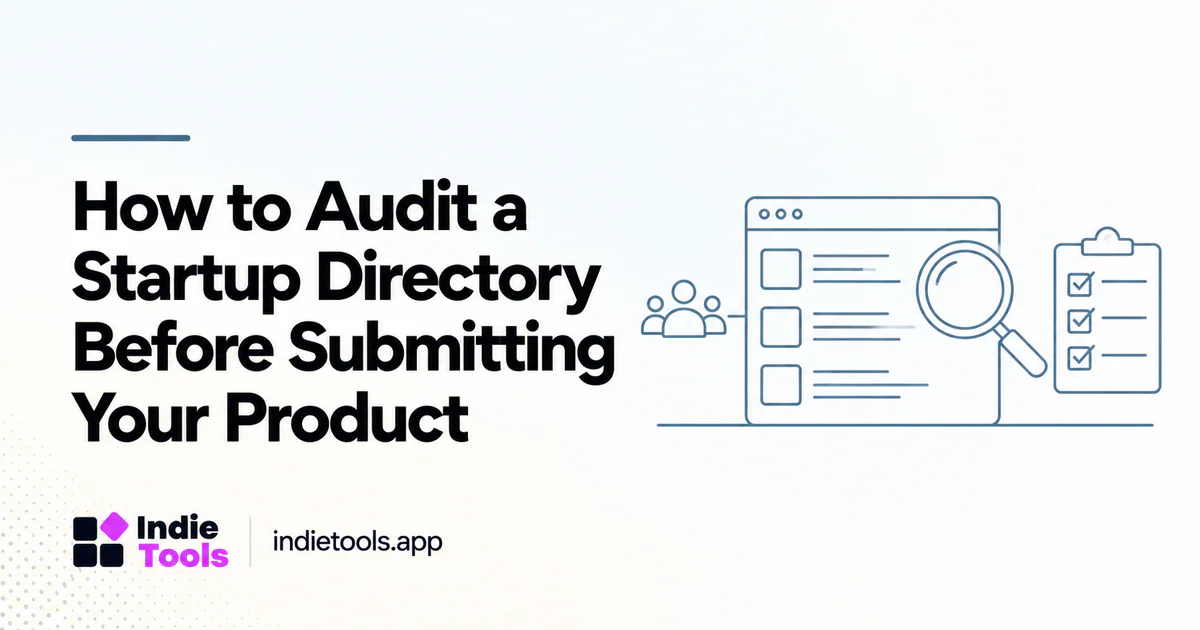
Audit a startup directory by checking whether it helps a relevant visitor discover and understand products. Domain metrics, submission counts and promotional claims are secondary to that basic question. A directory should have a clear audience, usable product pages and transparent commercial terms.
This workflow is designed for a founder deciding where to spend limited attention. It is not a ranking of directories and does not assume that every submission will produce traffic.
Inspect the visitor experience
Open the homepage, a relevant category and several product pages. Can a visitor distinguish the tools, follow a useful link and understand why a product belongs in the collection? Check the experience on mobile as well as desktop.
Look for maintained records rather than judging only visual polish. Broken destinations, empty descriptions and repeated copies of the same product can make discovery difficult. A smaller focused collection may be easier to evaluate than a large undifferentiated list.
Examine audience fit
Read the directory's categories and recent content. Ask whether the audience is likely to care about your product's specific workflow. A developer API and a consumer fitness application do not necessarily benefit from the same context.
Avoid treating a published traffic estimate as a promise of visitors to your listing. Even a genuine site-wide audience may not reach the category or placement you are considering. Ask for placement-specific reporting when evaluating paid promotion.
Review submission and correction rules
Find out what is required to submit, how review works and how an inaccurate listing can be corrected. Check ownership verification and duplicate-product policies where available. These rules affect whether the directory can maintain a useful catalog over time.
Read the current pricing page rather than relying on an old comparison article. IndieTools publishes its listing and visibility options publicly. [1] The same review discipline should apply to any platform: confirm what is included now, how long it lasts and what is not guaranteed.
Separate promotion from ranking claims
A paid placement can be evaluated as advertising: audience, format, duration, destination and measurement. It should not be purchased on an unsupported promise of search rankings. Google provides specific qualification guidance for paid outbound links. [2]
Check whether sponsored visibility is clearly distinguished from editorial or metric-based ranking. Readers should be able to understand why a product appears in a particular position. Transparent labels help you evaluate the exposure you are actually buying.
Test a small, attributable submission
Use an accurate description and a destination that matches the directory audience. Record the submission date, placement and any campaign parameters supported by the platform. On your own site, define the useful next action before evaluating results.
An illustrative pilot could focus on one category and one landing page. Measure qualified visits and completed onboarding rather than celebrating a backlink alone. If the platform cannot provide certain metrics, mark them unavailable instead of estimating them from unrelated site-wide numbers.
Keep a decision log
Write down why the directory was selected, what the experiment cost in money and time, and what you learned. A low-volume placement may still produce useful feedback, but that is different from proving scalable acquisition.
Review the listing after major product changes. Accurate screenshots, pricing descriptions and destinations protect the value of the initial submission. Avoid repeated submissions under slightly different domains as a substitute for maintaining one coherent product record.
Is a high-DR directory automatically worthwhile? No. Audience fit and the actual placement still need review.
Should every free directory be used? Free submissions still consume time and can create maintenance work.
What is the best reason to submit? A credible opportunity for the right people to discover a clearly presented product. Start there, measure what happens and keep SEO claims separate from observed outcomes.
Explore related IndieTools resources: Domain Rating leaderboard and product categories.
Continue your research
- Directory Backlinks: Measure Referral Quality
- Directory Submission ROI: Measure What You Know
- Multiple Domains, One Product: Duplicate Listings
Sources and verification
Sources consulted for this article on October 1, 2026. Product capabilities are documented claims unless an actual test is explicitly described.