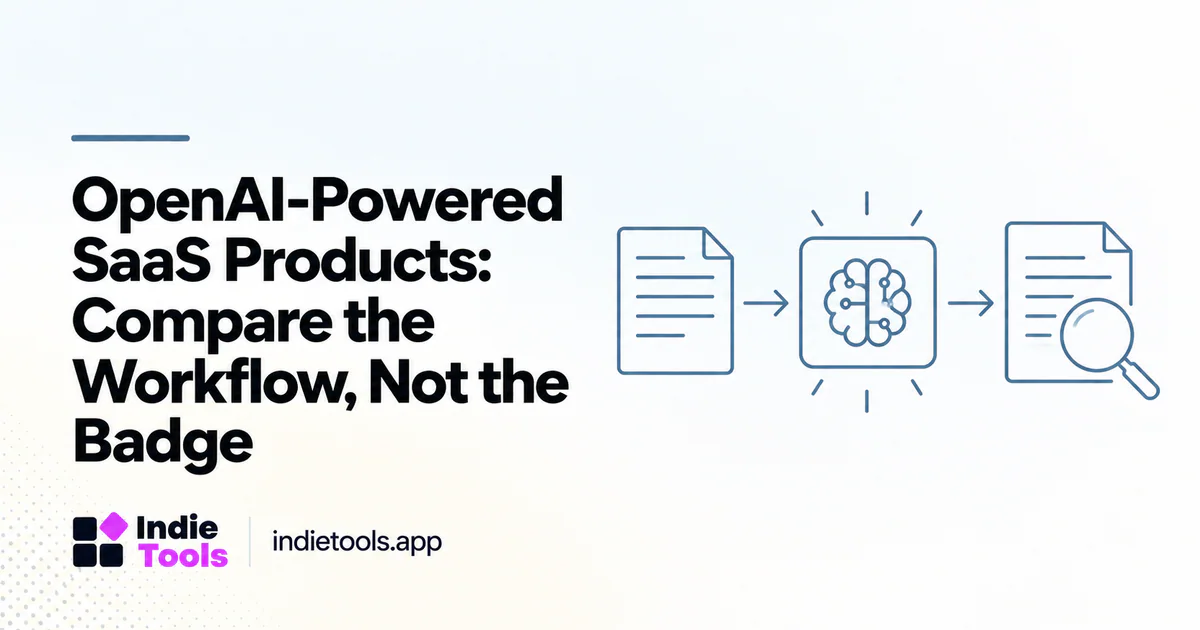
Compare OpenAI-powered SaaS products by the task they help a user complete, the evidence behind their outputs and the controls around failure. A model-provider label tells you something about a dependency, not whether the finished product fits your workflow.
OpenAI's evaluation guidance emphasizes testing model behavior against defined expectations. [1] Apply the same principle when researching an AI product: define what a useful result looks like before judging a demonstration.
Specify the job to be done
Write a realistic input and the output you need. For customer research, that might be a set of themes linked to source statements. For support, it might be a draft answer grounded in approved documentation. “Uses AI” is too broad to distinguish tools that solve different problems.
Include an unacceptable outcome. A polished summary that invents a customer quote or a support answer that cites an unrelated document should fail the test, even when the wording is fluent.
Build a small evaluation set
Use examples you are authorized to process, with sensitive information removed or handled according to your requirements. Include ordinary cases, ambiguous cases and inputs the product should reject or escalate. Do not evaluate only the easiest demonstration supplied by the vendor.
Record the exact product configuration and observation date. Provider models and application prompts can change, so a result should not be treated as permanent evidence about every future version.
Inspect source traceability
Check whether the output points back to the relevant input or source. Open the referenced material and verify that it actually supports the conclusion. A citation-shaped link is not enough if it leads to an irrelevant page or an invented passage.
Distinguish generated interpretation from copied evidence. A tool may usefully suggest a theme while leaving the final judgment to a researcher. The interface should make that division clear rather than presenting every generated sentence as established fact.
Compare end-to-end effort
Measure preparation, review, correction and export time, not only generation latency. A product that responds quickly but requires extensive manual repair may be less useful for your task than one that takes longer and produces a verifiable result.
Keep website speed separate from AI workflow latency. A fast public landing page does not establish how long a large document will take to process. Test the actual workload under the provider's permitted trial conditions.
Review controls and limitations
Inspect data-handling information, access permissions, retention options and export capabilities in the provider's current documentation. Ask for clarification when important details are unavailable. Do not infer privacy guarantees from a technology logo or a broad claim of being “enterprise-ready.”
For actions that can change external systems, examine approval and recovery behavior. An assistant that drafts a message and one that sends it automatically present different operating requirements. Choose according to the risk and the user's control needs.
Use discovery data correctly
IndieTools' technology directory includes OpenAI among its declared stack labels. [2] Use that as one way to discover candidates, then compare the actual product workflow. Do not infer the specific model, provider relationship or current implementation from a label alone.
An illustrative scorecard might compare traceability, correction effort, export quality and handling of ambiguous inputs. Keep the criteria and observations visible rather than publishing an unexplained “AI quality score.”
Does the same model mean the same product quality? No. Inputs, retrieval, interface design and controls can differ.
Should the fastest output win? Only when it also meets the task's quality and safety requirements.
What should the final shortlist contain? Products that passed your representative task tests, with dated evidence and unresolved questions. A badge helps identify a dependency; a workflow evaluation helps identify a usable tool.
Explore related IndieTools resources: product categories.
Continue your research
- Fast AI Tool Websites: Speed vs Model Latency
- AI Tools for Customer Interview Synthesis
- Product Facts AI Search Can Verify
Sources and verification
Sources consulted for this article on October 1, 2026. Product capabilities are documented claims unless an actual test is explicitly described.