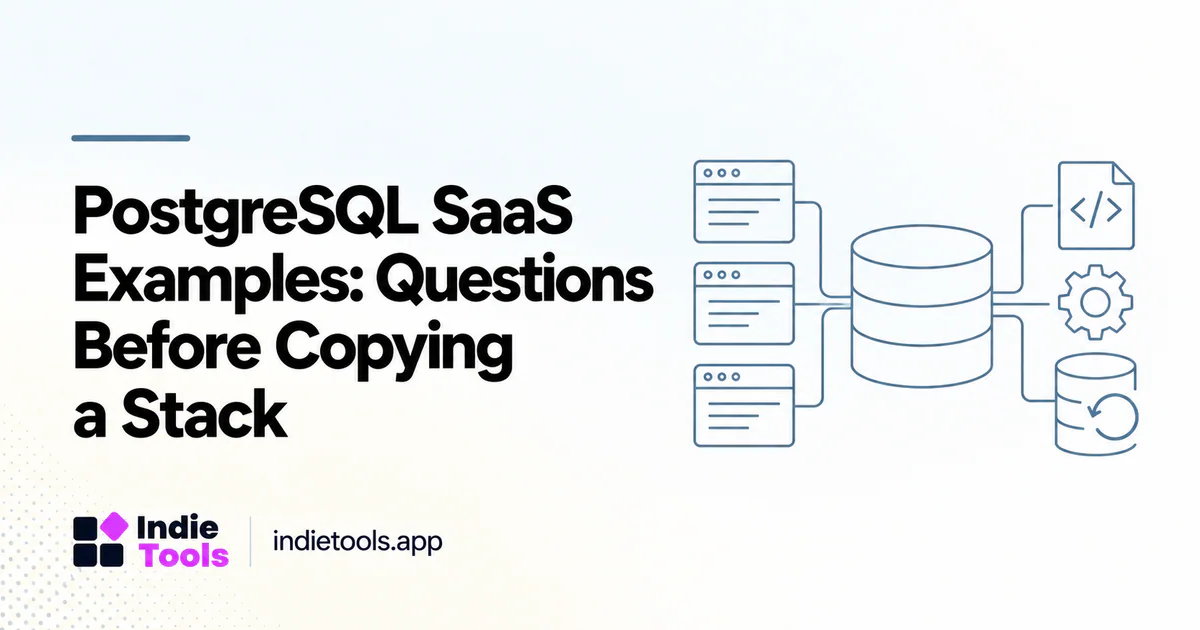
Research PostgreSQL SaaS examples by examining the data relationships and operating requirements behind the product. The database name is useful context, but it does not reveal schema design, tenant boundaries, query behavior or recovery readiness.
A strong research process turns examples into questions you can test. It does not assume that a familiar database removes the need for application-specific design.
Match the data model
Describe the entities your product manages and how they relate. A directory may connect products, founders, categories and time-stamped observations. A media tool may track projects, files and processing jobs. Those models create different access and consistency requirements.
Look for examples that resemble those relationships rather than only matching your frontend framework. The most relevant lesson may concern how records are versioned or how long-running work is represented, not the database brand itself.
Discover declared examples
The IndieTools PostgreSQL collection includes products such as Cliptude, Orbit and IndieTools itself. [1] These are public stack declarations, not published database audits. Do not infer their schemas, hosting arrangements or performance characteristics from the collection alone.
When a provider publishes a technical article, preserve its date and scope. An article about an earlier architecture may explain the product's history without describing its current deployment.
Define tenant isolation deliberately
For a multi-tenant application, decide how organization boundaries are represented and enforced. PostgreSQL documents row-security policies as one available mechanism. [2] Their existence does not establish that any particular product uses them or that they eliminate every isolation risk.
Review permissions, administrative paths and background jobs together. A normal user request and a maintenance process may execute under different privileges. Test the boundaries in your own authorized environment using realistic roles and failure cases.
Examine query and growth assumptions
Identify the operations that will become more expensive as data grows: search, reporting, joins, exports and historical comparisons. Build representative sample data rather than judging performance with a nearly empty database.
A product directory's weekly measurement history is a useful illustrative case. The current product record and its repeated observations should have clear identities. Replacing last week's value may simplify a screen but make historical analysis impossible. Choose the data model according to the product's actual reporting requirements.
Plan changes and recovery
Document how schema migrations are tested, applied and, when necessary, corrected. A migration plan should include the application's compatibility with the old and new schema during deployment. Do not assume that restoring a database is the only acceptable response to every release problem.
Verify backups through recovery exercises appropriate to your environment. Include the files and external references the application needs, not only database rows. This is an operational requirement to test, not something a public stack badge can prove about a vendor.
Compare the whole operating model
Consider who maintains the database, how incidents are detected and which skills the team already has. A managed service and a self-managed deployment can share PostgreSQL while assigning very different responsibilities to the founder.
Use current provider documentation for any concrete service limits or prices. Do not copy an old blog's cost estimate into your architecture plan without checking the workload and date.
Turn research into a small design review
Create a representative schema, exercise the important queries and test permission boundaries. Record the observations and unresolved questions. The output should explain why PostgreSQL fits the workload and what operational responsibilities remain.
Does a PostgreSQL label reveal the hosting provider? No. Treat deployment details as separate facts.
Can a directory prove a database scales for your application? No. Your workload and implementation need their own tests.
What is the most useful lesson from examples? The questions they prompt about data relationships, isolation and recovery. A stack decision is stronger when those questions have evidence-backed answers rather than an impressive list of products using the same technology.
Explore related IndieTools resources: reported technology collections.
Continue your research
- Supabase SaaS Examples: What Listings Cannot Show
- TypeScript SaaS Stacks: Map Frontend and Backend
- CMS Tools for Product Directories
Sources and verification
Sources consulted for this article on October 1, 2026. Product capabilities are documented claims unless an actual test is explicitly described.