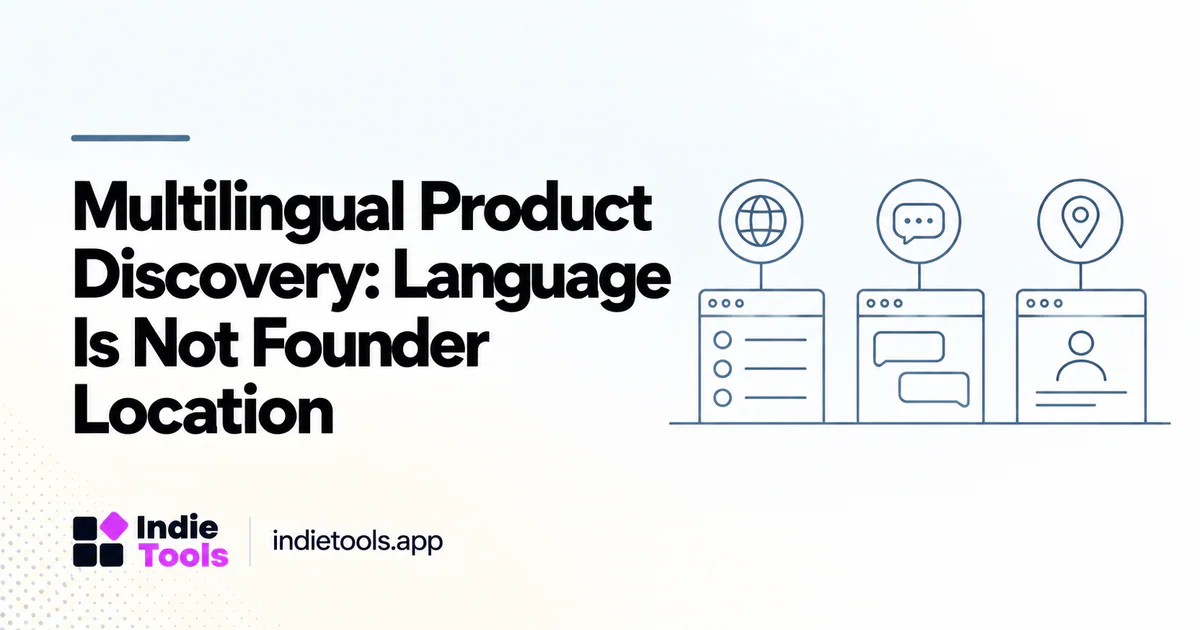
A product's language support and its founder's selected country answer different questions. Keep them separate when building a shortlist, writing a comparison or designing a directory. Otherwise, a convenient filter can produce misleading conclusions about who can use a product.
A tool created by a founder in one country may serve users in many languages. Another product may have a translated marketing page but an application available in only one language. Discovery should make those distinctions easier to understand, not compress them into a flag icon.
Define the language requirement
Ask which part of the experience must be available in the desired language. The interface, documentation, customer support and generated output are separate requirements. A writing tool can produce text in a language that its own interface does not use.
For a team purchasing customer-facing software, also consider the language seen by its customers. An administrator may be comfortable with English while needing a localized form or portal for end users. Record that requirement explicitly before comparing products.
Read country fields at their stated scope
IndieTools explains that a founder selects the product's country and that this is not verification of availability or company registration. [1] Treat the field as a discovery attribute rather than an inferred language or compliance signal.
When a directory does not explain its location model, mark the meaning as uncertain. Do not fill the gap by guessing from a domain suffix, an IP address or a founder's name. Those shortcuts can produce incorrect claims about a product and the people behind it.
Verify language coverage with a task
Open the relevant interface and complete a small authorized test. Inspect navigation, validation errors, notifications and help links. Partial translation often becomes visible outside the main dashboard.
A useful trial might create a sample project and send a test invitation. Check which language appears in the invitation and the recipient's first screen. This reveals the customer experience more reliably than counting language options on the homepage.
Separate translated pages from country collections
Google supports annotations for localized versions of pages. [2] Those relationships should represent actual language or regional variants, not unrelated pages that happen to mention different countries.
A directory's “products selected under Türkiye” collection is not automatically the Turkish translation of its global product directory. It may contain a different set of products and serve a different purpose. Keep content equivalence, language and geographic filtering explicit in the site's model.
Preserve the user's choice
Provide a clear way to choose a language when multiple versions exist. Do not assume every visitor in a country wants the same language. Similarly, a browser preference should not be used to conceal other relevant product information.
When a page is only partly localized, state the boundary. A clear notice can be more useful than a seamless-looking experience that switches unexpectedly to another language during signup or payment. The objective is predictability, not the appearance of complete coverage.
Build a better comparison record
Use separate fields for interface languages, support languages, documentation languages and declared country. Add the source and observation date for each. Keep “not verified” distinct from “not supported.”
An illustrative shortlist might retain a product from outside the preferred country because it fully supports the required customer workflow, while excluding a locally tagged product that does not. That is not a judgment about the country; it is a requirements-based software decision.
Questions about language-based discovery
Does an English listing prove an English interface? No. Verify the actual product experience and current documentation.
Should a language be represented by a country flag? Consider whether the design could confuse language with nationality or region. A written language label is often clearer for the task.
What should a directory prioritize? Accurate, separately sourced attributes that help people evaluate the workflow they need. Country exploration and language compatibility can complement each other without being treated as the same thing.
Explore related IndieTools resources: product categories.
Continue your research
- Discover Indie SaaS Products by Country
- International SaaS Support: Coverage and Handoffs
- SaaS Product Localization: A Listing Checklist
Sources and verification
Sources consulted for this article on October 1, 2026. Product capabilities are documented claims unless an actual test is explicitly described.