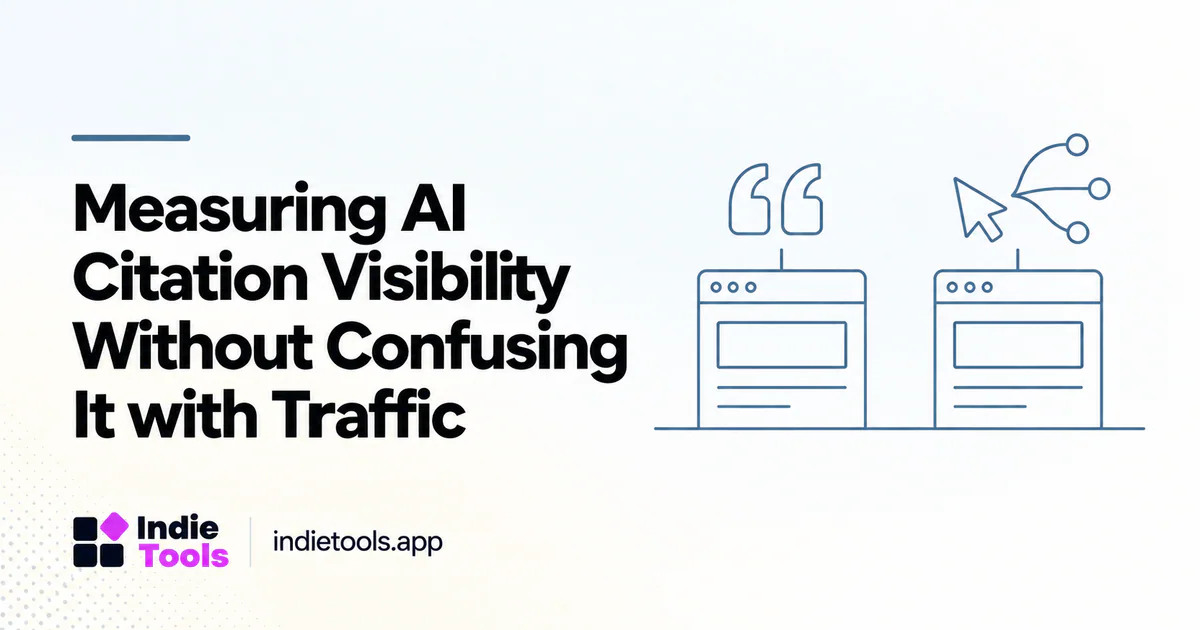
Measure AI citation visibility, referral traffic and customer activity as separate outcomes. A product can appear in an answer without receiving a visit, and a visit can arrive without enough attribution data to identify the answer that preceded it.
A useful reporting system preserves those distinctions instead of compressing everything into a single “AI visibility score.” For IndieTools and the products listed on it, the objective is to understand which information is discoverable and whether identifiable visitors find something useful afterward.
Define what counts as an observation
For a sampled answer, record the exact prompt, service, date, language and whether web search was enabled. Distinguish a brand mention from a linked citation and record the actual destination URL. A link to an unrelated company with the same name should not count as a correct product citation.
Store the answer or an allowed evidence capture so a reviewer can check the classification. Respect the service's terms and avoid collecting private user conversations. A controlled sample answers questions about that sample, not about every conversation on the platform.
Keep the prompt panel stable enough to compare
Create a small set of genuine research questions: finding a tool for a defined task, understanding a benchmark or comparing specific requirements. Separate branded questions from unbranded discovery questions. “What is our product?” is not equivalent to “Which tools solve this problem?”
Version the panel when questions change. Otherwise, a higher citation rate may simply reflect an easier set of prompts. Record unsuccessful responses and missing citations rather than retaining only the outputs that support a positive story.
Use denominators that match the claim
An illustrative test with 40 completed observations and 10 correct linked citations has a 25% citation rate within that test. Those invented numbers demonstrate the calculation; they are not IndieTools results. They do not show that a quarter of all potential buyers encounter the brand.
Report incomplete runs separately. Also distinguish repeated observations of one question from coverage across many different questions. A service change, locale or model setting can affect comparability, so preserve those conditions in the report.
Measure website visits independently
Incoming analytics should identify the landing page, available source information and relevant next action. OpenAI states that ChatGPT search referral URLs include utm_source=chatgpt.com; this is an attribution signal for those visits, not a record of every preceding citation. [1]
An analytics tool may also group recognized assistant referrals. Plausible documents such an AI Assistants channel. [2] Keep unknown traffic unknown rather than assigning it to AI because other channels appear too small.
Use native reports without assuming identical definitions
Google's current guidance points publishers to a Generative AI performance report in Search Console. [3] Check the documentation and available report in the property before comparing its metrics with a third-party prompt panel.
A search impression, a sampled answer citation and a website session are different units. Present them in separate columns with their measurement windows. Do not add them together as a combined audience count, and do not assume the same user was observed across all systems.
Connect findings to an editorial decision
For an IndieTools benchmark guide, a citation may suggest that a definition or table is useful. Referral behavior can then show whether visitors open the underlying methodology or explore a relevant product collection. These are complementary observations, not proof that one caused the other.
Finish the report with an action grounded in the evidence: clarify a misidentified product, improve a weak landing page, investigate an attribution gap or retain a useful explanation. Avoid promising an increase before a comparable follow-up measurement exists.
Frequently asked questions
Is a mention as valuable as a visit?
They measure different things. A mention may create awareness, while a visit allows observation of on-site behavior. Neither automatically establishes revenue.
Can a dashboard show every AI citation?
A sampling tool shows the answers it observed. A publisher's traffic dashboard cannot reveal all private interactions that never reached the website.
How often should a prompt panel run?
Choose a cadence that fits the decision and budget. Consistent conditions and an explicit reporting window matter more than collecting frequent but incomparable snapshots.
Explore related IndieTools resources: IndieTools MCP catalog documentation and IndieTools product guides.
Continue your research
- Analytics Tools for AI Referral Traffic
- AI Crawler Access: Search vs Training
- Turn Product Discovery Data into a Content Plan
Sources and verification
Sources consulted for this article on October 1, 2026. Product capabilities are documented claims unless an actual test is explicitly described.