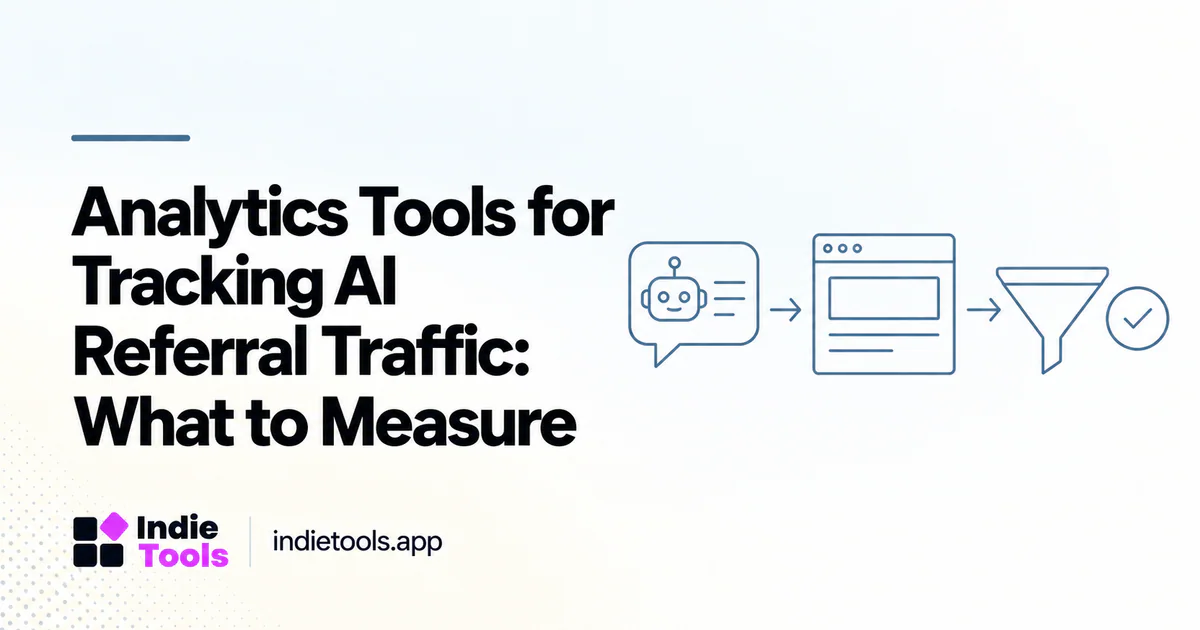
Choose AI referral analytics tools by checking whether they connect an identifiable incoming visit to a meaningful action on your website. A count of mentions in sampled AI answers is a different measurement from traffic, and neither one automatically represents revenue.
For a SaaS business, the useful question is not simply “Did an assistant mention us?” It is “Which pages attract identifiable visitors, and do those visitors reach the next useful step?” Keeping those questions separate prevents a promising visibility report from becoming an unsupported growth claim.
Distinguish three measurement layers
Citation monitoring samples answers and records mentions or linked sources. Referral analytics records visits that reach your site with usable attribution information. Product analytics follows actions such as completing onboarding or creating a first project.
An evaluation should state which layer a tool covers. Do not assume a website analytics dashboard can reveal private conversations or every citation that preceded a visit. Likewise, a monitoring service that runs a set of prompts does not measure the total audience of all AI systems.
Look for a usable referral workflow
Plausible documents an AI Assistants channel that groups recognized assistant referrals and connects them with entry pages and configured goals. [1] That is a relevant example of a traffic-centered workflow, not evidence that every AI-driven visit can be identified.
For any analytics product, inspect how it classifies a source, whether the rules are visible and how unknown visits are handled. Search IndieTools' analytics category for additional candidates, then verify each provider's current implementation rather than assuming all “AI analytics” products measure the same thing. [2]
Define useful events before comparing dashboards
Select events that describe progress toward value. For a directory, that might be opening a relevant product, visiting the maker's website or starting a submission. For a SaaS application, it might be creating an account and completing a core task.
Avoid treating every button click as a conversion. A click on a navigation menu is not equivalent to an activated trial. Document event names, triggering conditions and exclusions so a future change to the interface does not silently alter the report.
Test known visits and missing information
Create a small validation plan using traffic you are authorized to generate. Check a tagged campaign link, an ordinary external referral and a direct visit. Confirm that the analytics tool separates these cases as expected and does not count your own repeated testing as customer demand.
Then inspect the unattributed portion of traffic. A missing referrer does not prove that a visit came from AI, and it should not be redistributed across known channels to make a dashboard look complete. Keep “unknown” visible when the evidence is missing.
Evaluate the landing page, not only the source
An assistant referral to a benchmark article may represent a different need from a referral to a pricing page. Compare what visitors encounter and what action would be useful next. The answer may be better navigation or a clearer product explanation, not a stronger sales message everywhere.
An illustrative report could separate benchmark readers, comparison readers and visitors who land directly on product pages. For each group, show visits and the next relevant action. Small samples should be presented as observations, not stable conversion rates that justify a large budget change.
Connect reporting to an editorial decision
Review whether the pages receiving useful visits are accurate, current and easy to navigate. When a guide attracts relevant readers but few continue, inspect the gap between the question answered and the next offered resource.
Do not rewrite every page to chase one observed mention. Keep a dated record of what changed, why it changed and what outcome you will inspect. AI referrals can become one input to content planning alongside organic search, direct feedback and actual product demand.
Common measurement questions
Can referral analytics show every AI citation? No. It observes visits reaching your site with the information available to the analytics system, not all answers generated elsewhere.
Does crawler traffic count as customer traffic? It should be reported separately. A crawler request is not a person evaluating or buying your product.
Which tool should a founder choose first? Start with the measurement layer you are missing. A clear traffic-and-conversion setup is often more actionable than adding another unexplained visibility score.
Explore related IndieTools resources: reported technology collections.
Continue your research
- Measure AI Citations Without Confusing Traffic
- Directory Submission ROI: Measure What You Know
- Privacy-First Analytics Alternatives: Migration
Sources and verification
Sources consulted for this article on October 1, 2026. Product capabilities are documented claims unless an actual test is explicitly described.