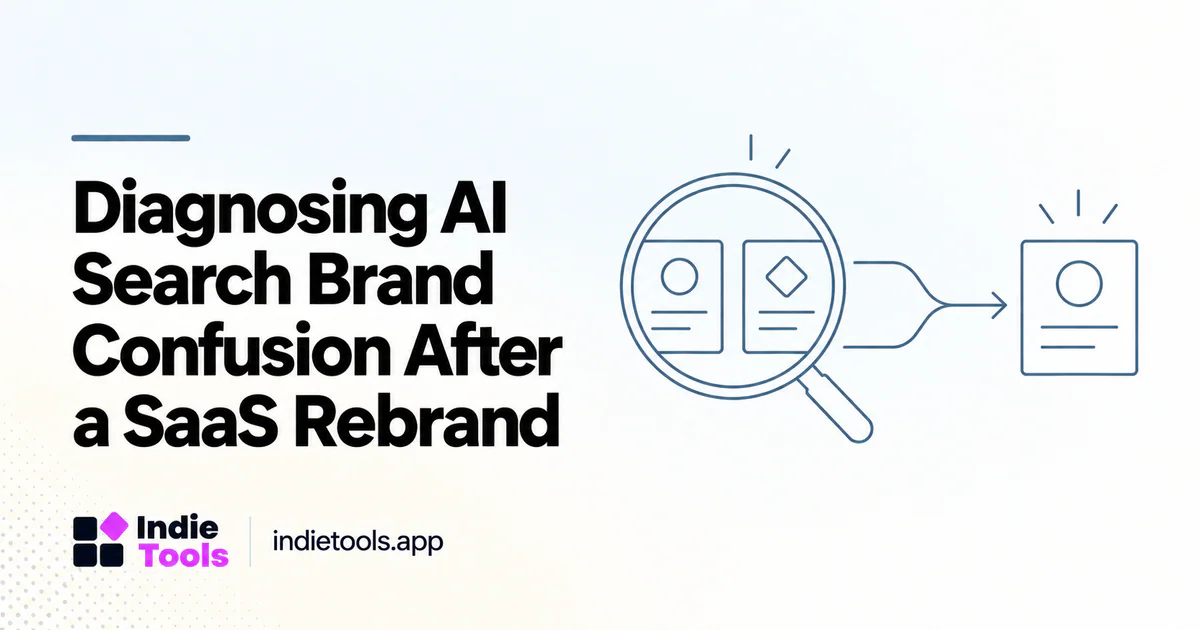
When an answer engine confuses a renamed SaaS product with its former brand or an unrelated company, begin by checking the public evidence trail. The problem may involve stale pages, conflicting listings, an incomplete domain migration or an ambiguous name rather than a missing optimization trick.
A diagnosis should separate the types of confusion and fix the underlying records. Repeating the new brand name across many low-value pages is not a substitute for a coherent identity and migration history.
Capture the error precisely
Record the question, service, date, language and cited URLs. Distinguish an outdated product name from a wrong company, obsolete feature or incorrect domain. Those errors may require different corrections.
Keep the complete context when possible. A historical question may correctly use the former name, while a current purchasing question should point readers toward current information. Do not label every appearance of the old brand as a failure.
Publish a clear transition statement
On the official website, explain that the product was renamed and identify the current name and destination. Include the effective date and clarify whether the change also affects the company, account access or available features.
A short factual statement is usually better than an elaborate narrative that leaves the relationship uncertain. Maintain it long enough to help readers following old references. Do not imply that unrelated products with similar names are part of the same business.
Audit redirects and canonical destinations
When URLs change, map meaningful old pages to the closest relevant new pages. Google's site-move documentation provides guidance on redirects, canonical signals and migration monitoring. [1]
Avoid redirecting every old URL to an unrelated homepage when an equivalent destination exists. Check important product, pricing and documentation routes, including links used by directory listings. Record errors and redirect chains so corrections are based on observed behavior rather than assumptions.
Update external records by importance
Review the directories, social profiles and integration pages that a prospective customer is likely to encounter. Prioritize the official URL, product name and core description. Preserve account ownership and product history rather than creating unnecessary duplicate listings.
For an IndieTools listing, the desired editorial outcome is one accurate product record connected to the current public destination. This is a maintenance recommendation, not a claim about an automatic transfer or rename feature. Verify the available account workflow before making changes.
Keep historical evidence without maintaining contradictions
An old release note can remain historically accurate if it clearly belongs to an earlier period. A current pricing page using the former name and obsolete terms is a different problem. Label history as history and update active decision pages.
Use consistent titles and visible headings to identify the current page. Google's title-link guidance recommends descriptive titles that represent the content. [2] Do not fill titles with both brand names repeatedly when one concise transition explanation would be clearer.
Recheck the same observations
After correcting the public records, repeat the original diagnostic questions under comparable conditions. Track whether cited destinations and factual answers change, but do not promise an immediate correction across every system.
Also watch actual referrals and support questions. Fewer visitors reaching the wrong domain or asking whether the product still exists may be more actionable than a single favorable AI answer. Keep crawl access, search observations and customer behavior as separate evidence streams.
Frequently asked questions
Should the old domain be deleted immediately?
A migration often needs continuity for existing links and users. Plan domain retention and redirects deliberately rather than removing the old destination before the transition is verified.
Can a rebrand erase old search references?
Not instantly or universally. Historical references may remain useful and external systems update on their own schedules. Focus on accurate current information and clear relationships.
Is creating a new directory listing the safest approach?
Not automatically. It may split the product's identity and history. Review whether the existing record can be updated or transferred before creating a second representation of the same product.
Explore related IndieTools resources: product categories and founder updates and releases.
Continue your research
- Backlink Attribution After Changing Domains
- Test Website Speed After a Domain Migration
- Founder Profiles After a SaaS Acquisition
Sources and verification
Sources consulted for this article on October 1, 2026. Product capabilities are documented claims unless an actual test is explicitly described.