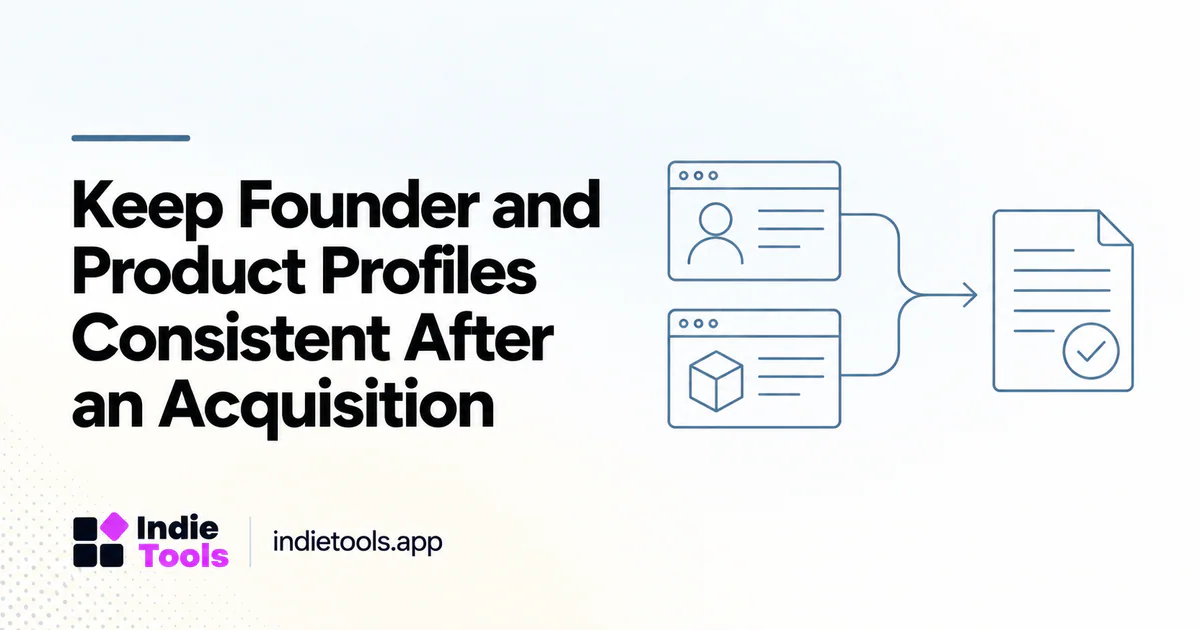
After a SaaS acquisition, update the product's current ownership and contact information without rewriting its history. The founder who originally built the product, the current owner and the team responsible for support may be different people or organizations.
A clear profile should preserve those distinctions. This article addresses public information maintenance, not legal transfer requirements or a substitute for the parties' contractual and professional advice.
Inventory the public records before editing
List the official website, directory profiles, founder pages, social accounts, support destinations and documentation links. Record who controls each account and which information is currently displayed.
Prioritize records that affect trust or access. A support address pointing to a former owner can create immediate confusion, while an outdated biographical sentence may be less urgent. Do not assume that transferring a domain automatically transfers every external profile.
Separate founding history from current responsibility
Use precise labels such as founder, current owner or maintainer when the facts support them. A sale does not mean the new owner originally created the product, and preserving the original founder's contribution does not imply that they still provide support.
An illustrative public note might say that the product joined a new owner on a stated date while retaining its name and service. Include only verified information approved for disclosure. Avoid publishing private transaction terms merely to make the announcement more detailed.
Verify account changes through the proper process
Use each platform's authorized transfer or support workflow. Do not share passwords casually, impersonate the previous owner or assume that a public profile proves authority to modify a record.
For an IndieTools product, verify the available account and support process before changing ownership-related information. The site's public pricing information describes product and founder presence, but it should not be treated as documentation of every transfer operation. [1]
Keep product identity stable where appropriate
An ownership change does not necessarily require a new product listing. Creating another record can split release history, references and discovery context. Review whether the existing public identity can be maintained accurately.
If the product also changes domain or name, treat that as an additional migration task. Map old destinations to relevant new ones and verify important links. Google's site-move guidance provides technical considerations for URL changes, separate from the business transaction. [2]
Review promises that may have changed
Check support commitments, integrations, pricing descriptions and screenshots against the current service. Do not assume a previous listing remains accurate merely because the product name did not change.
Historical articles may remain valuable when they are clearly dated and describe the earlier state. Active product pages should reflect the current offering. When an old endorsement or founder quote is retained, preserve its context rather than presenting it as a statement by the new team.
Publish a useful transition update
Explain what users need to know: where support lives, whether their access changes and which public information is being updated. Do not make assurances about uninterrupted service or future development unless the team can support them.
IndieTools' social area provides a context for founder updates and product announcements. [3] A transition post can direct readers to the maintained product record while leaving a clear historical reference. It should complement, not replace, the underlying profile corrections.
Frequently asked questions
Should the original founder disappear from the product history?
Not automatically. Preserve accurate historical attribution while making current responsibility clear. The appropriate presentation depends on verified facts and the parties' permissions.
Is a new directory listing required after a sale?
Often the same product identity can remain, but the platform's authorized workflow must be checked. Avoid creating duplicates simply because ownership changed.
Which update has the highest priority?
Correct information that affects user access, support and the official destination first. Then align profiles, descriptions and historical context across discovery channels.
Explore related IndieTools resources: product categories.
Continue your research
- AI Search Brand Confusion After a SaaS Rebrand
- Consistent Product Descriptions Across Directories
- Turn Release Notes into Useful Directory Updates
Sources and verification
Sources consulted for this article on October 1, 2026. Product capabilities are documented claims unless an actual test is explicitly described.