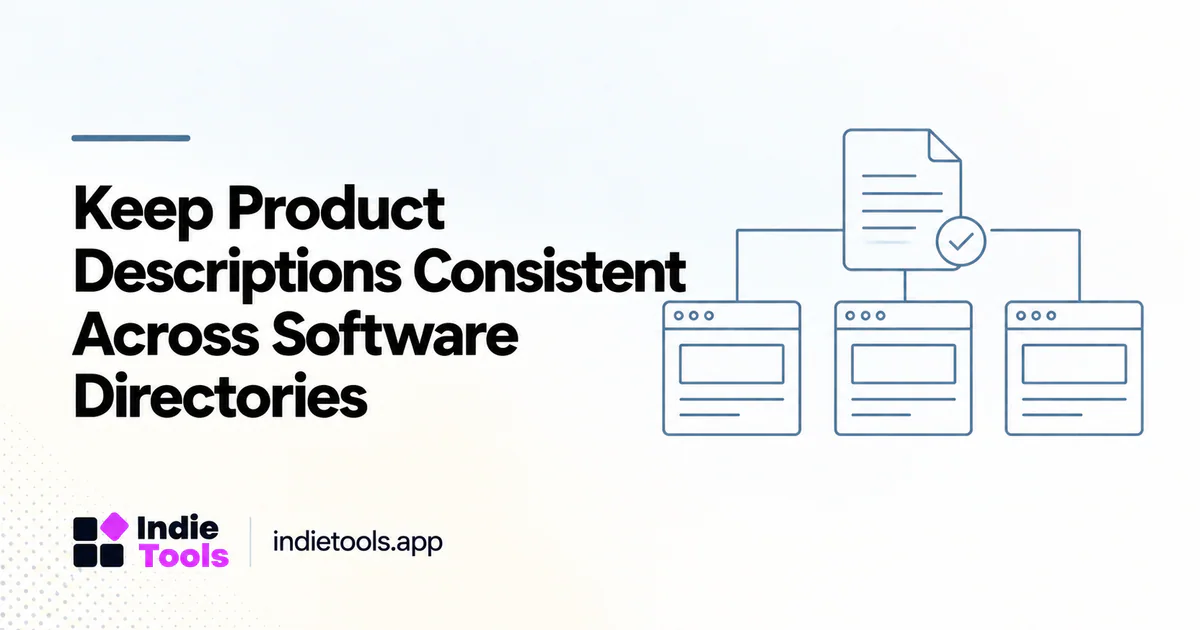
Consistent product descriptions should preserve the same facts across directories without requiring identical copy everywhere. The product name, official URL, core workflow and material limitations should agree, while the explanation can adapt to each audience and format.
This distinction matters for founders maintaining several listings. A short startup directory description, an integration marketplace page and a detailed comparison may need different wording, but they should not describe three different versions of the product.
Create a small source-of-truth record
Maintain a reviewed record containing the current name, official domain, one-sentence purpose, intended users, supported platforms and links to pricing and documentation. Add an owner and last-checked date for fields likely to change.
Keep marketing variations separate from factual fields. A punchier tagline should not overwrite the underlying product definition, and a seasonal offer should not become the permanent price in every listing. This makes future updates easier to apply consistently.
Adapt emphasis without changing meaning
A developer-focused directory may emphasize the API, while a founder community may care more about setup time and the business workflow. Both descriptions can be accurate when they refer to the same capabilities and state relevant conditions.
For an illustrative scheduling product, “schedule release announcements” and “coordinate social publishing for a small team” may describe different angles on the same workflow. “Automates every network without approval” would be a materially stronger claim and should not appear unless current evidence supports it.
Track where the product is listed
Use a listing inventory with the directory name, public URL, account owner, current status and next review date. Record whether the destination leads to the product homepage, a dedicated landing page or a platform listing.
IndieTools provides category-based product discovery and additional technology context. [1] [2] When maintaining an IndieTools record, choose the relevant category and reported technologies carefully rather than adding loosely related labels to maximize exposure.
Prioritize changes by their impact
Correct a broken URL, discontinued feature or misleading price before polishing a tagline. Next, update screenshots and descriptions that no longer match the main workflow. Minor tone differences are less urgent than contradictions that can cause a visitor to make the wrong decision.
Create an update trigger for a rename, acquisition, major pricing change or platform migration. A recurring review is useful, but event-driven updates prevent important corrections from waiting until the next calendar reminder.
Keep claims traceable
A directory description should link readers toward current product evidence, not become the sole authority for a sensitive or complex claim. Assertions about security, compliance or legal suitability need appropriate substantiation; a short marketing field is not a substitute for that review.
For ordinary feature claims, preserve the supporting documentation URL in the internal record. When the source changes, a reviewer can identify which listings may need correction. This is more reliable than searching for every variation of the old sentence by memory.
Evaluate consistency through reader questions
Ask someone unfamiliar with the product to compare two listings and the official page. Can they identify the same product, explain its main task and understand the key conditions? If the answers differ, locate the underlying factual mismatch.
Do not treat copied wording as proof of quality or assume duplicate descriptions automatically create a ranking penalty. The practical objective is accurate distribution. Google's people-first content guidance supports making pages useful and reliable rather than rewriting information solely to satisfy imagined ranking rules. [3]
Frequently asked questions
Should every directory use the same description?
Use consistent facts, not necessarily identical sentences. Adapt length and emphasis to the reader while retaining the product's identity and limitations.
Which listing should be corrected first?
Prioritize errors that misdirect visitors or change a purchasing decision: domain, availability, pricing conditions and discontinued capabilities.
Does consistent wording guarantee AI recognition?
No. Clear identity and evidence reduce avoidable ambiguity, but a publisher cannot guarantee how an external system will retrieve or summarize the product.
Continue your research
- Product Facts AI Search Can Verify
- AI Search Brand Confusion After a SaaS Rebrand
- Multiple Domains, One Product: Duplicate Listings
Sources and verification
Sources consulted for this article on October 1, 2026. Product capabilities are documented claims unless an actual test is explicitly described.