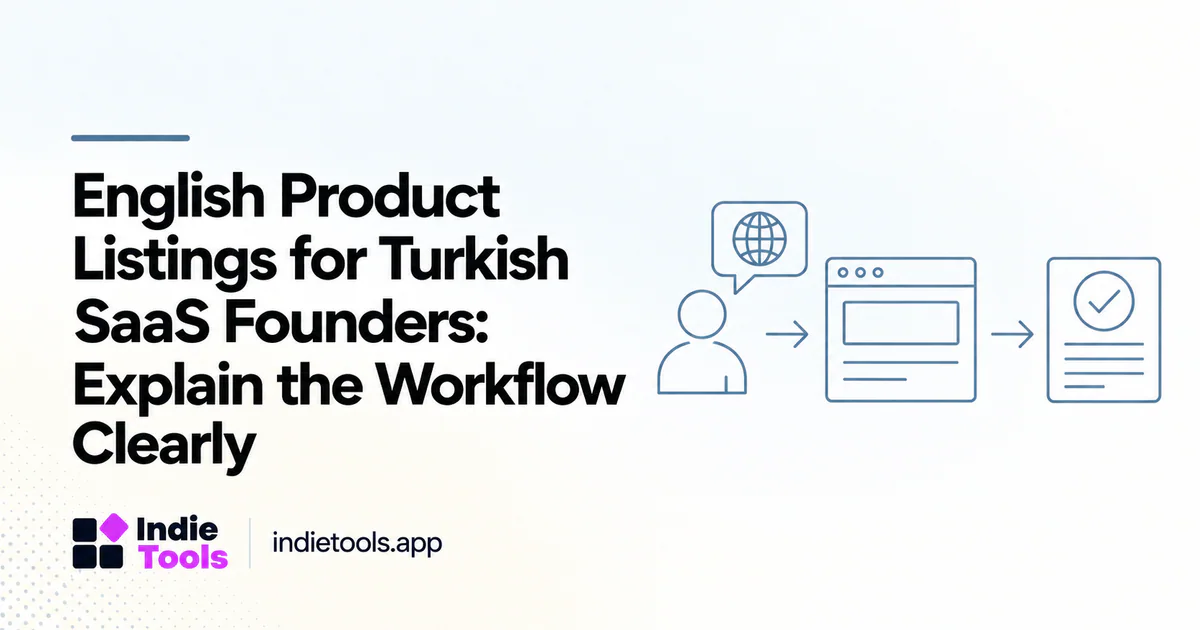
An effective English product listing explains who the software helps, what task it performs and what the user gets at the end. Turkish founders do not need to hide their identity or imitate an enterprise brand voice. They need accurate, readable product information that an international buyer can understand without local context.
The most useful editing exercise is to replace broad claims with a concrete workflow. That improves the description for both human readers and systems trying to identify what the product actually does.
Lead with the task and audience
Avoid starting with a sentence such as “We are an innovative technology solution that empowers digital transformation.” It does not identify the product category or the buyer's problem.
A fictional but more useful example is: “A shared inbox for small SaaS teams that turns customer emails into assigned support conversations.” The sentence identifies the audience, input and workflow. It does not claim that the tool is the best or that it produces an unmeasured business result.
Translate meaning rather than sentence structure
Some phrases that sound natural in Turkish become formal or ambiguous when translated directly. Review whether the English description sounds like a product explanation rather than a company introduction. Prefer the term the intended user would use for the task.
Keep established technical names when they are the clearest choice. Explain unfamiliar abbreviations on first use. A founder should not have to simplify the product inaccurately, but the reader should not need a glossary to understand the opening paragraph.
Use a practical description pattern
A short listing can follow this sequence: audience and task, core workflow, important limitations and next step. Expand only the parts that help a buyer decide whether to investigate further.
For an illustrative invoice-reminder tool, the body might explain how a user imports due dates, schedules reminders and reviews delivery status. It should also state whether sending email requires connecting an external service. That dependency is more useful than an unsupported claim that the tool “automates all finance operations.”
State language support precisely
Separate the marketing site's language, application interface, documentation and support. “English interface and documentation; Turkish and English email support” gives a reader something concrete to evaluate. Do not use “multilingual” when only the homepage has been translated.
If international visitors reach a Turkish-only onboarding flow, tell them before they click. A mismatch between listing language and the actual product experience can create avoidable confusion even when the product itself is useful.
Present country information without overclaiming
IndieTools' country selection is founder-reported, not verification of incorporation, hosting or availability. [1] Use it as a discovery attribute and keep any business or infrastructure claims tied to appropriate official information.
A Turkish founder can build a product for a global audience. The listing should explain that audience directly instead of relying on a country tag to imply either local-only or worldwide availability. Verify any supported-region statement before publishing it.
Check the destination and supporting evidence
Open the official link while logged out and on a mobile device. The page should reinforce the same product name, description and next action. A clear listing cannot compensate for a destination that is unavailable or explains a different offer.
Use screenshots that show the promised workflow and captions that explain what is visible. Avoid exposing real customer information. When quoting a customer or reporting a result, obtain the necessary permission and provide enough context to keep the claim accurate.
Questions before submitting the listing
Should the founder's Turkish identity be removed for international appeal? No. Focus on clarity and relevance rather than hiding accurate information.
How many English keywords should the description contain? Use the main task and natural related terms where they help explain the product. Repetition is not a substitute for a clear description.
What should the final review ask? Can a reader identify the audience, task, output and important limitation after one careful read? When the answer is yes, the listing is ready for factual and platform-rule review—not an automatic promise of search traffic.
Explore related IndieTools resources: product categories.
Continue your research
- SaaS Product Localization: A Listing Checklist
- Consistent Product Descriptions Across Directories
- Product Listing Screenshots That Explain the Task
Sources and verification
Sources consulted for this article on October 1, 2026. Product capabilities are documented claims unless an actual test is explicitly described.