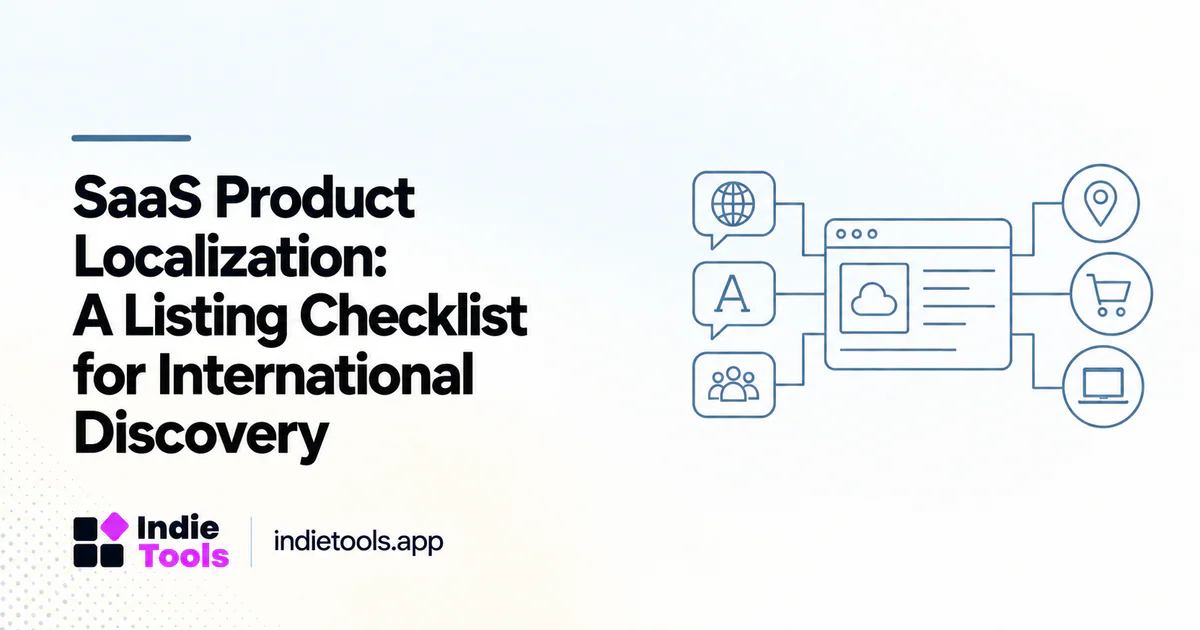
Localize a SaaS listing by helping the intended audience understand the same real product in their own context. Translation is part of that work, but the listing also needs accurate terminology, current availability and a clear path to the appropriate product experience.
The objective is not to produce a different promise for every market. It is to preserve the facts while removing unnecessary language and context barriers. A localized description should remain consistent with the interface, documentation and support the customer will actually receive.
Create a source-of-truth description
Before translating, write a concise description of the audience, core task and output. Define ambiguous terms and remove slogans that do not explain the product. A weak source description becomes harder to correct after it has been distributed in several languages.
Keep a glossary for feature names, plan names and technical terms. Mark names that should remain unchanged. This helps reviewers distinguish intentional branding from a translation error and reduces contradictory descriptions across directories and landing pages.
Localize the workflow, not just the headline
Explain examples that make sense to the intended reader without inventing local capabilities. A project-management tool may use a more familiar example organization, but it should not imply a local billing integration that the product does not support.
Check screenshots and captions together. An English screenshot inside a translated listing can be acceptable when clearly described, but the page should not imply that the interface is fully localized when it is not. State partial language coverage honestly.
Separate language from regional targeting
Google distinguishes multilingual sites from sites targeting multiple regions. [1] That distinction is useful for your content planning even before technical implementation. A Spanish-language description is not automatically specific to one country, and a country collection is not automatically a translated edition of a category page.
For your own website, use a deliberate language and region structure. For third-party listings, follow the platform's language rules and link to a destination that matches the description when one exists. Do not create duplicate product identities merely to store translations.
Verify availability statements
Review payment methods, supported languages, service regions and support coverage against current provider information. These fields can change independently. A product may accept a currency without offering support in the language commonly associated with that currency.
Use explicit wording. “English interface with Turkish email support” is more informative than “fully international.” Keep the statement narrow enough that a reader can understand what is included without needing to interpret a marketing phrase.
Review with someone who understands the task
A fluent translation can still use the wrong product terminology. Ask a reviewer familiar with the workflow to read the listing and describe what they believe the tool does. Compare that interpretation with the source-of-truth description.
An illustrative review could identify that a translated word suggests accounting software when the product only tracks expenses. Correcting this mismatch improves discovery quality because the page is less likely to attract people looking for an unsupported function.
Maintain translations after releases
Assign a version or review date to the source description. When a feature changes, identify which translations depend on it. Do not update the English listing and assume the rest will remain accurate indefinitely.
Keep the update process proportional to the number of markets. A small set of well-maintained listings is more useful than many abandoned translations. Archive or revise outdated material rather than changing only the displayed date to create the appearance of freshness.
Questions about international listings
Should every product be listed once per language? Prefer one product identity with supported language variants where the platform permits them. Avoid duplicate records for the same offering.
Can machine translation help? Yes, as a drafting aid followed by terminology and product-fact review. It should not invent capabilities or local availability.
How does IndieTools fit the workflow? Its country and category discovery can complement your official localized pages. Treat those as different dimensions and keep the product's core identity consistent across both. [2]
Explore related IndieTools resources: product categories.
Continue your research
- English Product Listings for Turkish SaaS Founders
- Country-Specific SaaS Pages: When They Add Value
- Consistent Product Descriptions Across Directories
Sources and verification
Sources consulted for this article on October 1, 2026. Product capabilities are documented claims unless an actual test is explicitly described.