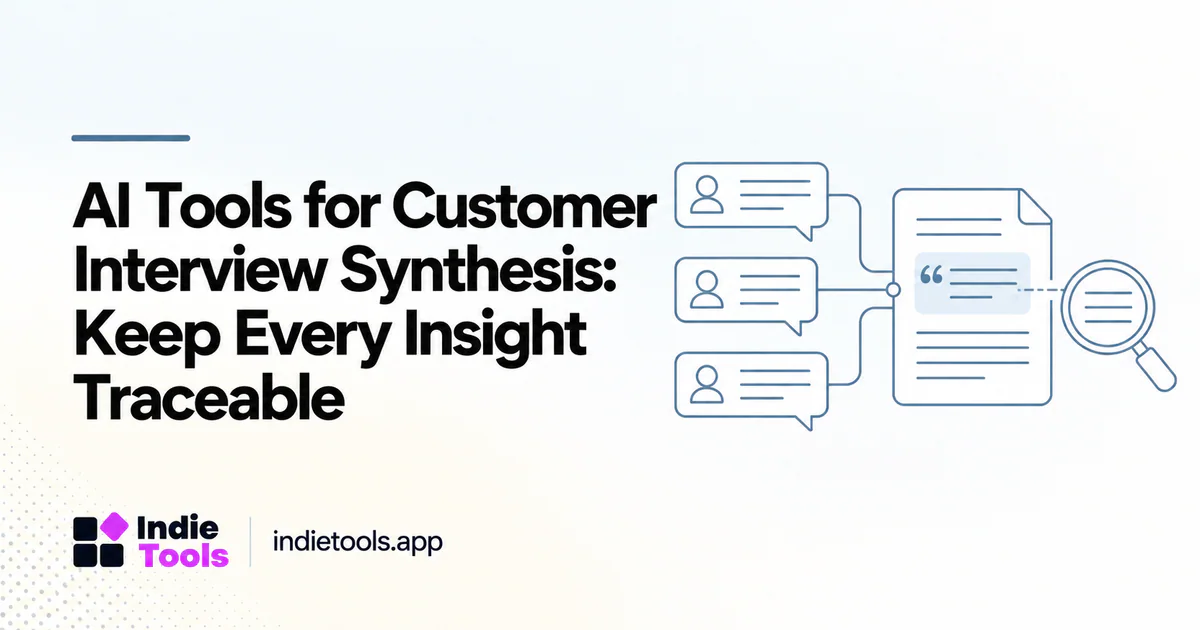
Choose an AI customer interview synthesis tool by testing whether its conclusions can be traced back to the original evidence. A fast summary is useful only when a product team can inspect the quote, understand the context and distinguish repeated customer needs from a persuasive one-off comment.
This guide focuses on the workflow between a recorded interview and a product decision. It is not a hands-on ranking of vendors. IndieTools' AI and productivity categories can help you discover candidates; the evaluation below helps you decide which ones deserve a trial. [1]
Define what needs to be synthesized
Separate three jobs: transcription, organizing evidence and interpreting findings. A transcription tool may produce readable text but offer little support for comparing interviews. A research repository may preserve evidence well but require a separate recording workflow. A general AI assistant may summarize pasted text while leaving source management to your team.
Write down the output you actually need. For a pricing investigation, that might be a list of objections grouped by customer segment, each supported by a quote and a link to its source. “Give us insights” is too vague to test reliably.
Shortlist by evidence workflow
Dovetail describes AI Projects as a workspace for transcribing and summarizing research, creating clips and organizing findings with tags and fields. [2] That makes it a relevant example of a repository-centered approach, rather than proof that it is the right choice for every small team.
When evaluating another product, look for the same workflow boundaries. Can a researcher correct the transcript? Does the correction affect later summaries? Can a teammate open the underlying passage? Can findings be exported without losing the connection to evidence? Record answers from current documentation and a trial, not from a feature label alone.
Create a small, deliberately difficult test set
Use a few interviews you are authorized to process. Include one enthusiastic participant, one dissatisfied participant and one interview with ambiguous language. Remove unnecessary personal information before upload and check the provider's data handling terms against your requirements.
Ask every candidate the same question. For example: “What prevented these participants from completing setup, and what evidence supports each explanation?” Then compare the output with a human review. The aim is not to see which tool writes the most fluent paragraph. It is to find missing evidence, invented certainty and misplaced emphasis.
Score findings, not writing style
An illustrative evaluation sheet can assess traceability, coverage, contradiction handling and editability. A finding earns credit for a valid source connection, not simply for sounding plausible. A tool should preserve the difference between “one participant asked for this” and “this was a recurring problem.”
Also test negative evidence. If several participants explicitly say that price was not the obstacle, a synthesis should not recast every hesitation as a pricing objection. Keep the review criteria visible so the team can challenge the result instead of accepting a polished summary as authority.
Protect collaboration and retention
Interview research can contain commercial plans, names and customer-specific problems. Check who can view raw recordings, who can share findings and how material is deleted. A public presentation of insights may need a different permission boundary from the original research workspace.
Test the exit path before committing. Export a transcript, a tagged finding and a source reference. Open them outside the product. A system that saves time this month but traps the evidence in an unusable format can create a difficult migration later.
Turn synthesis into a decision record
A useful deliverable contains the question, participant scope, findings, supporting evidence, contradictory evidence and the decision made. Add an owner and a review date when the decision depends on information likely to change.
For example, a team might choose to simplify account setup because several interviews identify the same confusing step. The record should still explain that this is qualitative evidence from a specific sample, not a measured percentage of all customers. That distinction keeps the result useful without overstating it.
Common buying questions
Can an AI tool replace customer research? It can assist with processing and retrieval, but your team still needs to define the question, recruit relevant participants and judge the evidence.
Should a solo founder buy a full repository immediately? Start with the smallest workflow that preserves sources and permissions. Add more tooling when the volume or collaboration problem is real.
What should decide the purchase? A successful trial using your own research question, plus acceptable data handling and export behavior. Use product discovery to build the shortlist, then let evidence quality decide.
Explore related IndieTools resources: reported technology collections.
Continue your research
- Customer Feedback Tools: Requests to Releases
- OpenAI-Powered SaaS: Compare the Workflow
- Product Facts AI Search Can Verify
Sources and verification
Sources consulted for this article on October 1, 2026. Product capabilities are documented claims unless an actual test is explicitly described.

 Pushable AI
 99helpers