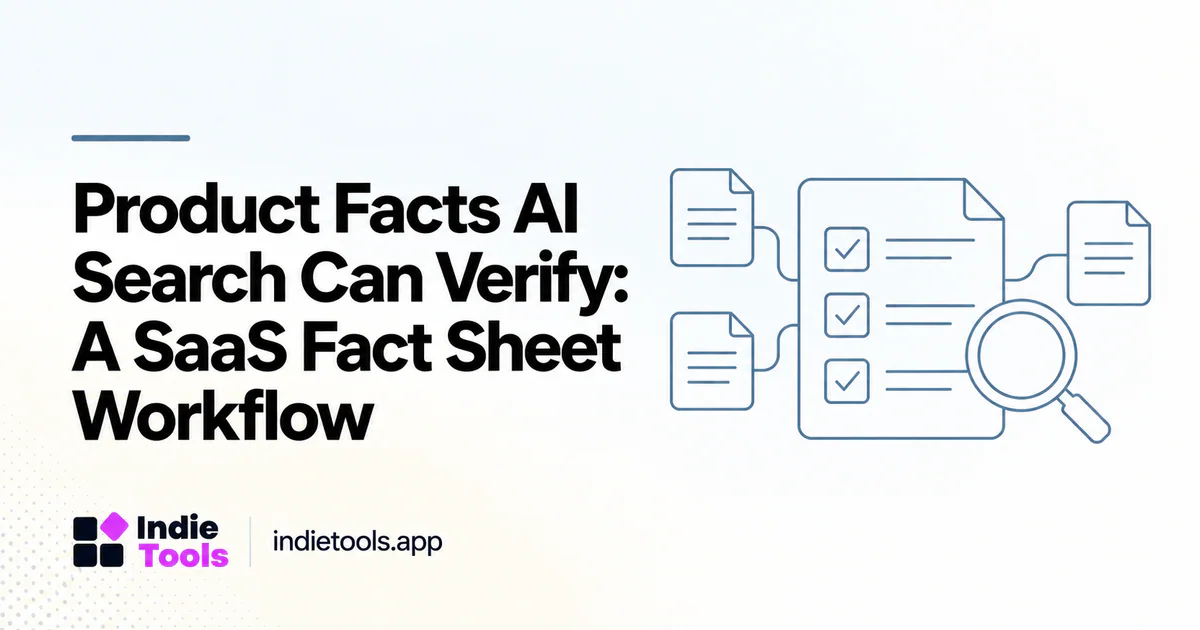
An AI-search-ready product description should make important facts easy for a reader to verify: what the software does, who it serves, where it runs, what it costs and which limitations apply. The goal is a trustworthy product record, not a block of instructions telling an assistant to recommend the company.
For a SaaS founder, this starts with an ordinary editorial problem. Marketing pages, documentation and directory listings often describe the same product differently. Before adding another content format, establish which claims are current and where their supporting evidence lives.
Write an identity statement before a feature list
Use a specific opening sentence that identifies the product category, intended user and core task. An illustrative example is: “Fieldboard is a web application that helps small support teams turn customer requests into a shared release queue.” Fieldboard is fictional; the sentence demonstrates a structure rather than describing a listed product.
That statement is more informative than “the ultimate AI-powered growth platform.” A visitor can decide whether the product is relevant without interpreting several abstract promises. Keep the public product name and official domain beside the description so similarly named tools are easier to distinguish.
Build a claim-to-evidence table
Create an internal fact sheet with one row per claim. Useful columns are the fact, its scope, its evidence URL, the date checked and the person responsible for updates. An integration claim might point to current documentation, while a pricing claim should point to the actual pricing page.
Distinguish “supports an integration” from “the integration is included in every plan.” Likewise, a web application is not necessarily a native mobile application merely because it opens in a phone browser. State uncertainty explicitly when the available source does not resolve it.
Preserve the difference between facts and evaluation
Facts include supported export formats and whether a public API exists. Evaluations include ease of use, suitability for a particular team and whether a price represents good value. An evaluation can be useful, but it needs a stated scenario and supporting reasoning rather than a fabricated objective score.
IndieTools separates product discovery into categories and technology collections. Use those collections to find relevant context, while checking a product's own documentation for implementation details. A listed technology is a clue for research, not proof of a particular production architecture. [1] [2]
Publish meaningful limitations
A fact sheet should explain the conditions that change a purchasing decision. Examples include a feature available only on a particular plan, an export that excludes attachments, or a language supported in the interface but not in customer support.
This does not require a lengthy disclaimer after every sentence. Place the qualification where it matters. A pricing table can carry the billing interval; an integration section can identify the required account; an availability statement can distinguish public release from private beta.
Keep human and machine-readable versions aligned
A public HTML page should remain understandable on its own. Structured data or a machine-readable catalog should describe the same product rather than introduce hidden features, invented reviews or different prices. Google's structured-data policies require represented content to be accurate and consistent with what users can see. [3]
For a proposed IndieTools content workflow, the fact sheet could feed the product page, directory summary and comparison table from one reviewed record. This is an implementation recommendation, not a claim that every existing field already shares that architecture.
Test the record with concrete questions
Ask a reviewer to answer five questions using only the public evidence: What does the product do? Who is it for? What does the quoted price include? Which platforms are supported? What limitation could rule it out?
Record missing answers and ambiguous wording. Fix those problems at the source instead of producing many near-identical articles. The result is useful even when no answer engine cites it: prospective customers receive a clearer explanation and fewer contradictory claims.
Frequently asked questions
Should the fact sheet include competitor names?
Only where a real comparison is useful. Explain the specific workflow difference and provide current evidence rather than adding unrelated brand names for visibility.
Can an AI-generated description replace evidence?
No. A generated summary can organize verified information, but its wording does not establish that a product feature exists.
Does a fact sheet guarantee AI citations?
No. It improves the quality and consistency of available information. Whether a system retrieves or cites a page remains outside the publisher's control.
Explore related IndieTools resources: IndieTools MCP catalog documentation.
Continue your research
- Consistent Product Descriptions Across Directories
- Data Tables Humans and Answer Engines Can Read
- MCP Product Catalogs vs Search-Indexed Pages
Sources and verification
Sources consulted for this article on October 1, 2026. Product capabilities are documented claims unless an actual test is explicitly described.