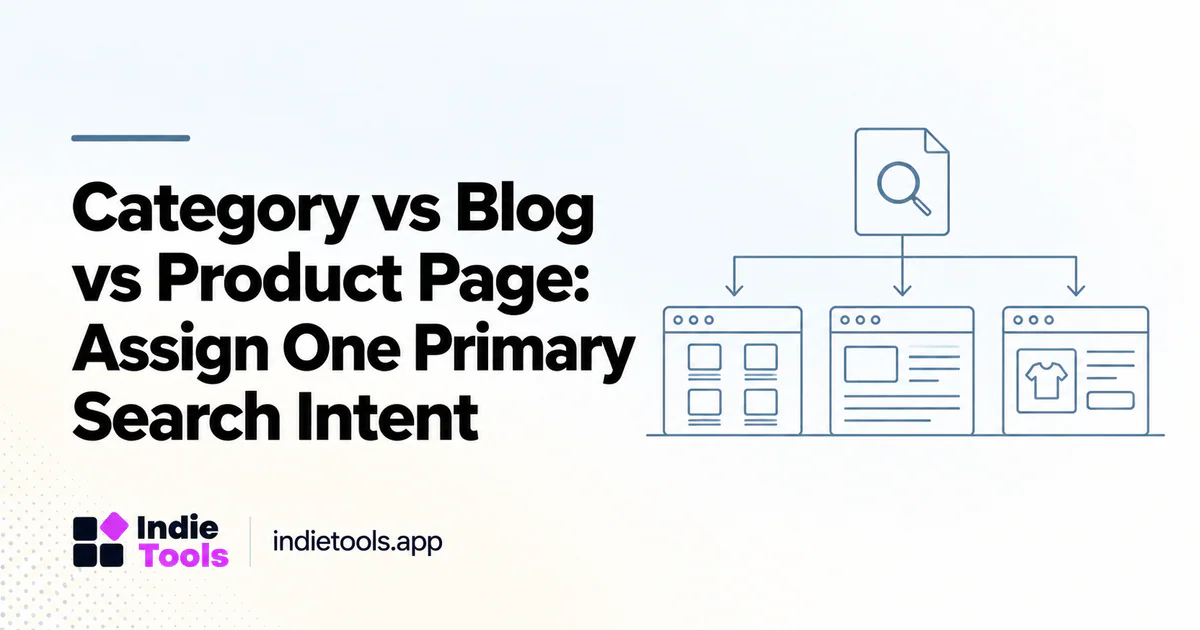
Assign a primary search intent to the page that can satisfy it most directly. A product page, category collection and blog guide can all mention the same topic, but they should not be interchangeable versions of the same answer.
For a software directory, this distinction keeps the architecture understandable. Readers looking for options need a useful collection; readers researching one product need its details; readers trying to solve a task need an explanation. The right page type follows the user's job, not the convenience of the publishing system.
Describe the query as a task
Translate the search phrase into what the visitor is trying to do. “API documentation tools” suggests exploring options. “How to test API documentation” suggests a workflow guide. A named product query may call for current product facts and official links.
These are qualitative intent hypotheses until they are checked against actual search results and site performance. Avoid treating a keyword spreadsheet as proof of demand. Volume, ranking difficulty and the site's existing query ownership require their own evidence.
Give the collection a clear role
A category page should help readers discover and narrow relevant products. Its introduction can define scope, but a large generic essay should not bury the actual options. Filters, useful summaries and clear product links usually support the collection's job better than repeated keyword paragraphs.
IndieTools' category structure provides a natural discovery layer. [1] A supporting article can explain how to evaluate the products without pretending to be another version of the same category landing page.
Let product pages own product-specific facts
The product page should be the durable place for the offering's identity, official destination and current public facts. Supporting articles may discuss it, but they should not become disconnected copies of the entire product record.
When a fact changes, a shared structured source can reduce contradictions. A comparison still needs editorial review because a changed fact may alter its reasoning. The goal is one maintained factual base, not a rigid rule that a product can only be mentioned on one URL.
Use guides for decisions and tasks
A guide should provide something the collection does not: a test plan, a decision framework, an explanation or a sourced analysis. “How to validate AI referral traffic” can complement an analytics category because it teaches a specific evaluation task.
Avoid creating near-identical articles for synonyms when the desired outcome is the same. “Best tools for indie founders” and “top tools for solo makers” may require one stronger page rather than separate generic lists. Confirm the distinction before assigning two primary keywords to two drafts.
Build a query-ownership map
Record the primary query family, intended reader task, preferred URL and supporting pages. Keep broad category terms and narrow implementation terms separate. Add a note explaining why each supporting page exists.
An illustrative row might assign “website speed leaderboard” to the live speed collection and “how to interpret leaderboard ties” to a guide. The guide should link to the collection at the point where the reader needs current results, rather than reproducing an undated ranking.
Diagnose overlap with evidence
When two pages appear to compete, inspect their content and actual query performance before merging them. Similar wording does not automatically mean one should be deleted. The pages may serve different stages or audiences.
If they are genuinely duplicates, choose a consolidation approach based on content equivalence and URL history. Google's canonical guidance concerns duplicate or very similar pages; it is not a substitute for deciding which distinct editorial page should answer a query. [2]
Questions about intent ownership
Can a category page contain editorial text? Yes, when it helps readers understand and use the collection rather than delaying the promised discovery task.
Can a blog post rank for a category-like query? It can, but the architecture should still reflect the page's actual purpose and evidence, not an assumption about a guaranteed search outcome.
What is the first practical step? Map existing pages before commissioning more content. Assign the broad query family to its strongest suitable page and give each new guide a clearly different task to perform.
Explore related IndieTools resources: reported technology collections.
Continue your research
- Internal Links Between Products and Guides
- Turn Product Discovery Data into a Content Plan
- Dynamic Software Comparison Pages: A Fair Template
Sources and verification
Sources consulted for this article on October 1, 2026. Product capabilities are documented claims unless an actual test is explicitly described.