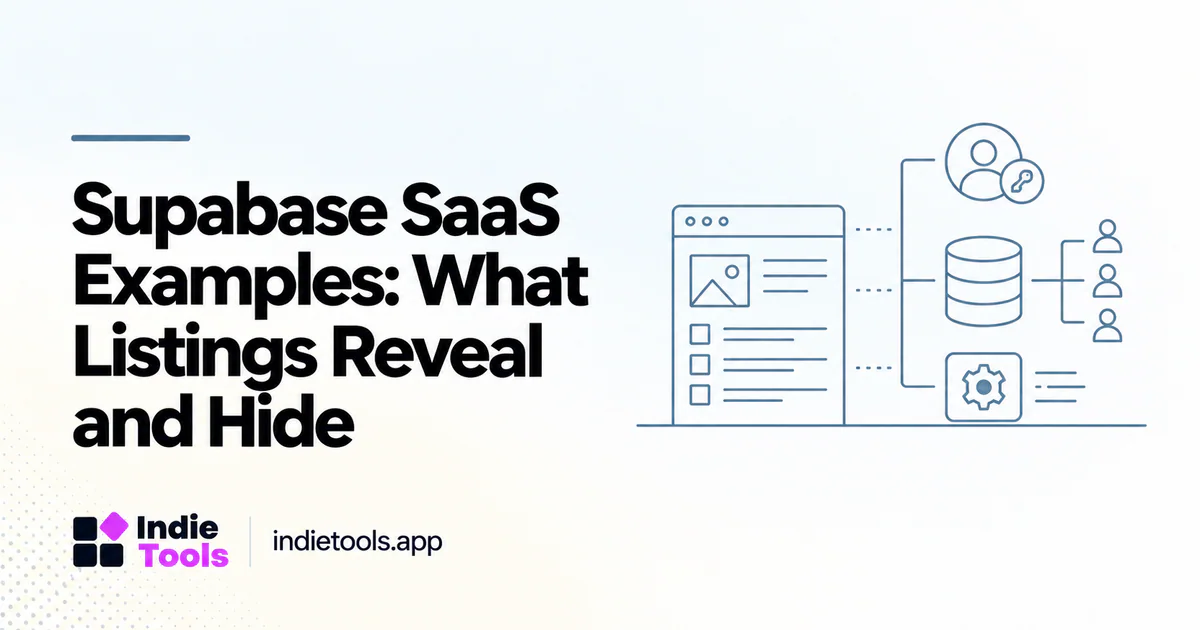
Supabase SaaS examples can help you discover product patterns, but a listing rarely tells you how authentication, data access and background work are implemented. Use the declared stack to identify candidates, then verify the architectural decisions that matter for your own application.
The question is not simply whether a product “uses Supabase.” The useful question is which responsibilities it assigns to the platform and how those responsibilities are controlled.
Read the declaration precisely
IndieTools' Supabase collection lists products including TrackMedia, Holosign and Desk Champ, with technology choices reported through product profiles. [1] That is evidence of a declaration, not an independent audit of each deployment.
A product might use the platform for its database, authentication, storage or another capability. Do not assume every listed feature is enabled, or that the marketing website and application use the same backend. Keep the provider's published details attached to the specific claim they support.
Map the data boundary
Write down who should be able to read and change each kind of record. Separate public content, individual user data and organization-level data. Identify the trusted server operations and the requests made directly from a client.
Supabase's documentation explains Row Level Security for controlling access to database rows. [2] A public technology label cannot prove those policies are correctly implemented. Any security-sensitive decision needs its own design review and authorized testing.
Ask operational questions
Investigate how schema changes are deployed, how backups are verified and how a failed job is retried. Determine which parts of the application continue working when an external dependency is unavailable. These questions remain important even when a platform simplifies initial development.
Do not infer a product's operating cost from the public number of users or its appearance. Workload, storage, traffic and configuration can differ substantially. Use your own expected workload and current provider terms when building a cost model.
Study a representative workflow
Choose an example that resembles your product's data access. A private document workflow, public leaderboard and team tournament tool have different permission and update patterns. Write a small scenario that represents the records and roles your application needs.
An illustrative test might create two synthetic organizations, add records to each and verify that normal application operations cannot cross the intended boundary. Run such tests only in systems you own or are authorized to assess. The point is to validate your design, not to probe another listed product.
Separate convenience from portability
Document where the application depends on platform-specific APIs and where it uses more general database interfaces. This does not make one choice automatically better. It makes the migration and maintenance tradeoff visible.
Try exporting representative data and recreating a development environment before the project becomes large. Include relationships and file references, not just a flat table. A successful export should preserve the information needed to continue operating the product.
Use IndieTools for focused discovery
Filter candidate examples by category and workflow, then visit the provider's own documentation. The directory helps reduce the search space; it cannot replace a technical requirements review. Save the date of each observation because stacks and platform features can change.
For a public comparison article, distinguish “listed as using Supabase” from “we verified this architecture.” That wording protects readers from treating a useful discovery page as a security or scalability certification.
Does a Supabase label prove a product is secure? No. Security depends on implementation, configuration and operations.
Should every SaaS copy a successful example's backend? No. Similar public interfaces can conceal very different workloads.
What should a founder learn from examples? Which product workflows are worth exploring, which architectural questions to ask and which assumptions to test in a small prototype. The final stack decision belongs to your own requirements, not to the popularity of a label.
Explore related IndieTools resources: reported technology collections.
Continue your research
- PostgreSQL SaaS Examples: Questions to Ask
- Payment Provider Stacks: What Founders Disclose
- Analyze Technology Adoption in a Product Directory
Sources and verification
Sources consulted for this article on October 1, 2026. Product capabilities are documented claims unless an actual test is explicitly described.