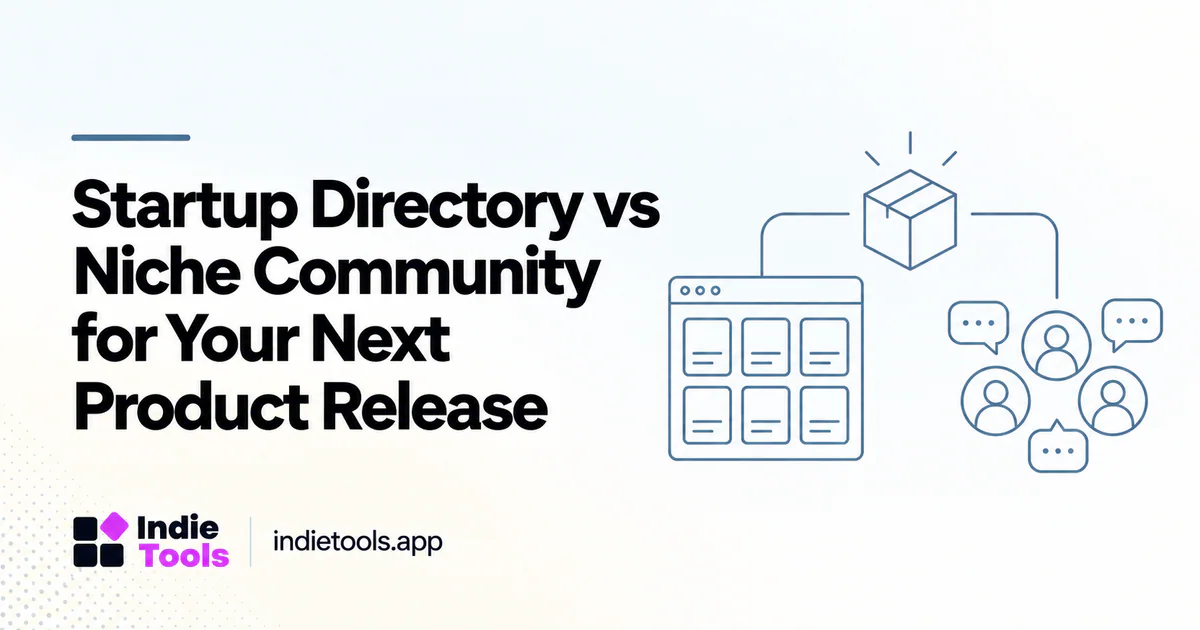
A startup directory and a niche community can support different parts of product discovery. A directory helps people browse structured product information; a community can provide contextual discussion with people who share a problem. The right choice depends on the release, audience and work the founder can sustain.
This is not a ranking of every platform. It is a decision framework for choosing the next distribution action without treating all public attention as equally valuable.
Start with the release's information needs
A familiar tool category with a clear workflow may be easy to explain through a concise listing and screenshots. A new approach that challenges how a team works may need discussion, examples and answers to objections.
Write down what a prospective user must understand before trying the product. If the explanation requires a nuanced conversation, a static listing alone may not be enough. If the product is straightforward but difficult to find, a relevant directory can provide useful browsing context.
Evaluate audience fit rather than headline size
A large audience is not necessarily the right audience. Look for products, questions and terminology related to the problem being solved. Do not assume that every founder community contains the buyers of every founder-built product.
IndieTools organizes discovery through product categories and technology collections. [1] [2] Those structures can help identify relevant context, but a category count does not reveal the purchase intent or size of the audience viewing a particular listing.
Compare the effort each channel requires
A directory submission may involve preparing a stable product record and keeping it current. A community conversation requires participation, timely replies and respect for local norms. Neither channel is entirely “set and forget.”
Choose an action that the team can support. Posting a complex release in a discussion space and disappearing when users ask questions can undermine the usefulness of the announcement, even when the initial post receives attention.
Match the message to the format
A listing should quickly identify the product, intended user and task. A community post should explain the problem and contribute something useful to the discussion. Avoid pasting the same promotional paragraph into every context.
IndieTools also has a social area for founder updates and releases, so its directory and conversational surfaces can complement one another. [3] A persistent product page can hold current facts while a release update explains a particular change.
Follow current rules and disclose your role
Before posting in a community, read its current participation and promotional rules. They can differ across platforms and change over time. Do not assume that a launch format accepted elsewhere is appropriate in every group.
Be clear that you are the maker or owner. Avoid fabricated endorsements, coordinated fake engagement and unsolicited mass messaging. A genuine explanation and useful response to feedback are more valuable than making a promotion look like an independent recommendation.
Measure the outcome appropriate to each channel
For a directory, inspect relevant visits, product-page behavior and identifiable outbound actions. For a discussion, also record the quality of questions and whether the conversation exposed a misunderstanding or new use case.
Do not compare comment counts directly with activated accounts. Keep learning and acquisition outcomes separate, then decide whether the next step is a better listing, a follow-up explanation or a different audience. The channels may be complementary rather than mutually exclusive.
Frequently asked questions
Should every release be posted in both places?
Not necessarily. Use both when each adds a distinct benefit and the team can maintain the resulting conversations and product information.
Is a niche community always better for feedback?
No. It depends on who participates and whether the discussion matches the target problem. Relevant users matter more than the channel label.
Can a directory replace an owned product website?
A directory can support discovery, but the official website remains an important place for current product evidence, documentation, pricing and the user's next action.
Explore related IndieTools resources: current IndieTools placement options.
Continue your research
- A 30-Day Post-Launch SaaS Discovery Plan
- Buffer Alternatives for Founder Announcements
- Audit a Startup Directory Before Submitting
Sources and verification
Sources consulted for this article on October 1, 2026. Product capabilities are documented claims unless an actual test is explicitly described.