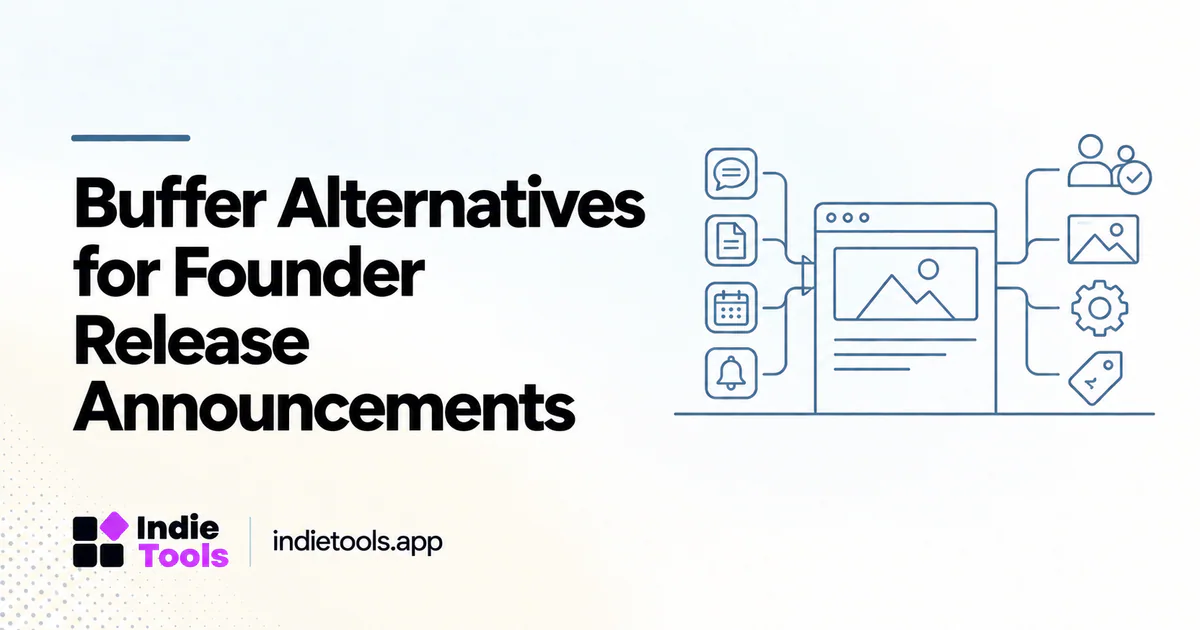
A founder looking for a Buffer alternative should identify the publishing workflow that needs to improve: supported channels, approvals, media handling, automation or operating cost. Replacing a scheduler without naming that problem can create a migration project without improving distribution.
Buffer's own site presents a social publishing platform. [1] This guide does not assume it lacks a feature you need. It provides a way to compare the exact configuration you use with relevant alternatives and a manual workflow.
Describe one release campaign
Choose a real, approved product update and define the intended posts, channels, visuals and destination. Include the person responsible for reviewing replies after publication. A scheduler cannot replace the product knowledge needed to answer questions about a release.
Keep the campaign modest enough to test. A single announcement with a short demonstration and a follow-up explanation can reveal more about the workflow than importing a month of repetitive posts into a trial account.
Compare managed and self-hosted options
Postiz describes managed cloud and self-hosted ways to use its scheduling product, with operational responsibilities differing between them. [2] That distinction matters when a founder is considering self-hosting as an alternative to a subscription.
PostPlanify's IndieTools listing describes publishing and collaboration capabilities. [3] Treat the listing as a discovery source and verify current channel support, plan boundaries and connection requirements directly before a purchase. Neither example is presented here as a hands-on-tested replacement for every Buffer workflow.
Test the channels you actually use
Connect only authorized accounts and inspect the provider's current setup requirements. Test a draft with a link, an image and the formatting relevant to your chosen platform. A tool supporting a network does not necessarily mean it supports every content type in the same way.
Review the final native post after publication. Check cropping, link previews and text formatting. A scheduler preview can help catch problems, but the destination platform is the place where the audience experiences the result.
Evaluate approvals and corrections
For a team, test who can create, approve and publish a post. Change a factual detail after approval and inspect whether another review is required. A workflow that allows a last-minute edit to bypass the intended reviewer can undermine an otherwise useful approval system.
Also test corrections. When a release is delayed or a URL changes, can the team identify scheduled posts that depend on the old information? Keep the canonical release brief separate from adapted social copy so the correction has a clear source.
Account for operating work
Self-hosting can provide useful control, but someone must maintain the application, backups and integrations. Review the provider's deployment guidance and the social platforms' requirements before assuming that a working server completes the setup.
For a managed service, inspect account limits, team access and the features included in the intended plan. Compare the configuration you will actually use. Avoid a headline price comparison that mixes a minimal plan from one provider with a full team setup from another.
Measure the result beyond scheduled volume
Track whether relevant people reach the release page or try the improvement. Use distinct campaign identifiers when appropriate, and keep the meaning of each event clear. A tool that publishes more posts does not automatically produce more useful discovery.
An illustrative pilot can compare the effort required to prepare and review the campaign, the reliability of publication and the quality of follow-up. The outcome may be to keep the current scheduler and simplify the workflow rather than replace the product.
Questions about switching schedulers
Is self-hosting automatically cheaper? Not once maintenance, infrastructure and integration work are ignored. Compare the whole operating model.
Should the same text be scheduled everywhere? Preserve facts but adapt the explanation to the audience and format.
What is the deciding test? A verified release can move from draft to reviewed publication and useful conversation with less friction and no loss of control. Discover alternatives on IndieTools, then test that complete path.
Explore related IndieTools resources: product categories and reported technology collections.
Continue your research
- Social Tools for Repurposing Release Notes
- A 30-Day Post-Launch SaaS Discovery Plan
- Startup Directory vs Niche Community
Sources and verification
Sources consulted for this article on October 1, 2026. Product capabilities are documented claims unless an actual test is explicitly described.