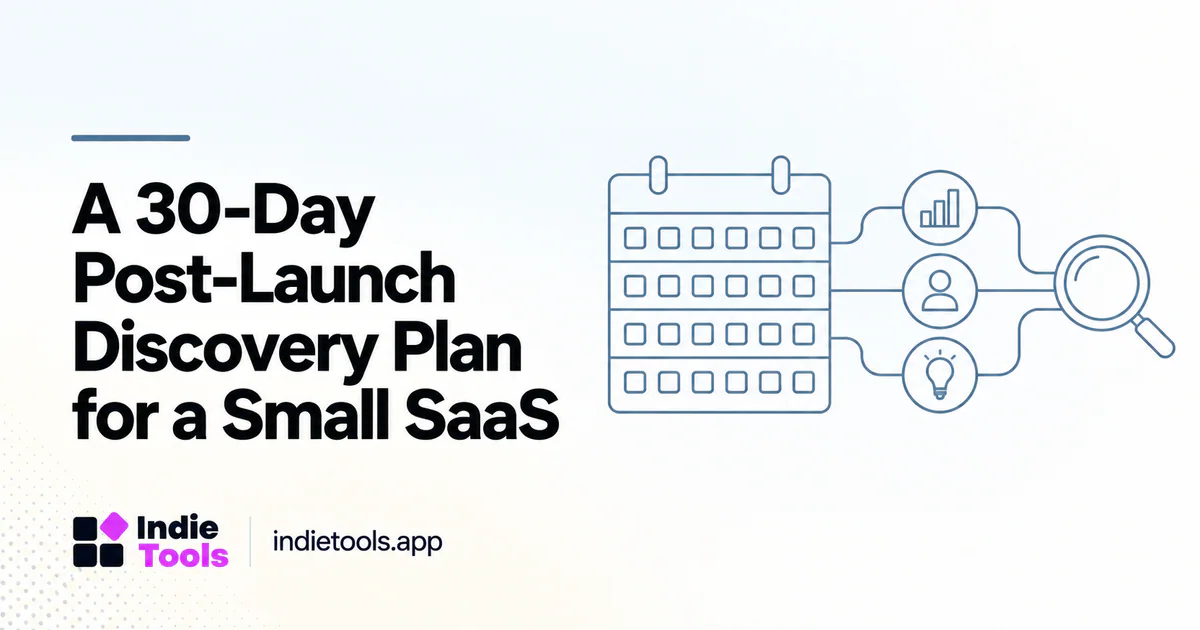
A useful post-launch plan turns initial attention into better product understanding and repeatable discovery. The next 30 days should not consist of reposting the same launch announcement everywhere. They should reveal which audience understands the product, where visitors get stuck and which explanations help them reach value.
The schedule below is a proposed operating plan, not a forecast of signups or a claim that every SaaS should follow the same calendar. Adjust the pace to available support capacity and the product's buying cycle.
Days 1–3: verify the handoff
Check the links people are actually using: the official homepage, directory listing, signup page and any launch-specific destination. Confirm that the description and screenshots match the current product and that the promised next action works.
Inspect the first available support questions and onboarding failures. Fix a broken invitation, confusing empty state or incorrect price explanation before creating more promotional assets. Sending more visitors into a broken path increases noise without resolving the underlying problem.
Days 4–7: collect a usable baseline
Define a small set of events that show progression: relevant visit, account creation and completion of the initial task. Separate test accounts and internal activity from customer observations where practical.
Record what is known and unknown about incoming sources. A first-week baseline may be small and irregular; it is still more useful than attributing every new user to the loudest launch channel. Keep qualitative feedback beside the numbers so the report explains what people struggled to understand.
Days 8–14: improve one explanation
Choose the question that appears most often and answer it with a concrete example. That may become a short use-case guide, a clearer product screenshot or a revised directory description. Focus on one meaningful change rather than rewriting every page at once.
IndieTools combines product discovery with founder updates and releases in its social experience. [1] A useful update can explain what changed and who benefits, then point readers toward the relevant product context. It does not need to repeat the original launch message.
Days 15–21: test one additional discovery path
Select a channel because its audience matches the workflow, not because a list claims it guarantees traffic. A relevant directory, a specialist community or a partner conversation may each be appropriate for different products.
Prepare the destination and measurement before posting. Follow the channel's current participation rules, disclose your relationship to the product and answer questions directly. Avoid automated mass posting or creating fake engagement to make the launch appear more successful.
Days 22–27: turn feedback into a visible improvement
Choose a change supported by repeated user evidence or a clear failure in the initial experience. Record the original problem, the implemented fix and the expected behavior. Verify the change before announcing it.
A release update should connect the improvement to a task. “Invited teammates now receive a clearer next-step screen” is more useful than “huge onboarding upgrade” when the reader needs to know what changed. Do not promise an activation increase before measuring it.
Days 28–30: decide what to continue
Review traffic quality, activation, support effort and the usefulness of conversations. Decide which channel deserves another test, which explanation should become permanent documentation and which activity should stop.
Use IndieTools' categories and technology collections to revisit how comparable products describe themselves, without copying their claims or assuming their visible popularity represents your market. [2] [3] The next month should build on observed fit rather than reset to another generic launch campaign.
Frequently asked questions
Should every day include a public post?
No. The plan should leave time for support, learning and product improvements. Publish when there is a useful update, example or question to share.
Is 30 days enough to evaluate SEO?
It is an operating window, not a universal search-growth deadline. Track indexing and early discovery separately from longer-term traffic and customer outcomes.
What should happen when traffic is low?
First verify the destination and message. Then test a more relevant audience or clearer explanation rather than assuming the solution is a larger volume of identical promotion.
Explore related IndieTools resources: current IndieTools placement options.
Continue your research
- Website Performance During Product Launch Traffic
- Turn Release Notes into Useful Directory Updates
- Startup Directory vs Niche Community
Sources and verification
Sources consulted for this article on October 1, 2026. Product capabilities are documented claims unless an actual test is explicitly described.