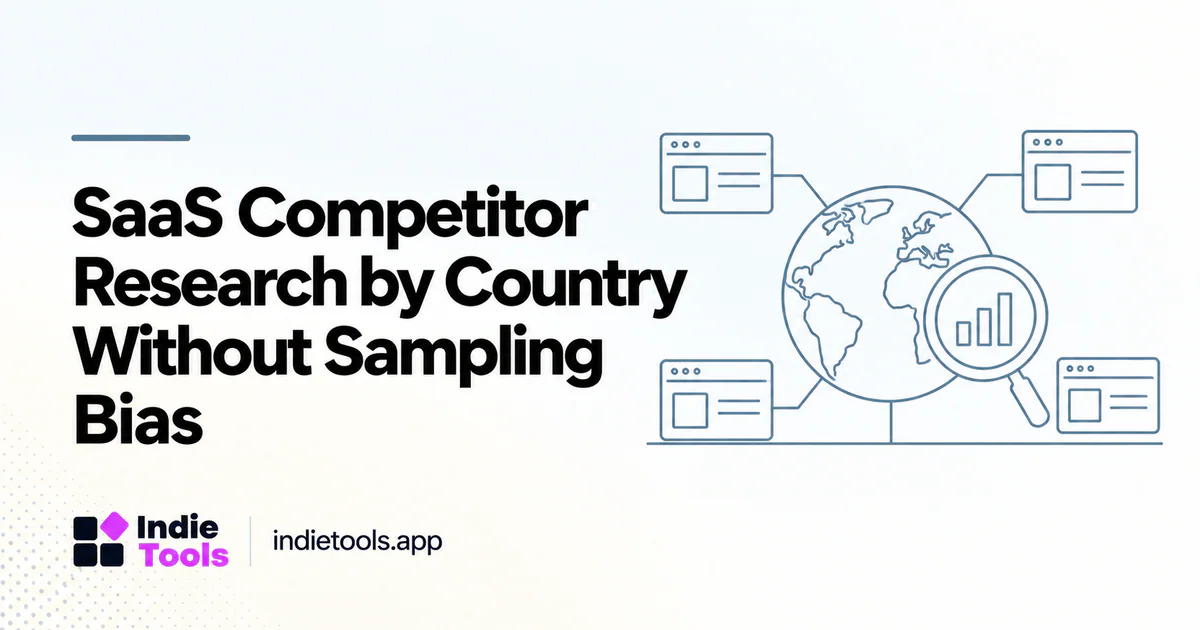
Country-based competitor research is useful for discovering products and patterns, but a directory sample should not be presented as the complete market. The first task is to define what the sample includes, what it excludes and which conclusions the evidence can support.
This matters when a founder uses country collections to plan outreach, compare positioning or choose a launch market. A small or uneven collection can still produce valuable leads, provided the report does not turn submission activity into a claim about national market size.
Define the unit of analysis
Decide whether you are studying products, companies, founders or domains. One company can operate several products, and one product can have several domains. Counting each representation as an independent competitor inflates the apparent market.
Create a stable identifier for the unit you choose. Record related brands and domains separately so duplicates can be reviewed. A useful competitor sheet should explain why two entries represent different offerings rather than relying on slightly different names.
Document the collection rules
IndieTools' country counts include public products with a valid founder-selected country and exclude products without that selection from the country totals. [1] This scope is important: the visible distribution reflects the catalog and completed fields, not every SaaS company operating in a country.
Apply the same discipline to other sources. Note whether a collection is curated, submitted by founders, restricted to paid members or limited to a category. The inclusion rule affects which products are likely to appear and which are easy to miss.
Separate discovery from estimation
A discovery question asks which products deserve further investigation. A market-estimation question asks how many relevant businesses or customers exist. The first can be supported by a useful shortlist; the second requires a broader, defensible method.
Do not estimate demand by multiplying the number of directory listings by an assumed customer count. The assumptions can dominate the result while the spreadsheet makes it look objective. Keep the research output at the level the evidence supports.
Compare positioning within a defined scope
Read how each candidate describes its audience, core task and differentiator. Use the official product source to verify important claims. Preserve “not stated” when pricing, deployment or availability is unclear.
An illustrative analysis could examine how a small set of scheduling tools presents approval workflows. It may reveal different messaging approaches worth testing in your own copy. It does not establish which country has the strongest scheduling market or which product earns the most revenue.
Review missingness and overlap
Calculate how many records lack country, category or other fields needed for the comparison. If the missing portion is substantial, explain how it limits the interpretation. Do not silently drop incomplete records and then describe the result as representative.
Also review overlapping categories. A product may legitimately appear in productivity and marketing collections. Deduplicate at the chosen unit of analysis before comparing counts. Otherwise, a multi-category product can be counted repeatedly as evidence of market breadth.
Turn findings into testable decisions
Use the research to choose a small next action: interview potential users, test a localized explanation or inspect a competitor's public onboarding. Keep the action separate from any unverified market-size assumption.
A useful report ends with observations, limits and questions to investigate. It should make uncertainty visible enough that another person can challenge the conclusion. This is more valuable than a confident map colored by incomplete directory counts.
Questions about country-based research
Can a directory identify every competitor? No. It can support discovery, but participation and field completion create limits.
Should incomplete records be discarded? Not automatically. Preserve them in the broader inventory and explain which analyses cannot use them.
What makes the research actionable? A defined sample, verified product facts and a next step that tests a business question without pretending the sample is the entire market.
Explore related IndieTools resources: product categories.
Continue your research
- Country and Technology Filters for Product Research
- Analyze Technology Adoption in a Product Directory
- Discover Indie SaaS Products by Country
Sources and verification
Sources consulted for this article on October 1, 2026. Product capabilities are documented claims unless an actual test is explicitly described.