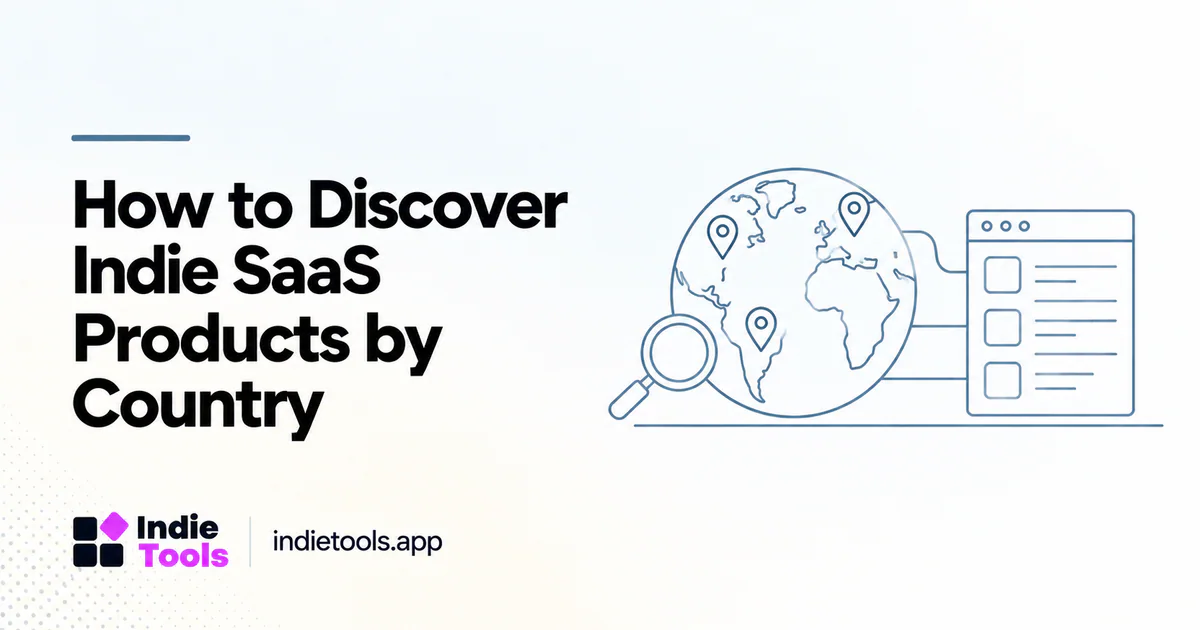
Use country-based product discovery to find a relevant group of makers, then verify the facts that affect your actual decision. A country label can support exploration and networking, but it does not establish where a company is registered, where data is hosted or whether the product is available to you.
IndieTools explicitly describes its country field as selected by the founder. [1] That makes it useful when interpreted at the right level: a declared connection to a place, rather than a complete business or infrastructure profile.
Start with the reason location matters
Different questions require different evidence. Finding founders with a shared regional context is not the same as procuring software with a particular hosting requirement. Looking for a product with Turkish-language support is not the same as looking for a founder who selected Türkiye.
Write the reason for the filter before applying it. This prevents a convenient country selector from standing in for requirements it was never designed to verify. When location is only a preference, keep relevant products without a country label in the broader research set.
Build a country-first shortlist
Open the country collection and inspect the products that match your use case. Read the description, visit the official website and note which questions remain unanswered. Keep the official domain alongside the listing so later research refers to the same product.
Avoid ranking the entire country's software ecosystem from one directory. Participation depends on who submitted a product and completed the relevant field. A small collection can be useful for discovery without being a census of the local market.
Add workflow requirements
After the country filter, apply the requirements that determine usefulness: supported platform, core task, deployment model and necessary integrations. A local product that does not solve the workflow is not a practical alternative simply because its location is appealing.
An illustrative research brief might seek a scheduling tool for a small team that needs approvals and exports. The country preference narrows discovery, while the workflow requirements decide which candidates deserve a trial. Keep those two decisions visible rather than blending them into an unexplained score.
Verify language and availability separately
Inspect the product interface, documentation and support information. Record which languages are actually available and whether support covers the intended working hours. A translated homepage is not proof that the application and help center are translated as well.
Check availability directly with the provider when it matters. Country selection, currency symbols and domain suffixes are not reliable substitutes for a current statement about where the service can be used. Avoid presenting an uncertain eligibility assumption as a recommendation.
Use the discovery context respectfully
A country collection can help identify relevant founder stories or potential collaborations. Contact people through appropriate public channels with a specific reason. Do not turn the collection into a source of indiscriminate outreach.
A useful introduction explains the shared problem or complementary product, not merely that both profiles mention the same country. Relevance creates a better basis for a conversation than a large exported list with a generic message.
Preserve an evidence-based shortlist
For each candidate, record the declared country, official URL, verified capabilities and observation date. Keep unknowns explicit. The resulting sheet should help another person understand why the product is being considered and what still needs to be checked.
When sharing the shortlist publicly, describe its scope accurately. “Products discovered in this collection” is defensible. “The leading SaaS companies in the country” requires a much broader methodology and evidence than a directory search provides.
Common country-discovery questions
Does the country field indicate hosting location? Not in IndieTools' stated model. Verify infrastructure requirements separately with the provider.
Can a global product appear in a country collection? Yes. A declared country connection does not imply a geographically limited audience.
What is the best next step after filtering? Apply your actual workflow requirements and verify the important facts at the official source. Country discovery is a useful beginning, not the complete purchasing decision.
Explore related IndieTools resources: product categories.
Continue your research
- Multilingual Discovery: Language Is Not Location
- SaaS Competitor Research by Country
- Country and Technology Filters for Product Research
Sources and verification
Sources consulted for this article on October 1, 2026. Product capabilities are documented claims unless an actual test is explicitly described.