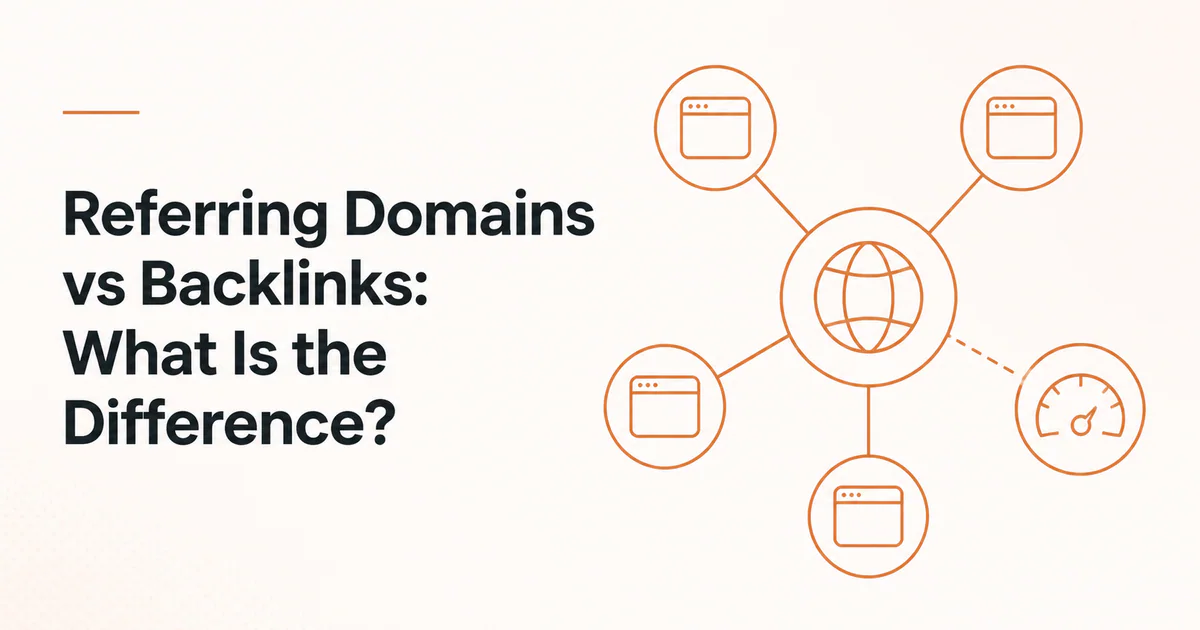
Quick answer: A backlink is an individual hyperlink from another page to your site. A referring domain is one unique website that supplies one or more backlinks. If one website links to you 500 times, that equals 500 backlinks but usually one referring domain. Both matter, but unique, relevant source diversity is often more informative than raw link count.
Confusing these metrics can make a backlink report look stronger than it is.
Comparison at a glance
| Metric | Counts | Example |
|---|---|---|
| Backlinks | Individual links | 500 links from example.com |
| Referring domains | Unique source websites | example.com counts once |
| Referring pages | Unique source URLs | 25 pages on example.com |
| Linked domains | Domains your site links out to | Your outbound destinations |
A single referring page can contain more than one backlink, and one referring domain can contain many referring pages.
What is a backlink?
A backlink is a link from an external page to a page on your website. It includes:
- source URL;
- destination URL;
- anchor text;
- link attributes;
- surrounding context;
- discovery and last-seen dates.
Backlinks can be editorial, user-generated, sponsored, navigational, image-based or created through redirects. Their value varies substantially.
What is a referring domain?
A referring domain is a unique external domain with at least one detected link to your site.
If news.example.com and blog.example.com link to you, tools may count them under one root domain or separate subdomains depending on the selected scope and provider methodology. Always record the tool and scope.
Example calculation
Suppose your SaaS has:
- 300 footer links from Partner A;
- 20 article links from Partner B;
- 5 review links from five independent publications.
That can equal:
- 325 total backlinks;
- 7 referring domains.
The five independent publications may add more source diversity than the 300 repeated footer links.
Why referring domains matter for DR
Ahrefs Domain Rating considers the quality and quantity of linking domains and how many other domains those sources link to. Repeating the same link across thousands of pages does not create thousands of independent source domains.
This does not mean the second link from a domain is worthless. Multiple pages can send traffic, support different topics and link to different resources. It means raw totals require context.
Read what is Domain Rating.
Link quantity vs source quality
Evaluate a referring domain through:
- topical relevance;
- editorial standards;
- organic visibility;
- source-page quality;
- audience fit;
- link placement and context;
- outbound linking pattern;
- durability;
- direct referral traffic.
A new referring domain is not automatically beneficial. Spammy or irrelevant sites can add to the count without helping users.
Followed, nofollow, sponsored and UGC links
Backlink tools record relationship attributes. Google recommends:
sponsoredfor paid links;ugcfor user-generated content;nofollowwhen the publisher does not want to associate or other values do not fit.
Qualified links can still send referral traffic. Do not pressure publishers to change accurate attributes simply to influence a third-party score.
Read dofollow vs nofollow backlinks.
Which metric should you prioritize?
| Goal | Metric to emphasize |
|---|---|
| Broaden independent sources | New relevant referring domains |
| Understand total link footprint | Backlinks |
| Find sitewide-link inflation | Backlinks per referring domain |
| Analyze linkable assets | Referring pages and destination URLs |
| Measure direct value | Referral sessions and conversions |
| Track DR inputs | Followed referring domains and source strength |
Use several metrics together.
Healthy backlink growth patterns
Healthy patterns often include:
- gradual growth from relevant sources;
- several pages earning links;
- natural branded and descriptive anchors;
- a mix of source types;
- editorial reasons for citation;
- referral traffic from at least some sources;
- limited dependence on one domain.
Sudden growth is not automatically bad—a major launch or research report can earn many links quickly. Investigate the cause.
Warning patterns
Review:
- thousands of links from one template;
- unrelated foreign-language domains;
- commercial exact-match anchors at scale;
- links from copied pages;
- networks with identical ownership and design;
- paid links without qualification;
- redirects from unrelated expired domains;
- domains created only to link out.
Do not disavow links merely because a tool labels them suspicious. Google recommends careful use of its disavow process, generally for significant artificial-link problems.
SaaS link acquisition examples
Useful referring domains can come from:
- customer case studies;
- integration partners;
- developer documentation;
- launch and product directories;
- open-source repositories;
- founder interviews;
- original research citations;
- industry newsletters;
- educational resources.
Use the new SaaS backlink guide and IndieTools backlink policy for responsible distribution.
Backlink audit workflow
- Select root domain or subdomain scope.
- Export referring domains.
- Separate followed and qualified links.
- Group domains by relevance and source type.
- Identify top linked pages.
- Find lost and broken links.
- Compare competitor source gaps.
- Verify important links manually.
- Track referral and search outcomes.
- Repeat quarterly or after major campaigns.
Frequently asked questions
Are 1,000 backlinks from one domain good?
They may send traffic, but they still represent one primary source domain and can be inflated by templates or sitewide navigation.
Is one backlink from a new domain always better?
No. Relevance, quality, context and audience matter.
Can two tools show different referring-domain counts?
Yes. Crawlers, indexes, subdomain handling, canonicalization and refresh times differ.
Which number affects Domain Rating more?
Ahrefs DR emphasizes qualifying referring domains and their link strength rather than raw backlink totals.

 Preflight.sh
 SEOReport