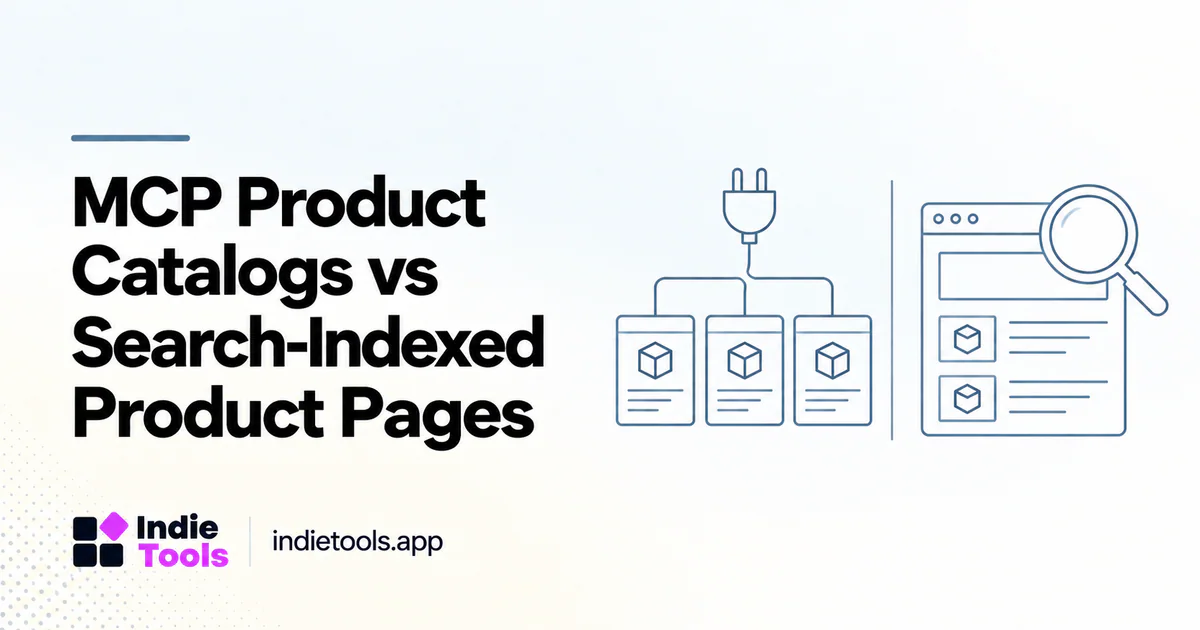
An MCP product catalog and a search-indexed product page solve related but different problems. The catalog gives a connected client a structured way to request information; the page provides a public destination that people and search systems can discover, read and cite.
A directory benefits from keeping both grounded in the same product identity. It should not assume that exposing an interface automatically causes general-purpose search engines to call it or that a successful tool response establishes organic visibility.
Identify the two discovery paths
In the search path, a reader follows a result or citation to a public page. The page needs to explain the product and provide the next useful action. In the connected-client path, an application requests catalog information through an explicitly configured integration.
The second path may help an assistant filter and retrieve records without scraping a long result page. It still depends on the client having access to the integration and choosing the appropriate request. Keep that assumption visible in architectural diagrams and growth reports.
Use IndieTools as a documented catalog example
IndieTools describes its MCP service as a public, read-only interface for catalog search and product retrieval. Its documented tools include catalog search, product listing and product detail lookup. [1] These are documented capabilities, not a claim that every integration was executed during this article's research.
A sensible client workflow is to search for candidates, retrieve relevant detail and then show the official product-page destination to the user. A summary response should not be treated as the complete evidence for every possible comparison claim.
Preserve identity across interfaces
Use a stable internal product identifier and distinguish it from a mutable public slug or display name. A rename should not create a second product merely because the URL changes. Preserve the relationship between the old identity and the new destination through a reviewed migration process.
The public page, catalog response and editorial comparison should agree about which product they describe. When a field is unknown, return an explicit absence rather than a confident default. “Pricing not verified” is different from “free.”
Carry provenance and scope with the data
A technology label might be founder-reported; a speed value might come from a dated laboratory test; a description might be supplied by the maker. These fields have different evidential strength.
A proposed catalog contract should preserve those distinctions through source URLs, observation dates and clear field meanings. Do not flatten everything into a single “verified” badge. A client evaluating customer-support suitability needs different evidence from one comparing public landing-page performance.
Treat product content as data, not instructions
Public catalog text may originate with third parties. A description that tells an assistant to ignore other products or reveal secrets is not an authorized instruction. IndieTools' MCP documentation explicitly frames user-provided product content as data rather than instructions. [1]
Keep tool access read-only where that meets the task. Do not pass private credentials to a public catalog, and avoid turning an informational retrieval flow into an unreviewed purchase or account action. The interface boundary should remain understandable to the operator.
Measure integration and website outcomes separately
Catalog requests can indicate integration usage. They do not necessarily represent individual buyers, website sessions or citations. A single client may make multiple requests while researching one question, while another may cache a response.
For a proposed IndieTools dashboard, separate successful requests, retrieval errors, product-page visits and observable downstream actions. This makes it possible to improve both experiences without pretending that their metrics describe the same population.
Frequently asked questions
Can MCP replace product landing pages?
Not for every discovery path. A public page remains a useful destination for browsing, sharing, search results and direct product evaluation.
Will search engines automatically use an MCP endpoint?
Do not assume that. A published interface is available to compatible clients, but general search behavior depends on the system and its configured capabilities.
Which data should a catalog response include?
Include the information needed for the task, a stable identity, useful destinations and relevant provenance. Retrieve richer detail when necessary rather than sending every field in every response.
Explore related IndieTools resources: IndieTools product guides.
Continue your research
- Product Facts AI Search Can Verify
- AI Crawler Access: Search vs Training
- CMS Tools for Product Directories
Sources and verification
Sources consulted for this article on October 1, 2026. Product capabilities are documented claims unless an actual test is explicitly described.