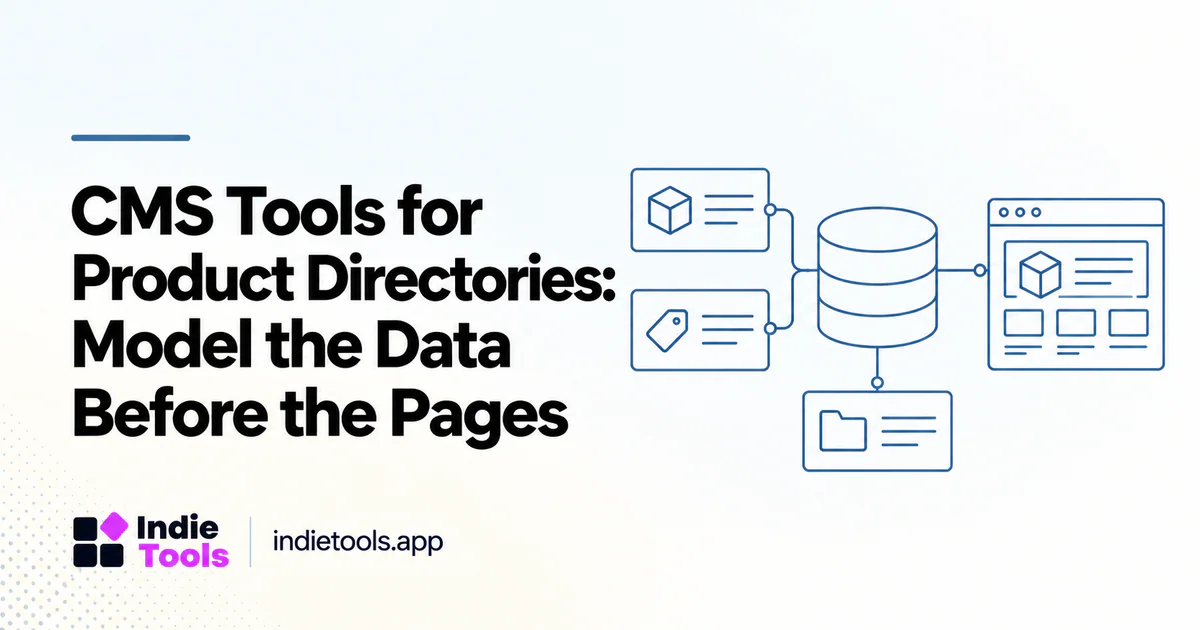
A product directory needs a content system that can preserve relationships, evidence and update history—not just a place to paste descriptions. Choose a CMS by testing how it handles a product, its categories, its official domain and the changing facts used by collection pages.
This distinction matters for programmatic SEO. A template can render hundreds of pages quickly, but it cannot repair inconsistent records or tell whether a pricing claim is still current.
Define the core entities
Start with products, organizations or makers, categories, technologies and source observations. Keep a product's identity separate from an individual measurement. A speed test has a timestamp and tested URL; the product remains the same entity when the next test produces a different result.
Similarly, a technology label should carry provenance when possible. IndieTools states that its technology collection reflects information reported in product profiles. [1] A CMS should preserve that distinction rather than silently presenting declared information as a detected architecture.
Compare content-model flexibility
Strapi's documentation describes a CMS with content modeling and API-oriented capabilities. [2] It is one example to investigate for a structured directory, not a universal recommendation. Another team may prefer a different headless system or a custom application that already owns the product database.
Create a sample model before evaluating the editor interface. Include a many-to-many category relationship, a source URL, an observation date and an optional field that is genuinely unknown. Check whether the tool can represent these accurately without forcing editors to hide structured information inside prose.
Test the editorial workflow
A founder submission, an editor's correction and an automated measurement are different kinds of changes. Decide which ones require approval and which systems are allowed to update each field. Avoid giving a background import permission to overwrite an editorial explanation unintentionally.
Run a realistic test: submit a product, request a correction, approve a category change and retire an obsolete feature claim. The workflow should preserve enough history to explain why the published record changed. A beautiful form is not sufficient if every correction requires direct database access.
Design for missing and conflicting data
Unknown is not the same as false. An empty open-source field should not automatically become “proprietary,” and a missing price should not become “free.” Establish explicit states for unavailable, not applicable and awaiting verification where they are useful.
Conflicting sources also need a review path. A listing may describe one plan while the provider's pricing page shows another. Store the evidence and flag the record instead of allowing the last imported value to win without review.
Protect URL identity
Give products stable internal identifiers that do not depend on a mutable display name. A title change or category move should not break every relationship in the system. Decide separately how public slugs are managed and how redirects are recorded.
Before launch, rename a sample product and move it between categories. Check its public URL, related collections and source links. This test exposes assumptions that can become expensive once search engines and external sites depend on the directory's routes.
Evaluate rendering and export
The CMS and the website renderer solve different problems. Verify that your delivery layer can produce readable pages, accurate metadata and useful navigation from the stored data. Do not assume an API response automatically becomes a well-structured search page.
Export a complete sample product with relationships and evidence. A migration should not reduce a structured directory to a folder of disconnected descriptions. Include images, identifiers and redirect records in the portability review, not only the article text.
Questions before committing to a CMS
Does every directory need a headless CMS? No. Use one when it improves the editorial and delivery workflow compared with the application you already maintain.
Should speed and DR history live inside product descriptions? Prefer structured observations that can be dated and rendered consistently. The description can explain them without becoming the only storage location.
What is the best selection test? Complete a product's lifecycle—from submission through correction and eventual retirement—using a representative model. Then compare operational effort, not just the ease of creating the first page.
Explore related IndieTools resources: product categories.
Continue your research
- WordPress Alternatives for Product Directories
- Programmatic SEO for Software Directories
- Update Programmatic Content When Products Change
Sources and verification
Sources consulted for this article on October 1, 2026. Product capabilities are documented claims unless an actual test is explicitly described.