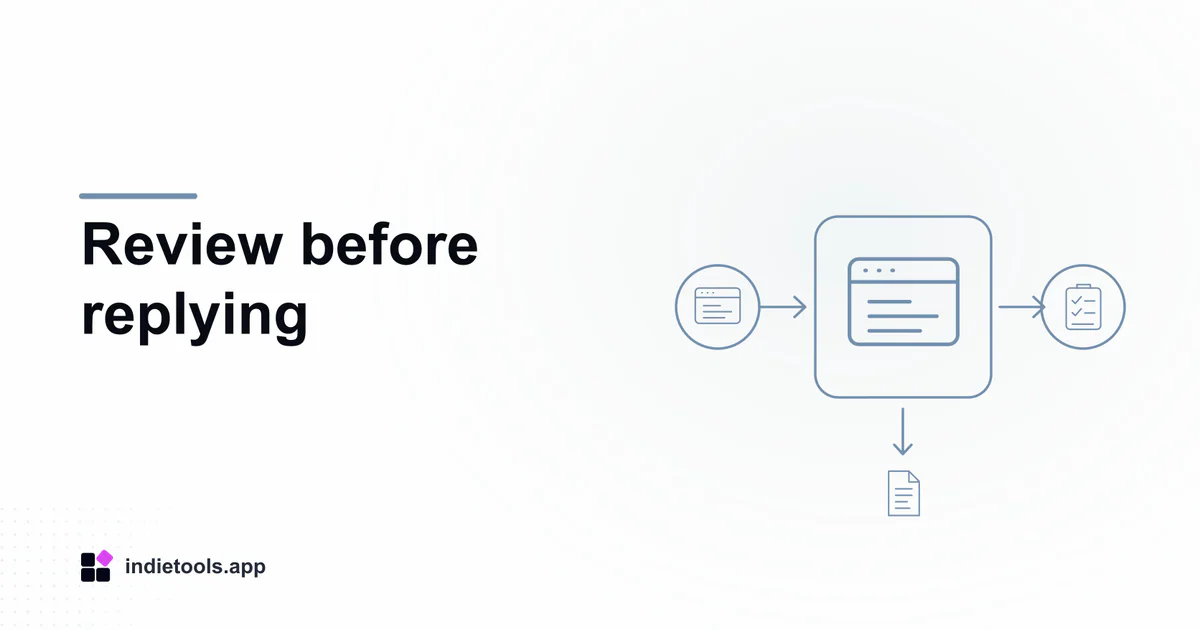
A useful reply workflow starts with the person's question and ends with a reviewed response in the original conversation. Keep discovery, drafting, sending and follow-up as separate steps so a promising lead score cannot silently become permission to publish.
ReachFast, found in the Poland catalogue, describes assisted drafts that open on X for the user to review and send. Its provider page keeps the final action with the user. This guide proposes a team process around that capability; it does not report a live outreach experiment or guarantee account safety.
Carry the original context into the handoff
A reviewer needs the original post, a link to the conversation, the product-fit reason and any relevant limitation. A screenshot containing only the highlighted keyword is insufficient. It can omit a follow-up that changes the request completely.
For a small team, assign one person to each candidate conversation. Keep the status simple: awaiting review, unsuitable, reply drafted or answered. This prevents two teammates from treating the same public question as separate opportunities and sending repetitive responses.
Write the answer before the product mention
Describe the practical point that helps the person make progress. If your product fits, explain the specific connection and disclose your relationship naturally. A response should remain understandable even if the reader does not click a link.
For example, a request for a tool with a particular export format deserves a precise answer about that format. Do not replace the requirement with a vague statement that your product is powerful or AI-enabled. If the feature is unavailable, preserve that limitation rather than asking a draft generator to make the offer sound stronger.
Review assisted drafts against known facts
Check product names, feature availability, links and tone. Remove invented customer outcomes and promises that the team cannot substantiate. Confirm that the draft refers to the actual thread instead of a similar-looking post.
Treat an automatically prepared reply as editable text. The convenience of a prefilled composer should not shorten the factual review. Open the real conversation before sending, because it may have changed since the discovery tool captured it.
Keep pacing and follow-up contextual
X's authenticity rules prohibit disruptive unsolicited bulk replies and irrelevant promotional content. A manual send button does not make repetitive behavior appropriate. Relevance, context and the recipient's response still matter.
Do not convert every unanswered post into a direct-message sequence. Let the conversation determine the next step. When someone declines, accepts a different recommendation or stops engaging, record the outcome and close the task instead of creating another reminder to push the same message.
Measure useful work rather than sent volume
A practical pilot can record whether a reply answered the question, whether a conversation followed and whether the exchange exposed a missing product explanation. These observations can improve documentation even when they do not create a sale.
Review a few completed handoffs each week. Look for duplicated effort, stale product facts and replies that were too generic to help. Update the process at those specific failure points. More automation is not automatically the right correction.
Before building this handoff, use the companion buying-intent review to decide which discovered posts deserve attention. Good qualification and careful replies solve different parts of the same workflow, and keeping them distinct makes the results easier to assess.


 Appnary