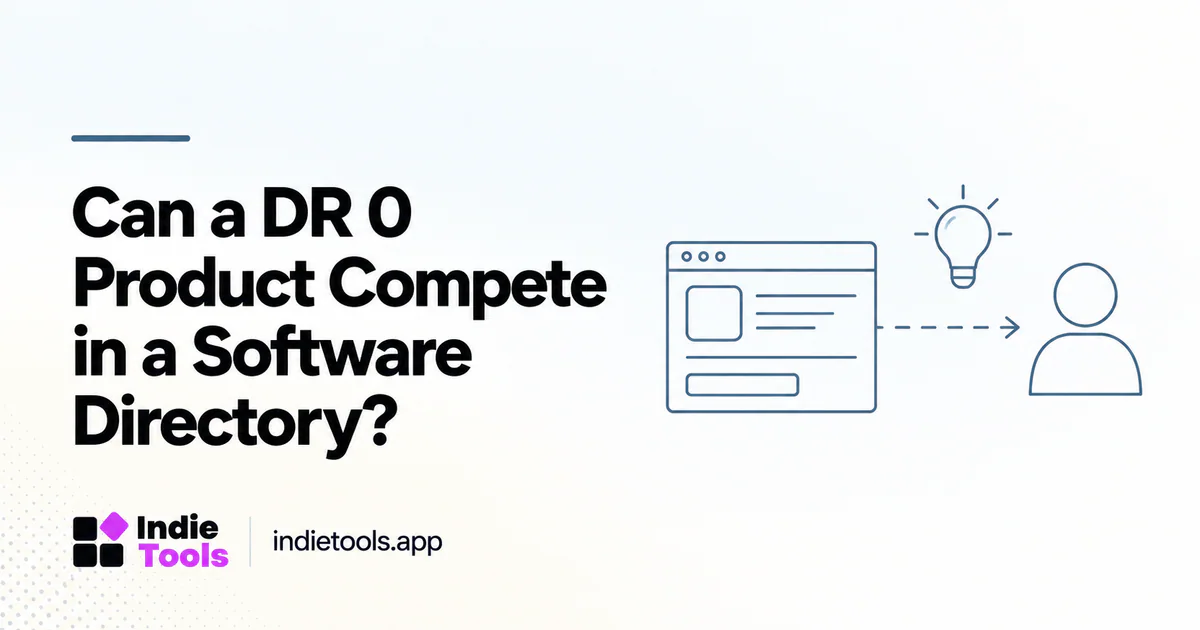
A DR 0 product can still be useful to the right buyer. Treat its backlink score as a narrow observation, then evaluate whether the listing clearly explains the problem, demonstrates the workflow and gives visitors a credible next step. Do not confuse a new or weak backlink profile with an unusable product.
Domain Rating describes backlink strength rather than a complete product assessment. [1] That distinction matters when a founder is deciding whether to launch a listing now or postpone discovery work until an SEO metric looks more impressive.
Answer the buyer's first questions
A visitor needs to know who the tool is for, what it does and what happens after clicking through. Replace a vague slogan with a concrete workflow. “Turn support conversations into grouped product requests” is more informative than “the ultimate AI productivity platform,” provided that it accurately describes the product.
State important boundaries. A tool for one support system should not imply universal integrations. A desktop utility should not be presented as a browser application. Specificity helps a qualified visitor recognize fit even when the brand is unfamiliar.
Show evidence that does not depend on DR
Use real screenshots, a working demonstration, clear documentation and an identifiable product owner where appropriate. Explain pricing or trial access accurately and make support information easy to find. None of these elements guarantees adoption, but they give the buyer something concrete to evaluate.
Do not fabricate testimonials, user counts or “trusted by” logos to compensate for being new. A small product with transparent limitations can be more understandable than a polished listing full of unverifiable claims. Keep evidence proportional to what you can actually substantiate.
Choose a narrow discovery context
Find the category and use case that best match the product. Broad exposure is not automatically useful exposure. A specialist API tool may benefit more from a clear developer workflow than from a description that tries to appeal to every founder.
IndieTools provides category-based product discovery. [2] Use that structure to position the product accurately, not to attach every popular label. Technology and country information can add context when it is factual, but neither should become a substitute for explaining the buyer's task.
Measure the first useful outcomes
Track visits to the product page, outbound clicks where available, signup completion and activation on your own site. Add a short optional question about discovery source when appropriate. Keep these observations separate from changes in backlink metrics.
Consider an illustrative outcome: a new listing receives a small number of visits and two useful conversations with target users. That does not prove scalable acquisition, but it may produce better product information than a larger number of irrelevant visits. Describe the outcome at its actual scale.
Build authority through useful work
Document a specific problem your product solves. Publish an integration example, a reproducible test or a detailed migration checklist when you have the expertise to do so. Share it in relevant places without treating every conversation as a link opportunity.
Review the listing after meaningful releases. An accurate, maintained description is preferable to repeatedly submitting the same product under new domains. Discovery is an ongoing record of what the product can do, not a contest to create the most entries.
Keep the decision practical
Do not wait for an arbitrary score before making a working product discoverable. At the same time, do not expect a directory listing to repair unclear positioning, a broken signup flow or a product that does not meet its promises. Those are separate problems with separate remedies.
Does DR 0 mean Google cannot index the site? Treat indexing as its own technical and content question; a third-party backlink score is not an indexing status report.
Should a founder buy links to look established? Do not substitute paid ranking claims for useful product evidence. Evaluate promotion as promotion.
What should be improved first? The clarity and reliability of the visitor's first experience: what the product does, whether the demonstration works and how to take the next step.
Explore related IndieTools resources: Domain Rating leaderboard.
Continue your research
- Audit a Startup Directory Before Submitting
- Directory Submission ROI: Measure What You Know
- High DR, Low Traffic: Evaluate a SaaS Website
Sources and verification
Sources consulted for this article on October 1, 2026. Product capabilities are documented claims unless an actual test is explicitly described.