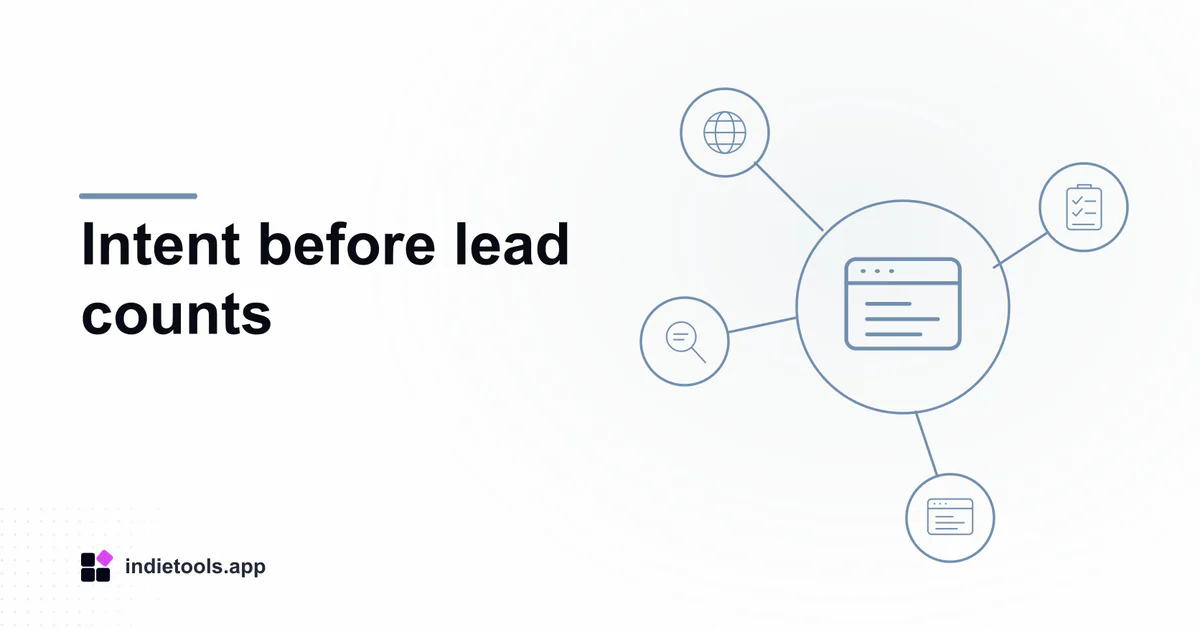
A social listening result becomes useful when the original conversation matches a problem your product can solve. Treat an intent score as a way to order review work, then inspect the post, its context and the product fit before calling it a lead.
The Poland product collection includes ReachFast. Its official site describes building a target-customer profile from a supplied website and finding relevant public posts on X. This single listed example, observed on October 3, 2026, does not represent the entire Polish marketing-software market or establish verified conversion performance.
Give the search a precise offer
Write a short description of the customer, task and limitations your product addresses. If the discovery tool reads a website to infer that profile, inspect the result against this brief. A broad homepage slogan can lead to a broad queue of unsuitable conversations.
Include exclusions. A tool for individual freelancers may not fit a request for an enterprise deployment, even when both posts contain the same category name. Clear exclusions make review more efficient without pretending that every imperfect match can be fixed by better sales copy.
Read beyond the highlighted sentence
Open the original post and inspect the conversation around it. A person may be recommending a product rather than requesting one, discussing an old problem or replying to a joke. A keyword match alone does not establish purchase intent.
Look for the requested outcome, current constraints and whether the question remains unresolved. Keep a separate state for uncertain context. It is reasonable to skip a post when the available information does not support a useful reply.
Evaluate false positives explicitly
Review a manageable sample and label why each result is relevant, uncertain or unsuitable. Useful rejection reasons include wrong audience, incompatible requirements, an already answered question and a request that your product cannot fulfill.
Compare those human labels with the tool's ordering. The objective is to learn whether the queue helps your particular workflow, not to prove that the highest score is always correct. Record the time spent reading and the quality of the resulting conversations alongside the number of items surfaced.
Keep public interest separate from permission
A public question may invite a relevant response, but it does not authorize repeated unsolicited contact. X's authenticity policy addresses disruptive bulk, duplicative and irrelevant content. Build those boundaries into the workflow rather than depending on a vendor's assurance that an account is safe.
A helpful response should make sense in the original thread. If the product is unsuitable, do not force a mention simply to turn the result into a reported action. A rejected lead can be evidence that the review process is working.
Compare outcomes with a clear denominator
Record reviewed posts, relevant conversations and any later outcome as different stages. Do not count a drafted response as a conversation or an unanswered link as a qualified customer.
For a small pilot, preserve a few representative acceptance and rejection examples with minimal necessary personal information. Use them to refine the product brief and review rules. Repeat the exercise when the offer changes, because yesterday's suitable audience may no longer match today's product.
The companion reply-review workflow covers the next step: turning a relevant result into an accurate, contextual response while keeping publication under human control.

 Appnary