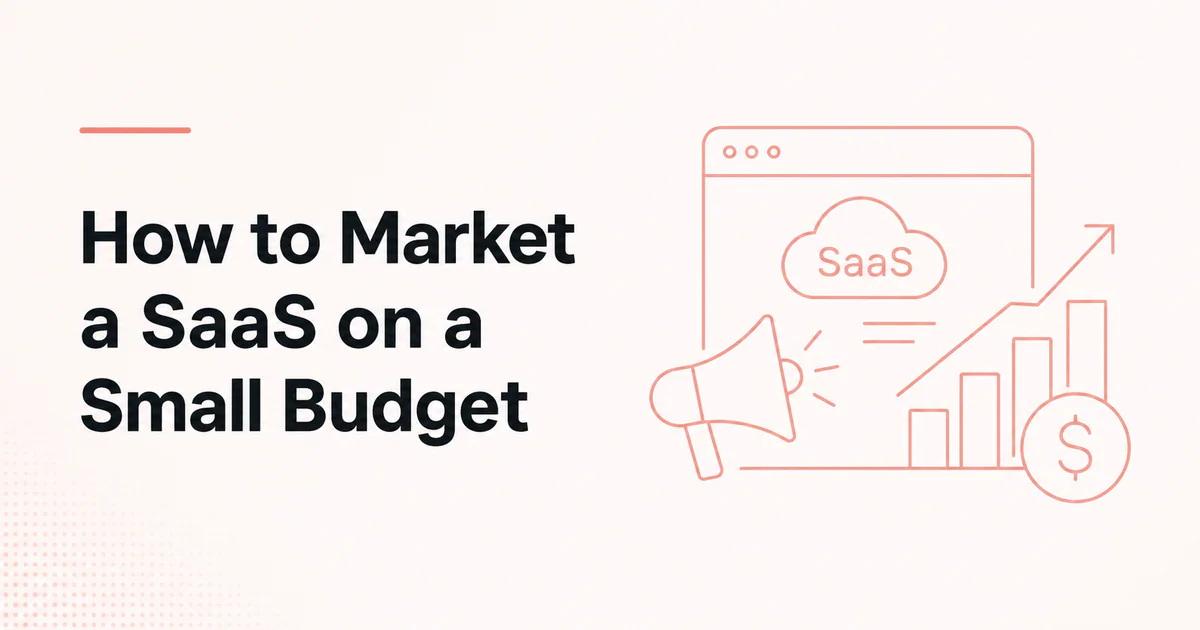
Quick answer: Market a SaaS on a small budget by narrowing the customer, interviewing them, choosing one direct and one compounding channel, creating useful problem-led assets, earning relevant directory and partner placements, and improving activation before buying traffic. Spend time where it creates reusable knowledge or distribution.
Low-budget marketing is not the same as free marketing. Founder time is expensive. The objective is a small system in which research improves messaging, messaging improves outreach, customer questions become content, and customer success creates referrals.
Set one 90-day business outcome
Choose an outcome tied to value:
- 10 paying customers in one segment;
- 30 activated trials from qualified accounts;
- 5 paid design partners;
- a repeatable channel producing a defined acquisition cost;
- improved activation from a known baseline.
Avoid goals such as “post every day” or “get 100,000 impressions.” Activities matter only when they support the outcome.
Build the smallest channel portfolio
| Channel type | Example | Role |
|---|---|---|
| Direct | Founder outreach, customer calls | Fast learning and early revenue |
| Concentrated | Niche community, partner, integration | Access to a qualified group |
| Compounding | Search content, directories, templates | Discovery that persists |
Run no more than two active experiments plus essential customer work. A solo founder cannot learn from seven channels at once.
Start with customer language
Review interview notes, support questions, sales objections and alternatives customers mention. Build a message bank:
- trigger phrases;
- problem symptoms;
- desired outcomes;
- current workarounds;
- perceived risks;
- proof customers need;
- words they use for the category.
Use this language in the page, outreach and articles. If you have not run these conversations, follow how to validate a SaaS idea.
Founder-led outreach
Send small batches to a specific segment. Each message should contain a truthful relevance signal, the problem hypothesis, a low-friction next step and an easy opt-out. Track positive replies and qualified conversations rather than open rates alone.
The first 10 SaaS customers guide covers discovery, pilots and introductions.
Create problem-led content
Useful content sits close to the product's job:
- a workflow guide;
- a comparison of real alternatives;
- a calculator or template;
- a troubleshooting article;
- original data from your product or directory;
- a transparent case study with context and limitations.
Answer the question directly at the top, use clear headings, tables where they clarify choices, examples and sourced facts. This structure helps readers and makes the page easier for search and answer systems to interpret.
Link content into a cluster rather than publishing unrelated posts. For example, a launch product can connect a SaaS launch checklist, Product Hunt checklist, directory guide and platform comparison.
Use directories as a system
Choose directories with audience and category fit. Create accurate, consistent profiles and use distinct tracking parameters. Update listings after major product changes. Measure assisted conversions because prospects may see a profile and return later through search or direct traffic.
Follow how to use startup directories for distribution and consider an IndieTools listing.
Build partnerships from shared value
Good small-budget partnerships include:
- a reciprocal integration with a complementary product;
- a co-authored workflow guide;
- a webinar solving a narrow audience problem;
- a template for an agency or consultant's clients;
- an expert contribution to a newsletter;
- a directory or resource-page inclusion earned by relevance.
Avoid mass “link exchange” requests. Offer something that improves the partner's product or audience experience.
Improve conversion before adding volume
Audit the path:
- Does the page name a specific customer and outcome?
- Is the call to action appropriate to trust and price?
- Can users reach first value quickly?
- Are errors and setup requirements visible?
- Does follow-up stop after activation?
- Can support identify where the user stalled?
Use the SaaS onboarding checklist. Buying traffic for a broken path converts budget into a larger sample of the same failure.
A lean monthly budget example
Allocate percentages rather than fixed amounts:
- 40% customer acquisition tests: one high-intent channel or partner experiment.
- 25% reusable assets: design, data, editing or a small tool.
- 20% measurement and infrastructure: analytics, email and core publishing.
- 15% reserve: double down on a signal or repair a conversion issue.
Founder time should follow the same logic. Most early time belongs in conversations, product value and one distribution motion—not scheduling generic posts.
A weekly operating rhythm
Monday: Review source-to-activation and customer conversations.
Tuesday: Conduct outreach and one interview.
Wednesday: Improve one page or onboarding bottleneck.
Thursday: Publish or distribute one useful asset.
Friday: Follow up with users, record learning and choose next week's constraint.
Frequently asked questions
What is the cheapest way to market a SaaS?
Founder outreach and relevant community participation have low cash cost and high learning value. They still require time and careful targeting.
Should a small SaaS invest in SEO?
Yes, when customers research problems or tools through search. Start with a small cluster closely related to the product and publish genuinely useful pages rather than many thin keyword variants.
Are startup directories worth it?
Relevant directories can create referral traffic, entity context and long-lived discovery. Results vary; track qualified visits, activation and assisted conversions.
When should I use paid ads?
After the audience, offer and activation path are reasonably clear. Start with a capped experiment and prewritten success and stop criteria.
 LaunchLog
 FoundrList
 Niches Hunter
 Email SDK