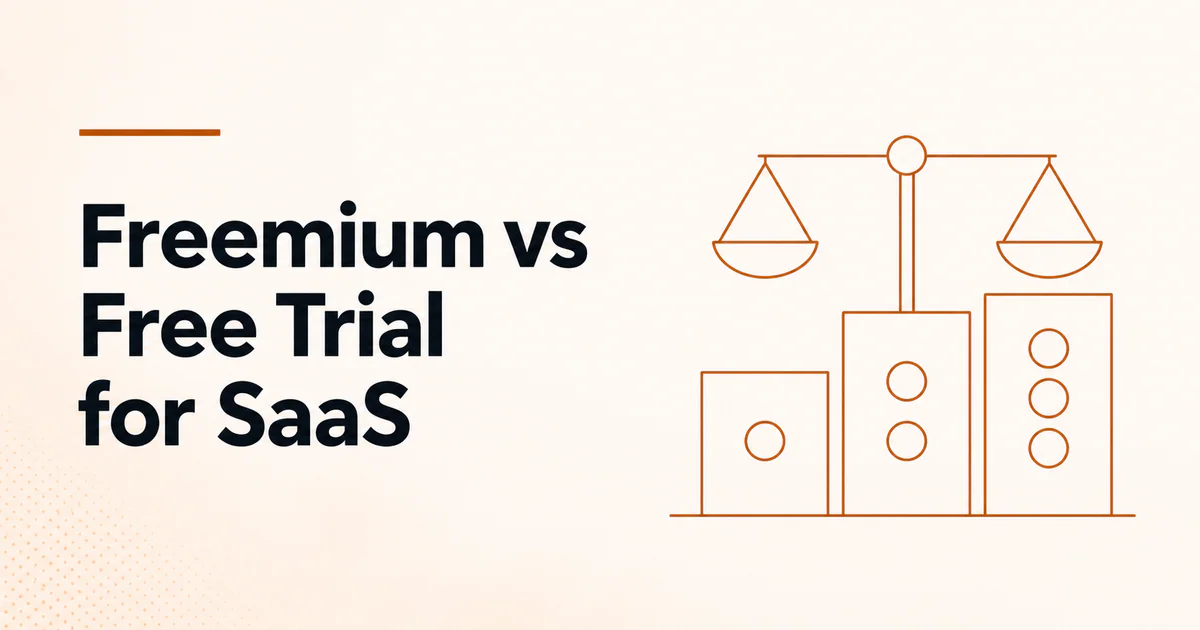
Quick answer: Choose freemium when the free product has low marginal cost, ongoing standalone value, a large reachable audience and a natural upgrade trigger. Choose a free trial when customers can experience the paid value within a defined period and urgency helps focus evaluation. Use a paid pilot or demo when setup is complex or each account costs significant time or money.
Freemium and free trial are not pricing models in isolation; they are acquisition and evaluation experiences. Both must lead users to a meaningful outcome and make the paid boundary understandable.
Comparison at a glance
| Factor | Freemium | Free trial |
|---|---|---|
| Time limit | Usually none | Defined duration or condition |
| Product scope | Ongoing limited capability or usage | Often broader paid capability temporarily |
| Urgency | Low unless a limit is reached | Built in through expiry |
| Audience requirement | Often benefits from high volume | Can work with smaller high-intent traffic |
| Marginal cost | Must remain sustainable for free users | Costs are bounded by trial duration, but abuse remains |
| Upgrade trigger | Limit, collaboration, advanced result or commercial use | Continued access after experiencing value |
| Best fit | Products with habit, sharing or ecosystem effects | Products with clear, fast evaluation path |
Paddle defines a free trial as a version limited in an important way, often time, and distinguishes freemium as a usable but less feature-rich free product.
Choose freemium when
- a user can receive durable value without human onboarding;
- free usage has low and controllable cost;
- the product spreads through collaboration, sharing or public outputs;
- the reachable market is large enough to support a broad top of funnel;
- advanced usage, capacity or team needs create a fair upgrade;
- free users contribute feedback, content, network value or qualified demand.
Examples can include lightweight tools, developer utilities and collaboration products. A free plan should be a coherent product, not a maze of disabled buttons.
Choose a free trial when
- users can reach first value inside the evaluation period;
- the paid product is difficult to represent as a permanently limited version;
- urgency helps customers allocate setup time;
- product costs make indefinite free use unattractive;
- continued access is the natural paid outcome;
- the audience arrives with active intent.
Trial length should match time to value and problem frequency. A seven-day trial is poor for a monthly reporting workflow if the user cannot encounter the natural trigger.
Choose neither when
Use a paid pilot, consultation or sales-assisted proof when:
- implementation requires significant work;
- data migration and security review precede value;
- each account creates substantial variable cost;
- the buyer and end user are different;
- value takes longer than a simple trial window;
- the product is highly configurable or enterprise-specific.
Free access is not mandatory for product-led growth. The evaluation experience must match the buying job. If the buyer needs a high-touch proof, the first 10 SaaS customers guide provides a paid-pilot alternative.
Design the boundary around value
Good freemium limits
Good limits are understandable and align with increased value: more projects, higher volume, collaboration, advanced exports, commercial use or automation. Bad limits remove trust, data access or the core reason to use the product.
Good trial design
Give enough capability to experience the actual paid outcome. Show remaining time without manipulative pressure. Explain what happens to data after expiry and provide a clear downgrade, export or cancellation path.
Avoid surprise gates
If the user invests hours before discovering that the necessary output requires payment, the experience creates resentment. Present material limits on the pricing page and at relevant setup points.
Protect unit economics
Model:
- infrastructure cost per active free or trial user;
- support time;
- abuse and fraud prevention;
- email and storage;
- conversion and expansion;
- retention after conversion;
- opportunity cost of serving the wrong segment.
For AI products, cap expensive actions, disclose limits and show usage. A free plan that creates unpredictable inference cost can turn acquisition into an unbounded liability.
Measure by cohort
| Stage | Freemium measure | Trial measure |
|---|---|---|
| Start | Qualified free signup | Qualified trial start |
| Activation | Core value completed | Paid-value event completed |
| Engagement | Repeat use before limit | Meaningful use within window |
| Monetization | Upgrade by trigger | Trial-to-paid conversion |
| Quality | Paid retention by source | Paid retention by trial behavior |
Do not celebrate conversion without retention. Aggressive gates can increase short-term upgrades and also increase refunds or churn.
Use the SaaS metrics guide and onboarding checklist to connect acquisition to value.
A four-week experiment
- Define activation and the expected time to value.
- Select one segment and one acquisition source.
- State the free or trial boundary clearly.
- Instrument start, activation, limit/expiry, upgrade and paid retention.
- Interview users who activated but did not pay.
- Change one variable: limit, duration, onboarding or message.
- Observe a complete usage and billing cycle before concluding.
Avoid switching the acquisition model, pricing and onboarding simultaneously; you will not know what caused the result.
The SaaS pricing models guide covers packaging around the choice.
Frequently asked questions
Is freemium better than a free trial?
Neither is universally better. Freemium favors broad ongoing use and natural upgrade limits; trials favor concentrated evaluation of paid value.
Should a free trial require a credit card?
Card-required trials can signal commitment and enable automatic conversion, but they may reduce starts and create trust concerns. Be explicit about billing date, reminders and cancellation. Test with qualified cohorts.
How long should a SaaS free trial be?
Long enough for the intended user to reach and repeat the key value event. Base duration on actual time-to-value data and the workflow's frequency.
Can I move from freemium to a free trial later?
Yes, but communicate changes, protect existing commitments appropriately and measure cohort effects. Pricing changes affect trust as well as conversion.
 MRRorDIE
 Gyule
Gyule