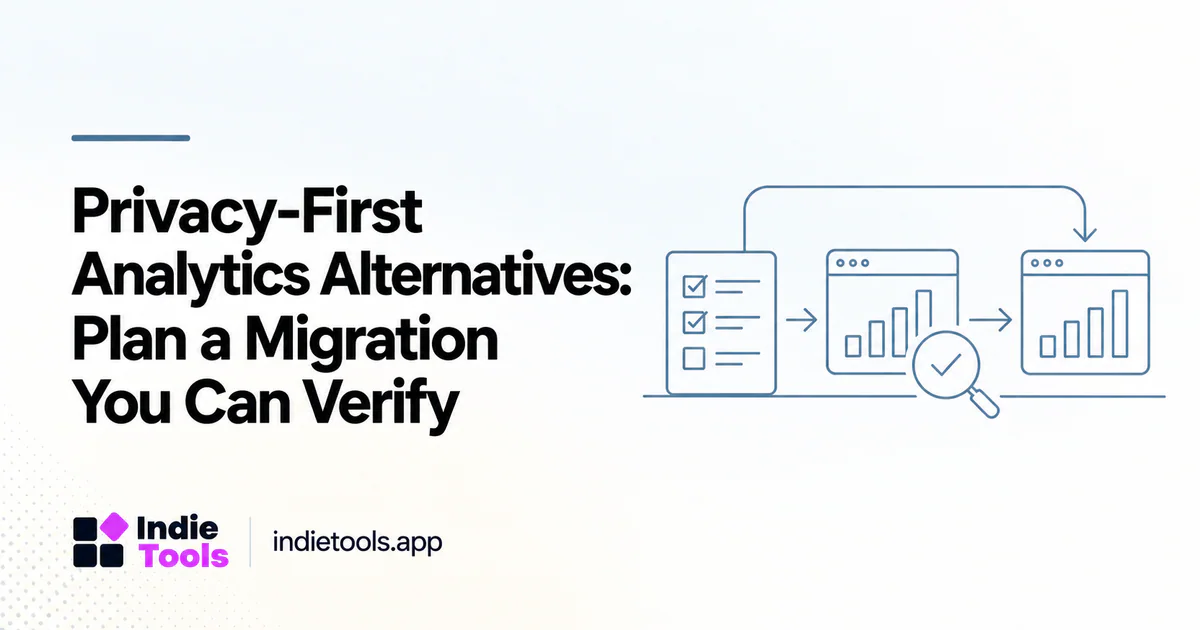
A privacy-focused analytics migration should begin with the questions your business needs to answer and the data required to answer them. Do not replace one tracking script with another and assume the reports will remain equivalent.
The practical objective is a measurement setup that is understandable, proportionate to the task and maintainable. Product labels such as “privacy-first” are useful for discovery, but they do not replace reviewing the actual configuration and the requirements that apply to your organization.
Inventory the reports you use
List the decisions supported by the current analytics system. A founder may need acquisition sources, landing-page performance and activation events. Another team may depend on a detailed ecommerce workflow or a reporting integration.
Separate essential reports from dashboards nobody uses. This creates room to simplify the implementation. It also prevents a migration from failing late because a small but important export or integration was omitted from the original feature comparison.
Compare deployment approaches
Plausible offers a managed service and a self-hosted Community Edition. Matomo presents both cloud and on-premise options. [1] [2] These examples illustrate deployment choices to investigate; they do not establish that the products collect identical data or meet every privacy requirement by default.
For each candidate, inspect the exact edition and configuration you intend to use. Review collected fields, retention, access controls and exports. Keep vendor claims separate from your own implementation decisions, and obtain specialist advice when legal compliance is part of the selection.
Translate events instead of copying names
Create a mapping from existing events to the new measurement plan. Describe what triggers each event and what the event means. Two tools can both display “signup” while counting different points in the journey.
For an illustrative SaaS, distinguish opening the registration form, creating an account and completing the first project. Decide which one is the conversion used in each report. Preserve this definition in documentation so future developers do not change the meaning while keeping the same label.
Validate with controlled activity
Generate a small set of authorized test visits and actions. Check an external campaign link, an ordinary page view and the core conversion. Confirm that test traffic can be identified or excluded from business reporting.
A temporary parallel run may help compare the systems, but do not expect identical totals. Different collection and classification methods can produce differences. Investigate the reason for a discrepancy rather than selecting whichever dashboard shows a more flattering number.
Preserve history with clear boundaries
Determine whether historical data can be imported and what meaning survives the transfer. A summary import may not reproduce every dimension or event relationship from the old system. Label the boundary between historical and newly collected data when necessary.
Keep a read-only export of essential historical reports before decommissioning the old setup. Include definitions and date ranges, not just a spreadsheet of unlabeled totals. A future analyst should be able to understand why a trend changes around the migration date.
Review the deployed site
After rollout, inspect whether the previous scripts are still loaded through a tag manager, theme or third-party integration. Removing one visible snippet does not necessarily remove every collection path. Check production pages rather than relying only on the deployment checklist.
Also review access. A simpler analytics system can still expose sensitive business information when dashboards are shared too broadly. Assign ownership for configuration changes, retention reviews and periodic validation of the events that drive decisions.
Questions before switching
Is a privacy-focused product automatically compliant everywhere? No. Applicability depends on the implementation, data and relevant requirements. A product's marketing claim is not a legal assessment.
Should historical and new totals match perfectly? Not necessarily. Understand and document differences before drawing trend conclusions.
Where should a founder start the shortlist? IndieTools' analytics category can surface alternatives, but the migration test should decide whether a candidate supports the reports you actually need. [3]
Explore related IndieTools resources: reported technology collections.
Continue your research
- Analytics Tools for AI Referral Traffic
- Open-Source vs Free SaaS Alternatives
- Find Software Alternatives by Workflow
Sources and verification
Sources consulted for this article on October 1, 2026. Product capabilities are documented claims unless an actual test is explicitly described.