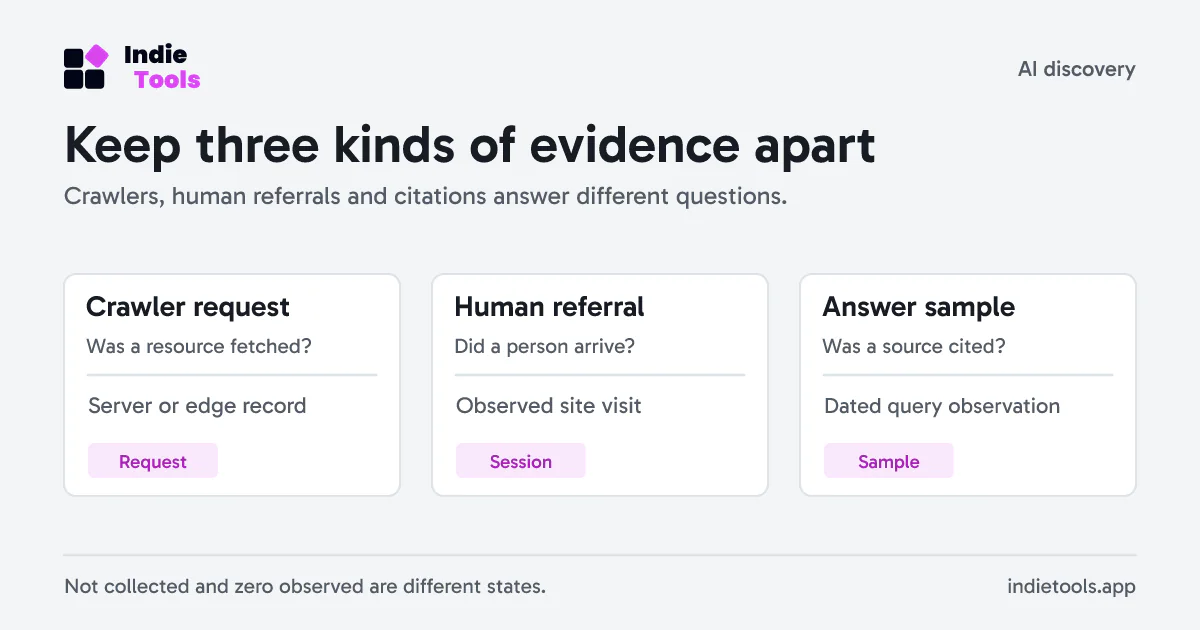
An AI discovery report should separate crawler activity, human referral visits and observed citations. These are three different kinds of evidence, with different collection methods and limitations. Adding them into one “AI visibility” total makes the report harder to interpret.
Use three sections and give each a specific question. The result can be useful even when one section has no data, provided you explain whether collection is absent or the observed count is zero.
Evidence one: a crawler requested a resource
Crawler records answer whether an automated client requested a page or asset. They do not show that a person saw your product in an answer, clicked a recommendation or purchased anything.
Record the requested path, time, method, status, declared agent and verification method where available. Distinguish a verified provider identity from a user-agent string that simply claims one. Also distinguish a successful page response from a blocked or failed request.
Revfaro's bot traffic guide explains its server-side collection requirement. The browser tracker does not collect these requests. A server, edge or CDN integration must forward them, and selected providers can be checked through reverse DNS or published IP ranges.
If that integration is not enabled, write “not collected.” Do not report zero crawlers as if monitoring had been running, and do not populate the chart with demonstration activity.
Evidence two: a human visit carried a referral
Referral analytics answers a different question: which observed visits arrived with recognizable source information? Review the landing page, subsequent actions and confirmed payments where attribution is available.
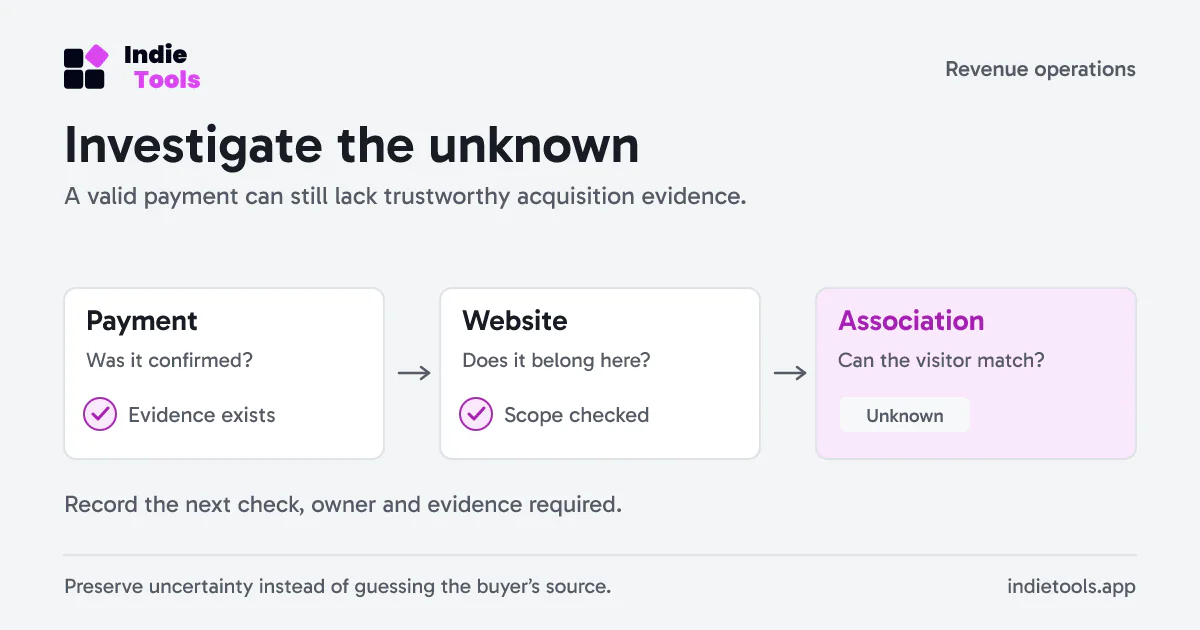
Retain an unknown category. Some applications, browser policies and copied links do not preserve the original referring context. A person who first learned about a product through an AI answer might arrive later without a recognizable AI referral.
That uncertainty does not justify assigning all Direct traffic to AI. It means the report describes observed referrals rather than a complete count of everyone influenced by an answer engine.
Evidence three: a specific answer mentioned a source
A citation review needs a different record again: exact query, service, date, relevant settings, observed answer and the linked source. Label it a sample. One answer observed under one set of conditions is not a universal ranking or a count of exposures.
Use permitted access methods and the provider's current terms. Do not imply that a traffic dashboard automatically monitors every answer or social conversation. Keep manually collected observations clearly separate from live analytics integrations.
Google's AI features guidance says its normal SEO practices remain relevant and that there are no additional special optimization requirements for AI Overviews or AI Mode. Eligibility and good implementation do not guarantee inclusion. A report should therefore connect observations to useful improvements without promising a particular citation outcome.
Give the report a common structure
| Evidence | Useful unit | What it cannot establish alone |
|---|---|---|
| Crawler request | Verified request to a path | Human exposure or recommendation |
| Human referral | Observed session or conversion | Every AI-influenced visit |
| Answer sample | Dated query and captured citation | Stable rank or total reach |
Below each section, list the collection method, reporting period, known gaps and next action. For example, repeated failed crawler requests may justify inspecting access rules. Human referrals landing on an unclear comparison page may justify improving that page. Neither observation requires inventing a combined score.
Review movement within each evidence type
Compare like with like across periods and annotate collection changes. Turning on server forwarding can create the first crawler records without any change in external demand. Expanding the query sample can increase observed citations without proving broader visibility growth.
For the human-visit side, see analytics tools for tracking AI referral traffic. For stronger evidence worth citing, the guide to building a SaaS benchmark dataset focuses on methods and source quality rather than a promised place in an answer.
 Revfaro