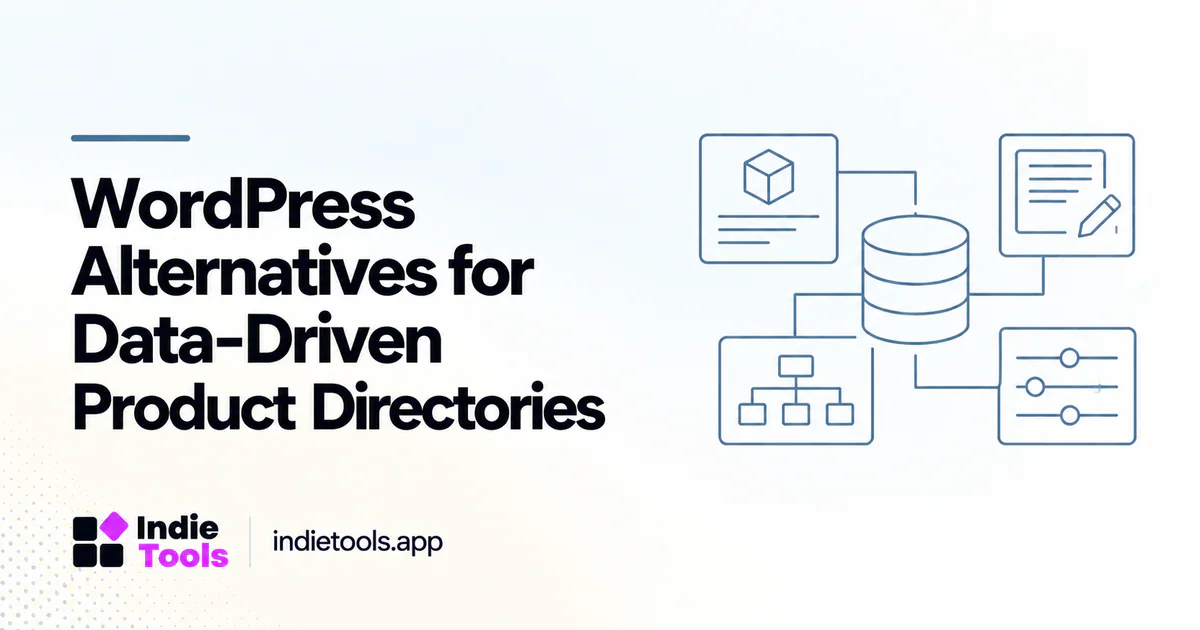
A WordPress alternative is worth considering when the directory's data model or operating workflow has outgrown the current implementation. The decision should start with product relationships, editorial controls and delivery requirements—not an assumption that another platform is inherently faster or better for SEO.
A directory can also remain on WordPress successfully when its existing model works. This guide focuses on the conditions that justify evaluating alternatives and the tests that make the comparison concrete.
Identify the structural constraint
Write down what is difficult today. Perhaps categories and technologies are stored inconsistently, measurement history is embedded in descriptions or an automated import overwrites editorial changes. These are data and workflow problems that a new theme alone may not solve.
Distinguish the platform from the implementation. A slow page can be caused by its assets or scripts, while a confusing editor can result from the chosen content model. Diagnose the specific problem before assuming that migrating the entire site is the right intervention.
Compare different architectural approaches
Strapi documents a content-management approach with structured models and APIs. Directus documents relational data modeling, including relationships between collections. Ghost's Content API exposes published content for external clients. [1] [2] [3]
These products illustrate different starting points, not interchangeable directory engines. A publication-oriented system may fit the editorial layer while a separate database owns products and measurements. A relational content platform may better match complex directory records but require a custom frontend. Evaluate the actual architecture you intend to operate.
Build one representative product model
Include a product identifier, official domain, category relationships, declared technologies and dated source observations. Add a speed measurement as a separate record rather than replacing the product's identity with the latest score.
Use edge cases: a product with two categories, a renamed product, an unknown price and a discontinued integration. The candidate should preserve these distinctions without forcing editors to write ambiguous prose to compensate for missing fields.
Test publication and correction
Run a submission through draft, review and publication. Then update one factual field and inspect every place it appears. A change to the official domain may affect the product page, comparison tables and outbound links.
Decide which system owns the field and how downstream pages refresh. A headless architecture can be useful, but it introduces delivery and cache decisions that still need to be designed. Do not assume that an API automatically keeps the public site current.
Plan routes and redirects early
Inventory existing URLs before building the replacement. Preserve routes where practical, and create a specific redirect map for changed URLs. Google provides guidance for site moves involving URL changes. [4] Migration planning should be based on the actual old-to-new mapping, not a blanket redirect to the homepage.
Test product, category, article and paginated routes separately. Include image URLs and important external links when they are part of the site's discovery history. A successful content import is not the same as a successful public-site migration.
Compare operational ownership
Identify who will maintain the CMS, frontend, background jobs and database. A custom stack can improve control while increasing the number of components the team must operate. Include backups, updates, monitoring and access review in the comparison.
Export a sample dataset with its relationships and media. The new system should improve the exit path, not merely create a different lock-in. Document the assumptions that would make the architecture unsuitable as the directory grows.
Questions before leaving WordPress
Will a different CMS automatically improve rankings? No. The published content, technical implementation and usefulness still require work.
Does a directory need one system for everything? No. Editorial content and structured product data can have different sources of truth when their integration is designed carefully.
What should decide the migration? A representative directory workflow becomes more accurate and maintainable, and the team can execute a controlled migration without losing the relationships and URLs that already matter.
Explore related IndieTools resources: product categories and reported technology collections.
Continue your research
- CMS Tools for Product Directories
- Programmatic SEO for Software Directories
- Open-Source vs Free SaaS Alternatives
Sources and verification
Sources consulted for this article on October 1, 2026. Product capabilities are documented claims unless an actual test is explicitly described.