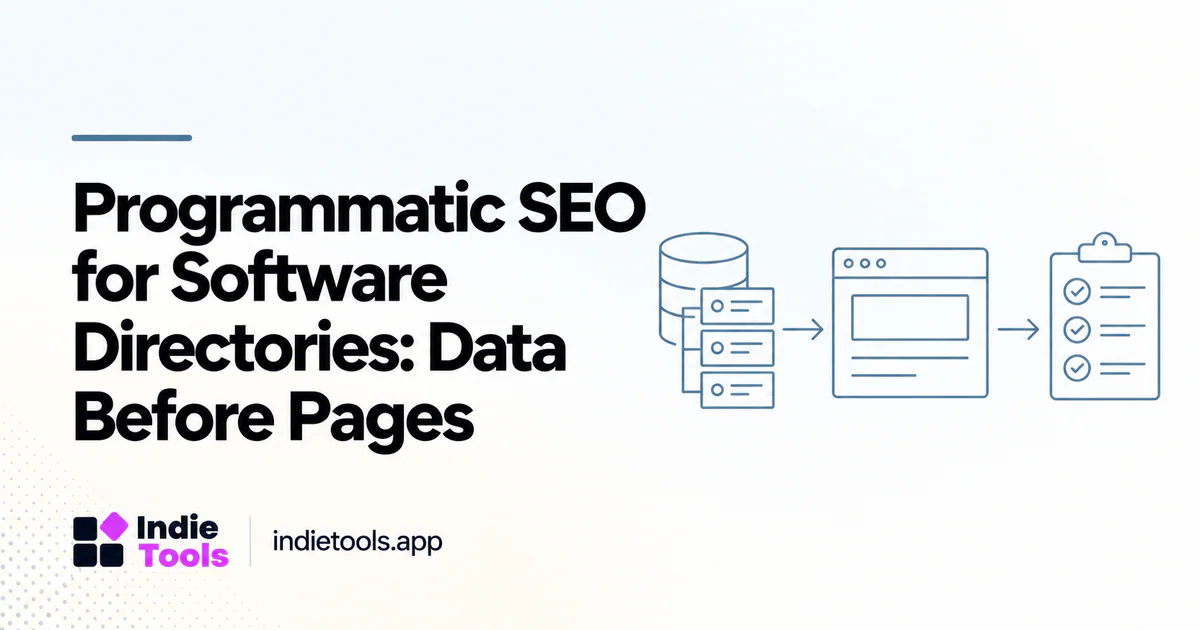
Programmatic SEO for a software directory should begin with reliable entities, source observations and a distinct page purpose. Templates are the delivery mechanism, not the source of value. A directory earns its usefulness by helping readers answer questions that the underlying data can genuinely support.
An IndieTools-style catalog can connect products with categories, declared technologies and dated performance observations. Those relationships create opportunities for useful collections and guides. They do not justify publishing every possible combination as a separate page.
Model products and observations separately
Give each product a stable internal identifier. Store its official domain, name and relationships independently from measurements that change over time. A speed result should include the tested URL, timestamp and method rather than replacing an undated “speed” field indefinitely.
This separation makes corrections possible. When a product changes domains, the historical observation remains attached to the URL that was actually tested. When a category changes, the content system can decide which collections need refreshing without rewriting the product's identity.
Assign a purpose to each page type
A product page explains one offering. A category page supports discovery among related offerings. A benchmark page interprets a defined set of measurements. A guide teaches a task. These page types can support each other without competing to answer the same query in nearly identical language.
Write the promised outcome before building a template. “Find developer tools with current, comparable speed observations” is a concrete purpose. “Create a page for every category and country pair” is only a generation rule.
Build a data contract
For each template, define required fields, acceptable missing values and freshness rules. A ranking needs an ordering method and tie handling. A comparison needs current evidence for its claims. A country collection needs a clear explanation of what the country label means.
IndieTools states that technology information is profile-reported and country information is founder-selected. [1] [2] Preserve those evidence boundaries in generated text. Combining fields does not transform reported information into independently verified facts.
Use editorial gates before publication
Check whether the page answers a distinct question, contains useful evidence and offers a sensible next action. Keep a route unpublished when required data is missing. A smaller number of dependable pages is preferable to a large set whose only difference is the heading.
Google's guidance on generative AI content emphasizes accuracy, quality and relevance, while its spam policies address scaled content created primarily to manipulate rankings. [3] [4] Automation should therefore make review and maintenance easier, not remove accountability for the result.
Design the page around the evidence
Open with the answer and scope. Present the relevant products or observations, explain the method and make sources inspectable. Keep limitations close to the claims they qualify rather than hiding them below a long promotional section.
An illustrative benchmark template might show the eligible sample, measurement period, median metric and a table of individual observations. Do not populate the median until the complete eligible dataset has been retrieved and validated. A visible top-ten table is not a substitute for the full sample.
Control the URL surface
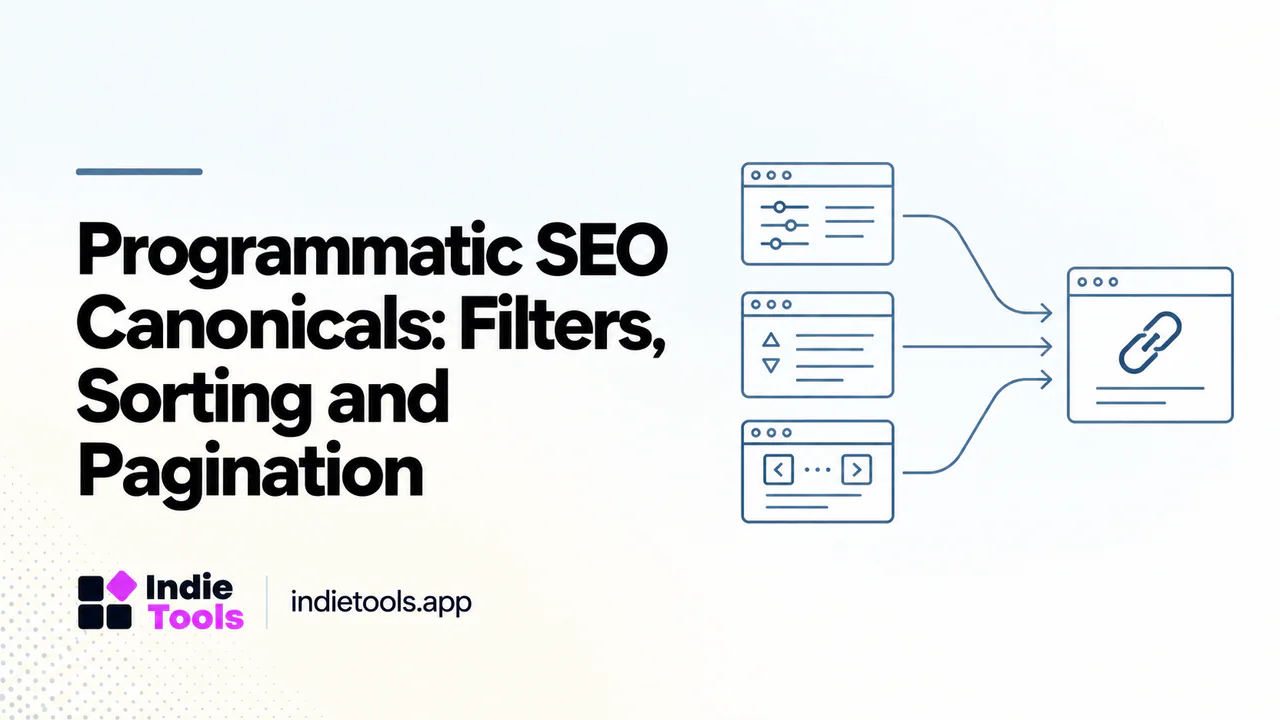
Separate curated, indexable collections from arbitrary interactive filters. Google documents how faceted navigation can create very large crawl spaces. [5] Decide intentionally which combinations deserve permanent pages and prevent uncontrolled parameter permutations from becoming a second, accidental site architecture.
Keep canonical URLs, internal links and sitemaps aligned with that decision. A template should not publish a new URL merely because a query string changed. Test edge cases before a large import exposes them at scale.
Operate pSEO as a maintained system
Store the source of every important field, record meaningful updates and assign owners for failures. A product shutdown, changed price or stale measurement should create a review task. Publishing is the start of the lifecycle, not the end.
Measure whether pages attract relevant queries and help readers continue to useful product information. Review weak pages individually before expanding the template. The right growth signal is a repeatable useful page type, not the number of URLs generated overnight.
Questions before scaling
Does pSEO require AI-written prose? No. Structured data, clear templates and editorial interpretation can provide value without generating long text for every record.
Should every data combination be indexed? No. Each permanent page needs a distinct, supportable purpose.
What should be built first? One complete template with real data, validation, source handling and a refresh path. Scale only after that page remains useful through an update and a correction.
Explore related IndieTools resources: product categories.
Continue your research
- Minimum Data for Programmatic SEO Pages
- Category vs Blog vs Product Page SEO
- CMS Tools for Product Directories
Sources and verification
Sources consulted for this article on October 1, 2026. Product capabilities are documented claims unless an actual test is explicitly described.