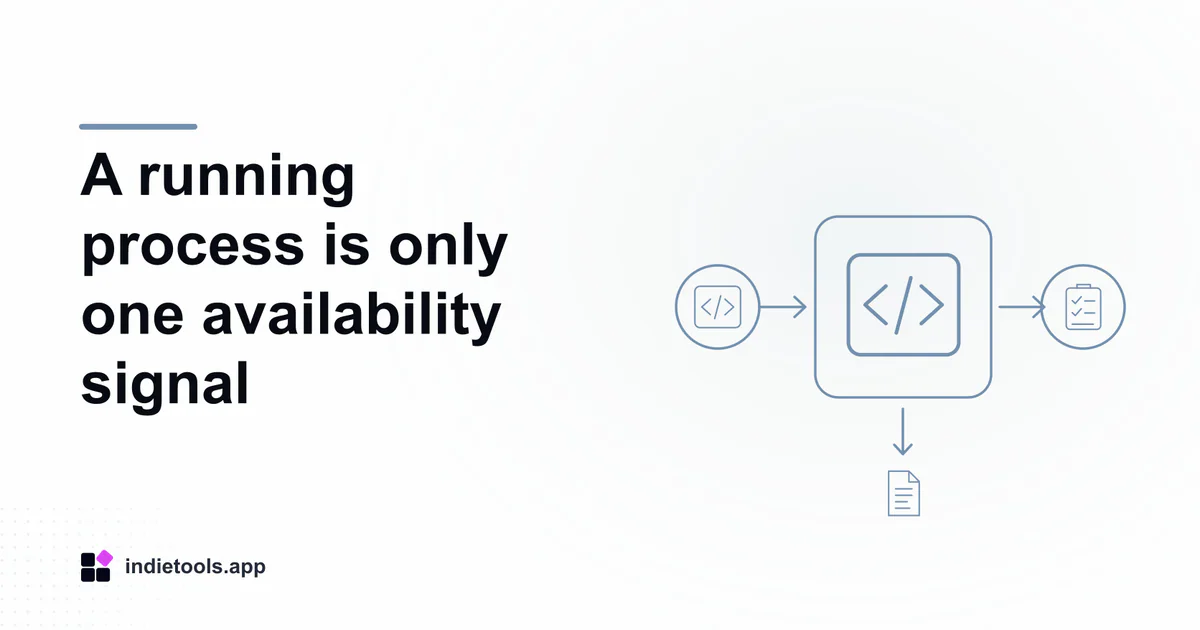
A Spring Boot marketplace needs separate answers to three questions: is the process alive, should this instance receive traffic, and can a customer complete the intended task? One health response cannot replace that complete availability model.
Graded Prompts, listed in the Spring Boot catalogue observed on October 3, 2026, describes a marketplace with search, human review and purchased prompt access. These are useful capability examples. The listing does not disclose its deployment platform, health endpoints or monitoring configuration.
Separate process health from customer outcomes
Write the essential journeys first. Browsing a public listing, submitting material for review and retrieving an owned item may depend on different systems. A failure in one should not automatically be described as a complete outage of all three.
Identify which dependencies are essential for each journey. A recommendation service might be optional for browsing, while an unavailable authoritative ownership record may prevent a private download. The application should communicate that difference clearly.
Keep a lightweight external check for a safe customer-facing route. Internal diagnostics can be green even when a proxy, hostname or public routing rule prevents customers from reaching the service.
Use probes for their operational purpose
Spring Boot's Actuator documentation distinguishes liveness from readiness and cautions against making liveness depend on external systems. Restarting every instance because a shared dependency failed can worsen the incident. Readiness dependencies also require deliberate application-specific decisions.
Review what the hosting platform actually does after a failed probe. Does it stop routing traffic, restart the process or merely report a warning? A correct application response is useful only when the surrounding infrastructure interprets it as intended.
Check the customer-serving port as part of the design. A separate management endpoint can remain reachable while the main application listener is unavailable, so its success needs appropriate context.
Test degraded behaviour deliberately
In an isolated environment, make one optional dependency unavailable and exercise the unaffected journeys. Verify that the product presents a clear limited state instead of failing every page or silently returning incomplete results as complete.
Use a separate scenario for an essential dependency. Confirm that new work is rejected or paused coherently and that previously accepted work remains identifiable for recovery. Do not turn repeated synthetic checks into real purchases or public submissions.
Record the expected recovery action before the test. Operators should know whether to restore a dependency, retry a job or roll back a release rather than responding to every alert with a restart.
Keep diagnostic detail appropriately scoped
Expose only the information needed by the caller. Public status communication can name an affected capability without revealing connection strings, private network addresses or internal exception details.
Retain richer diagnostic evidence in the authorized operational interface. Connect the alert to a runbook and a safe verification step so that recovery is established by the restored customer journey.
For publication correctness, pair this work with the marketplace approval transaction guide. Availability checks confirm that a path can operate; version-specific approval checks confirm that it operates on the right content.
 Graded Prompts
 CloudPloy

 Snapkin