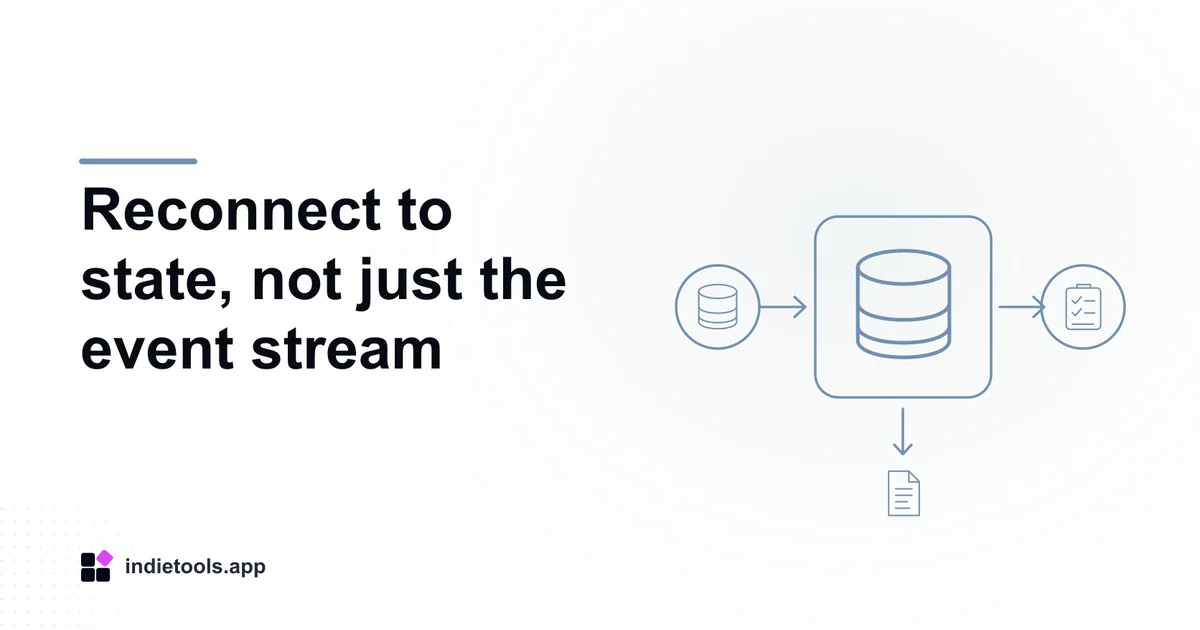
A Redis notification consumer should reconcile current state after a disconnect if missing an event could leave users with stale information. Reconnecting to a channel does not by itself recover every change that happened while the consumer was absent.
The Redis technology collection, checked on October 3, 2026, includes pinit.lol, described as a product discovery and placement site. Its Redis association does not say that it uses Pub/Sub, keyspace notifications or any particular ranking mechanism. A changing discovery board is simply a useful example for discussing the boundary.
Know what the notification proves
Redis keyspace notification documentation states that its Pub/Sub delivery is fire-and-forget and that disconnected clients miss events. A notification is therefore not automatically a durable record of every business change.
Write down the consumer's purpose. It may invalidate a derived list, update an interface or trigger a later lookup. Then identify the authoritative state it can consult after reconnecting. Without that source, the consumer may be unable to distinguish “nothing changed” from “changes were missed.”
For any workflow involving paid placement, retain commercial facts in their intended durable system. An absent notification should not become evidence that an order never existed or that an entitlement has expired.
Rehearse one missed change
Use an isolated environment and synthetic catalogue records. Pause the consumer through the supported test mechanism, make one authorized change and resume it. Observe whether the consumer refreshes its state or continues presenting the old representation indefinitely.
Record the producer's update time, the disconnected interval and the first correct reader state. This makes the test interpretable without inventing a reliability percentage. A single rehearsal establishes only the behaviour under those chosen conditions.
Add a case where several changes occur during the gap. The desired recovery may be a fresh current snapshot rather than replaying every intermediate screen state. That decision depends on whether the consumer serves a current view or an auditable event history.
Separate ordering from authority
After reconnection, a delayed message may describe an older version than the state the consumer just fetched. Define how the application avoids replacing newer information with that older representation.
Useful evidence may include a version or update marker associated with the underlying record. The exact mechanism belongs to the implementation, but the visible requirement is straightforward: the final state should reflect the authoritative current record, not whichever callback happened to finish last.
Do not use a local clock comparison as an unexplained substitute for a business ordering rule. Different producers and retry paths can make arrival time an unreliable account of what happened.
Document the recovery owner
An operator should know how to identify a disconnected consumer, trigger a scoped reconciliation and verify the affected surface. Broad cache deletion may create extra load and conceal the original cause, so the runbook should explain the narrow repair first.
Pair this review with the Redis cache-miss exercise. Missing stored representations and missed notifications are different failures, but both require an explicit route back to trustworthy state.
 IcyZip
 Acres
Acres Plainrow
 code.live
 Xeramail Temp Mail