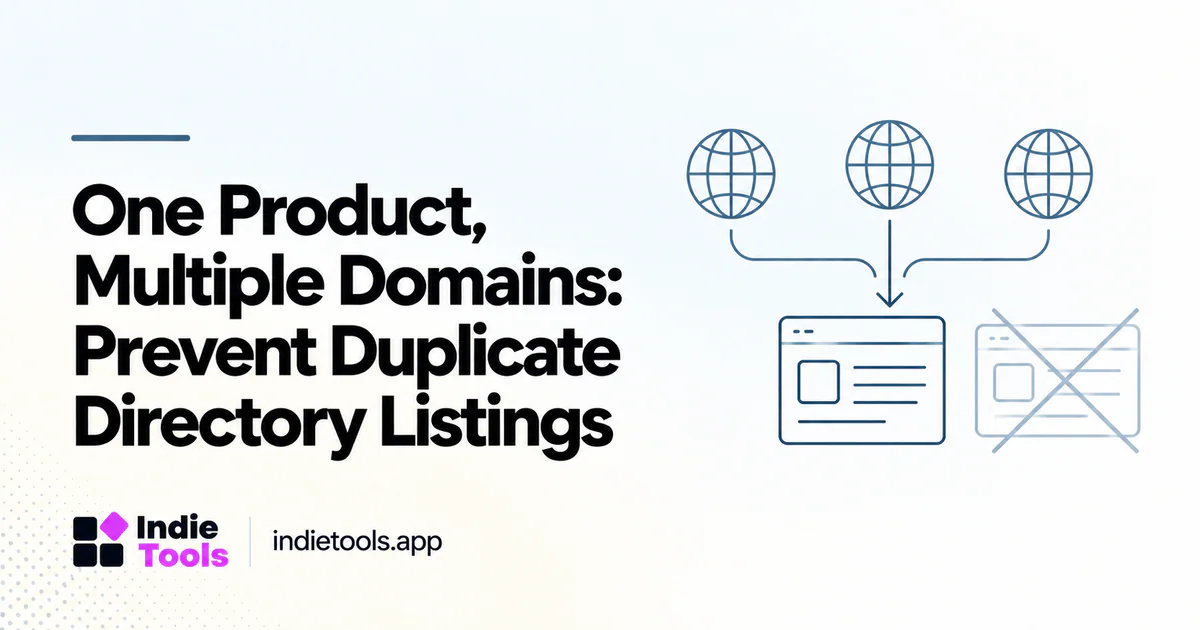
Multiple domains do not automatically represent multiple products. A homepage, application subdomain, demo environment and localized marketing site may all belong to the same offering. A directory should identify the product first and treat its URLs as attributes rather than assuming each address deserves a separate listing.
At the same time, one company can operate genuinely distinct tools. A fair review policy needs to distinguish separate user workflows from duplicate representations without relying only on the hostname.
Define what makes a product distinct
Consider the intended user, core task, independent availability and relationship to the existing listing. A separate tool with its own meaningful workflow may justify a distinct record even when it shares an owner or root domain.
A demo of the same application usually does not become a different product because its URL starts with demo. Likewise, a second marketing page describing the same service should not be treated as a new offering solely to occupy another directory position.
Review the destination, not just the submission text
Open the submitted page and identify what a visitor can actually do. Compare its branding, capabilities and signup path with the existing product. A copied description can hide duplication, while similar branding can also appear across legitimately separate tools.
When a page is unavailable, record the issue and request a working public destination through the directory's review process. Do not invent a product description from a domain name or assume a broken page will eventually contain a separate application.
Create a canonical product record
For a proposed directory data model, maintain one stable product identity with an official website and relevant alternate destinations. These might include an application URL, documentation, platform listing or old domain.
This avoids splitting product history whenever the founder changes a marketing address. It also allows editorial guides, technology collections and benchmark observations to refer to the same entity. The data model should distinguish an alias from a genuinely separate product relationship.
Handle subdomains and marketplaces carefully
A subdomain may be a valid official destination, but its relationship to the root domain should be understood. The same caution applies to a hosted marketplace or app store page. A shared platform's domain-level backlink metric should not be presented as the independent product's own authority. [1]
IndieTools' DR leaderboard describes eligibility and domain-related measurement context. [2] Before using any such record in a derived article, verify that the measured domain matches the scope of the product claim. A public score alone does not resolve entity identity.
Preserve useful history during a merge
When two records are confirmed duplicates, review their content, ownership and linked references before merging. Select the strongest accurate destination and redirect obsolete public URLs where an appropriate equivalent exists.
Google's canonicalization guidance addresses duplicate URL signals, while its migration guidance covers URL moves. [3] [4] Those technical mechanisms support consolidation; they do not replace the editorial decision about whether two submissions describe the same product.
Explain decisions consistently
Publish a short policy describing the distinction between a separate product, a demo, an alias and a localized version. Give submitters a way to explain a genuinely different workflow without rewarding repeated near-identical submissions.
For IndieTools, a practical review note could identify the already-listed product and the specific overlap. This is a proposed moderation approach, not a statement that a particular submission has been accepted or rejected. Clear explanations make the policy easier to apply fairly.
Frequently asked questions
Should every subdomain be rejected?
No. Some host distinct products. Evaluate the offering and relationship to existing records rather than banning an entire URL pattern.
Does a root-domain listing cover every tool owned by the company?
Not necessarily. Separate tools can deserve separate records when their workflows and public identities are genuinely distinct.
Is a canonical tag enough to fix duplicate listings?
No. It is a search signal. The directory still needs accurate entity relationships, consistent navigation and an editorial decision about which records should remain public.
Explore related IndieTools resources: product categories.
Continue your research
- Why App Store DR Should Not Rate Your Product
- Programmatic SEO Canonicals: Filters and Pagination
- Founder Profiles After a SaaS Acquisition
Sources and verification
Sources consulted for this article on October 1, 2026. Product capabilities are documented claims unless an actual test is explicitly described.