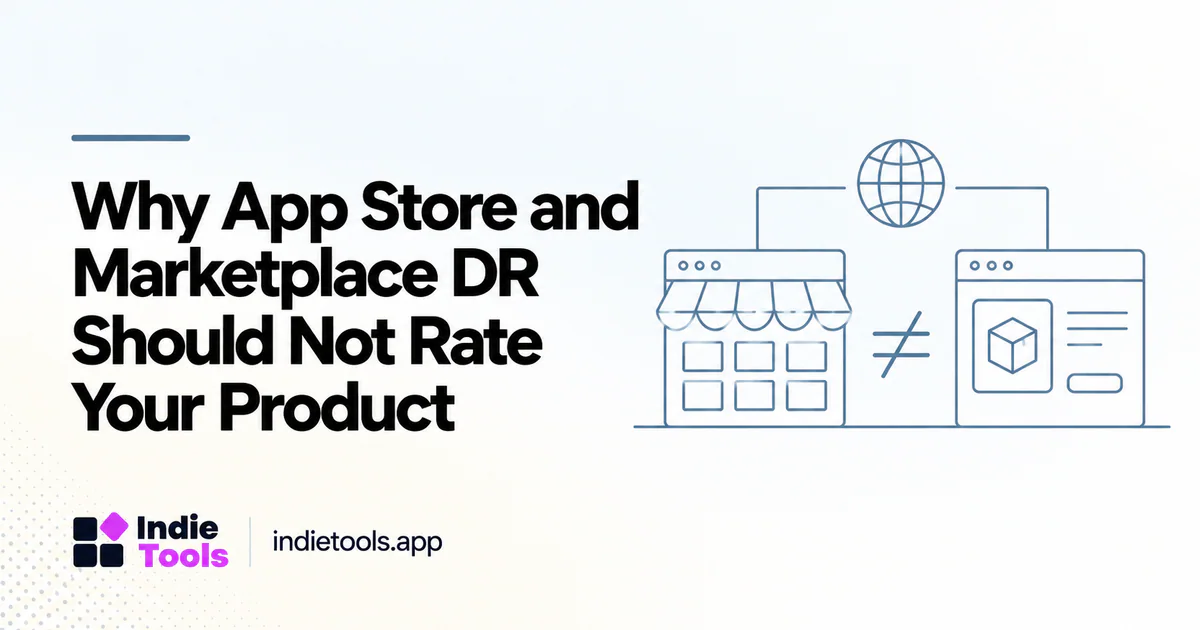
A product hosted on a marketplace should not automatically inherit the marketplace's Domain Rating as a claim about its own authority. Record the exact measured domain and distinguish it from the product identity. Without that distinction, a comparison can reward the choice of hosting platform rather than the product's backlink profile.
This issue appears whenever a directory accepts app-store URLs, storefront pages, shared subdomains or several products under one company domain. The right response is a clear data model, not a blanket claim that every subdomain is invalid.
Separate product, page and domain
Store three different fields: the product identifier, its public destination URL and the domain scope used for the measurement. Keep the original URL as evidence instead of replacing it with a normalized value and losing the source.
Ahrefs DR is a domain-level backlink metric. [1] A marketplace page may be the correct destination for buying an app while still being the wrong unit for a claim about that app's independent backlink strength. Destination quality and measurement scope are different questions.
Classify hosting arrangements
Distinguish an independent product domain, a product path on a company domain, a shared-platform subdomain and a marketplace listing. Add an “unresolved” state for cases that require review. A simplistic rule that removes everything after the first dot will mishandle legitimate domain structures.
Some products have no independent website. That is not a reason to exclude them from discovery. It is a reason to display the backlink measurement as unavailable or platform-scoped rather than pretending it is product-specific.
Keep classification transparent
A useful public label might say “platform domain measurement” or “company-domain measurement.” Explain what the number represents next to the number itself, not only in a distant methodology page. A reader scanning a comparison table should not need to reverse-engineer the scope.
If a product later adds its own domain, preserve the transition date. Do not splice the old platform score and new independent-domain score into one continuous growth chart. Those observations measure different entities.
Design a normalization review
Use automated detection to flag common shared hosts, then route ambiguous cases to editorial review. Preserve the rule version and the reason for exclusion. This allows a correction to be applied consistently when the catalog grows.
An illustrative case is a mobile app whose listing URL points to an app store. Keep the app discoverable, but do not describe the store's domain score as the app's own score. Another case is a company with several genuine products on one domain: keep the products distinct while avoiding multiple counts of the same domain in a domain-level benchmark.
Audit claims against displayed records
A directory's methodology text and its actual rows must agree. If a page says shared platforms are excluded, periodically inspect the results for exceptions. An exclusion policy is not evidence that the implementation has no mistakes.
IndieTools publishes a DR leaderboard and describes its measurement scope. [2] Readers and editors should retain the same discipline there: check the displayed domain before drawing a conclusion about a product. A public table is a starting point for review, not permission to skip entity validation.
Handle missingness without punishment
Show “not independently measured” rather than converting an unresolved platform address to zero. Zero is a measured result; missing or ambiguous scope is a data-quality state. Keeping them separate prevents a false ranking and makes the next review action obvious.
Are all subdomains unsuitable? No. Ownership, hosting arrangement and the measurement provider's scope must be considered.
Should marketplace-only products disappear? No. Product discovery and independent-domain benchmarking can have different eligibility rules.
What is the most important implementation field? The exact measured scope attached to each observation. Without it, even a correctly fetched number can become a misleading product claim.
Explore related IndieTools resources: product categories.
Continue your research
- Multiple Domains, One Product: Duplicate Listings
- Domain Rating Benchmarks for Early-Stage SaaS
- Domain Rating and PageSpeed: A Two-Axis Review
Sources and verification
Sources consulted for this article on October 1, 2026. Product capabilities are documented claims unless an actual test is explicitly described.